
India Malaysia trade cooperation entered a new phase on February 9, 2026, as Prime Minister Narendra Modi and Malaysian Prime Minister Anwar Ibrahim pledged to accelerate economic, technological, and defence collaboration during high-level talks in Putrajaya. The discussions, held during Modi’s two-day visit, underscored a shared determination to transform political goodwill into faster project execution and higher trade volumes.
Both leaders reaffirmed their comprehensive strategic partnership, first elevated in 2024, and signaled strong political will to broaden cooperation across trade, investment, food security, defence, healthcare, tourism, and digital technologies.
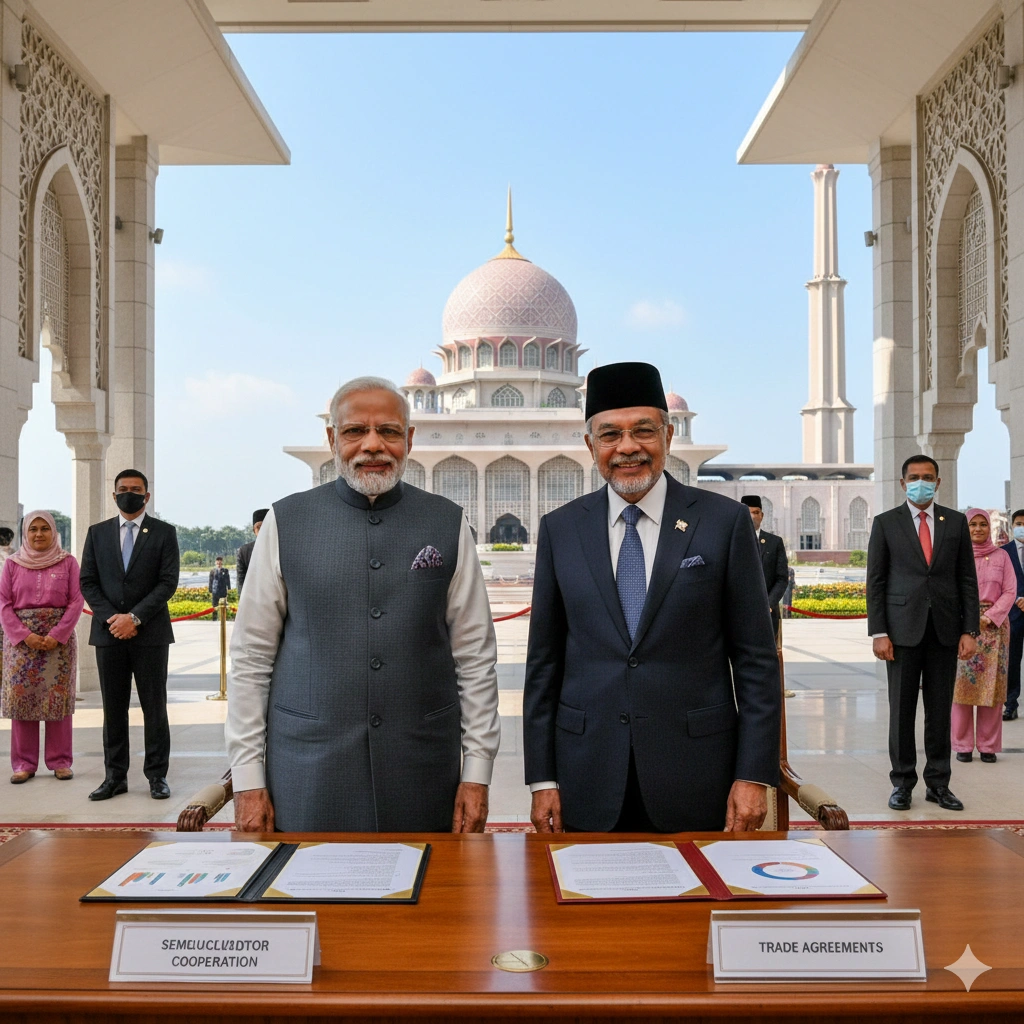
Push to Lift Trade Beyond $18.6 Billion
Trade featured prominently in the talks, with both sides acknowledging that bilateral commerce, valued at $18.6 billion last year, remains below potential. Prime Minister Anwar stressed that the agenda agreed upon was “comprehensive” and required urgency, noting that existing mechanisms must move faster to deliver tangible outcomes.
India currently exports around $7.32 billion worth of goods to Malaysia, largely engineering products and petroleum-related items, while importing approximately $12.54 billion in Malaysian goods, including minerals, vegetable oils, and electrical machinery. Officials on both sides described the trade relationship as asymmetrical but emphasized that new sector-focused initiatives could help rebalance and expand volumes.
A key element of the strategy is the continued promotion of local-currency settlement in cross-border trade, aimed at reducing dependence on the US dollar and lowering transaction costs for businesses.
India Malaysia Trade Cooperation Focuses on Semiconductors
Semiconductors Emerge as Strategic Priority
One of the most significant outcomes of the visit was the strong emphasis on semiconductor cooperation, reflecting global supply chain realignments and Asia’s growing role in advanced manufacturing.
Prime Minister Modi highlighted plans to deepen collaboration in chips, artificial intelligence, and digital technologies, positioning semiconductors as a pillar of future India Malaysia trade cooperation. Indian officials noted Malaysia’s long-established semiconductor ecosystem, built over decades, which has made the country the world’s sixth-largest chip exporter.
Semiconductors account for roughly a quarter of Malaysia’s GDP, driven by its strength in fabrication, assembly, and testing (FAT) operations. Indian companies, officials said, have shown strong interest in investing in Malaysian facilities, viewing the country as a stable and technologically mature partner.
For India, which is seeking to expand its domestic chip manufacturing under national incentive schemes, Malaysia offers both expertise and integration into global supply chains.
Defence Ties Set to Deepen Further
Defence cooperation also featured prominently in the talks. India and Malaysia have conducted five joint military exercises over the past five years, building interoperability and trust between their armed forces.
Under the 2024 comprehensive strategic partnership framework, both governments expect defence ties to deepen further, including in training, maritime security, and peacekeeping operations. During the visit, Modi and Anwar witnessed the exchange of 11 agreements, including arrangements related to disaster management and peacekeeping cooperation.
These agreements reflect a shared interest in maintaining stability in the Indo-Pacific and strengthening regional security collaboration.
Expanding Institutional and People-to-People Links
Beyond trade and defence, the leaders also focused on strengthening institutional and people-to-people connections. Malaysia agreed to support India’s plan to open a new consulate in Sabah, located on the island of Borneo. The move is expected to enhance business outreach, tourism, and community ties in East Malaysia, a region with growing economic significance.
Healthcare, food security, and tourism were also identified as areas with untapped potential, particularly as both countries seek resilient growth models amid global economic uncertainty.
Political Will and Strategic Convergence
Anwar Ibrahim emphasized that the success of the partnership would depend on sustained political commitment from both governments. He described the relationship as one that must move “quickly and decisively,” reflecting a convergence of strategic interests between South and Southeast Asia.
For New Delhi, deeper engagement with Malaysia strengthens its Act East policy, while Kuala Lumpur sees India as a key partner in diversifying economic and strategic ties beyond traditional markets.
What This Means for Regional Trade Dynamics
The renewed push in India Malaysia trade cooperation comes at a time when Asian economies are reconfiguring supply chains, prioritizing resilience, and seeking trusted partners. By focusing on semiconductors, defence, and local-currency trade, both countries aim to future-proof their relationship against global volatility.
If successfully implemented, the initiatives announced in Putrajaya could not only lift bilateral trade beyond $18.6 billion, but also anchor a long-term partnership built on technology, security, and shared regional interests.
For more details & sources visit: Al Jazeera
Read more about Malaysia news on 360 News Orbit – Malaysia.