
Algeria has taken a rare and politically charged step by initiating procedures to terminate the Algeria UAE air services agreement, a bilateral aviation pact signed in 2013. The move reflects a noticeable deterioration in relations between Algiers and Abu Dhabi and signals a broader recalibration of Algeria’s regional posture amid rising diplomatic tensions.
The decision, announced by Algerian state radio, comes after months of mounting criticism in Algerian media accusing the United Arab Emirates of interfering in regional affairs. While officials in Algiers have not publicly outlined a formal justification, the timing and context of the announcement underline a deepening rift between the two countries.
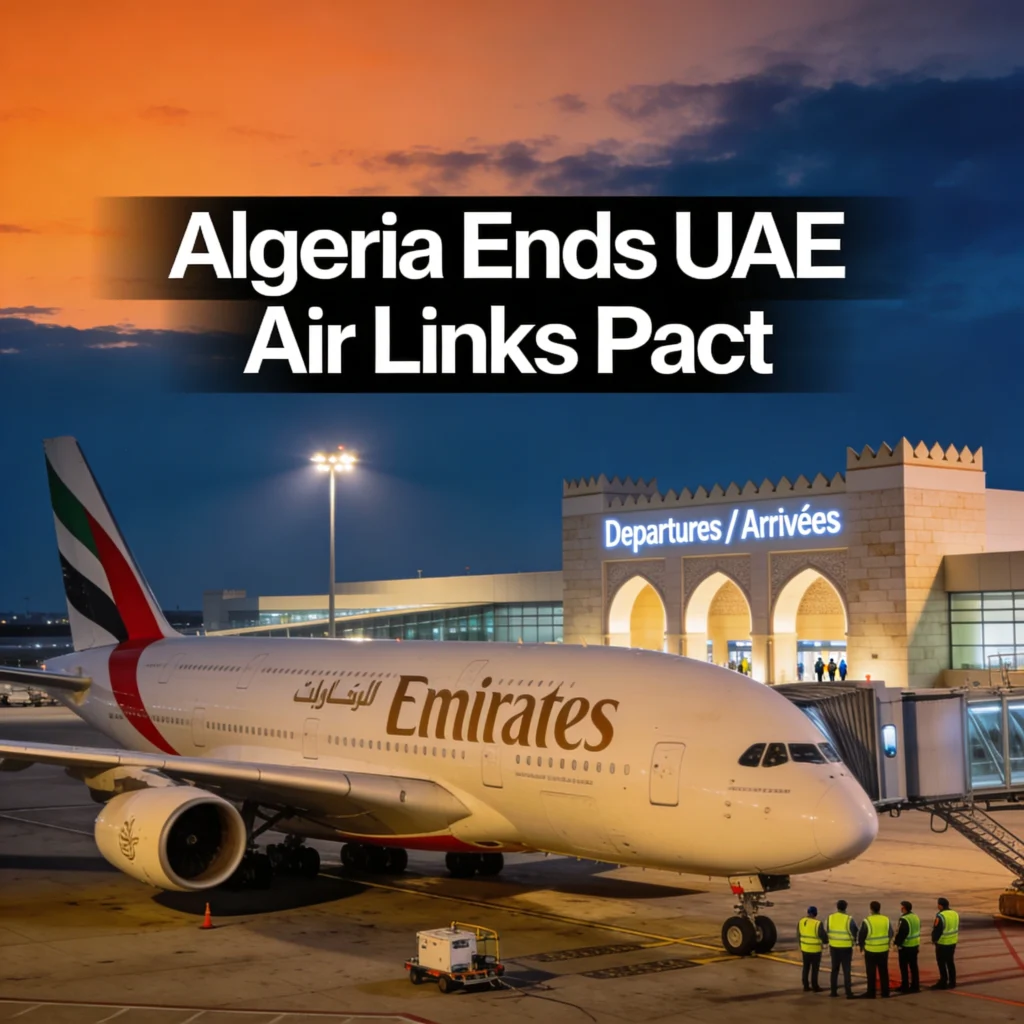
Background of the Algeria UAE Air Services Agreement
The Algeria UAE air services agreement was originally signed in Abu Dhabi on May 13, 2013, and formally ratified by Algeria through a presidential decree in December 2014. The pact laid the groundwork for structured aviation cooperation, regulating passenger flights, cargo transport, airline designations, and operational rights between the two states.
For more than a decade, the agreement supported steady air connectivity, facilitating tourism, business travel, and trade flows between North Africa and the Gulf. Its potential termination marks a significant departure from what had been a stable framework for bilateral aviation relations.
Legal Process for Termination Under International Aviation Rules
Under Article 22 of the agreement, Algeria is required to follow a formal and transparent process to complete the cancellation. This includes issuing an official diplomatic notification to the UAE government and simultaneously informing the Secretary-General of the International Civil Aviation Organization (ICAO).
Once notified, ICAO oversees the procedural aspects of the termination under international civil aviation norms. While the process does not immediately ground flights, it opens the door to future restrictions on airline operations, route authorizations, and airspace access if no replacement framework is negotiated.
Political Tensions Driving the Decision
Although the Algerian government has avoided naming the UAE directly, political signals over recent months have pointed clearly toward Abu Dhabi. In October, President Abdelmadjid Tebboune stated that Algeria maintained “warm” relations with all Gulf states except one—a remark widely interpreted by analysts as a reference to the UAE.
At the same time, Tebboune publicly praised Algeria’s relations with Saudi Arabia, Kuwait, Oman, and Qatar, describing them as “brotherly.” This contrast reinforced perceptions that Algeria views the UAE as an outlier in its Gulf diplomacy, particularly amid accusations of regional meddling and destabilization.
Potential Impact on Flights, Tourism, and Trade
If the cancellation of the Algeria UAE air services agreement proceeds without a revised arrangement, the consequences could extend beyond diplomacy. Aviation analysts warn that passenger traffic, tourism flows, and cargo logistics may eventually be affected.
Emirati carriers operating routes to Algeria could face reduced frequencies or regulatory uncertainty, while Algerian airlines may lose guaranteed access to Emirati airports. Any tightening of airspace or operational permissions would also raise costs for carriers and travelers alike, potentially reducing demand over time.
However, experts note that aviation agreements are often renegotiated even amid political tensions, meaning immediate disruption is not guaranteed.
A Signal of Algeria’s Hardening Regional Stance
Beyond aviation, the move is widely seen as a symbolic gesture underscoring Algeria’s increasingly assertive foreign policy. By targeting a long-standing technical agreement rather than issuing rhetorical warnings, Algiers appears willing to use economic and infrastructural tools to express political displeasure.
Such actions remain uncommon in Algeria–Gulf relations, making this development particularly noteworthy for regional observers. It also reflects a broader trend across North Africa and the Middle East, where geopolitical disagreements are increasingly spilling into trade, transport, and regulatory domains.
What Comes Next
As of now, Emirati officials have not publicly commented on Algeria’s announcement. Diplomatic engagement behind the scenes may still shape the final outcome, especially if both sides seek to avoid collateral economic fallout.
Whether the cancellation proceeds to completion or results in a renegotiated framework, the episode marks a clear cooling in Algeria–UAE relations and highlights how aviation agreements can become leverage points in wider geopolitical disputes.
For more details & sources visit: Reuters
Stay informed with the latest United Arab Emirates news on 360 News Orbit – UAE.