
Ghana Recalls High Commissioner to Nigeria in a decision framed as a firm step toward accountability rather than a diplomatic rift. On February 8, 2026, President John Dramani Mahama ordered the immediate recall of Baba Jamal, Ghana’s High Commissioner to Nigeria, following allegations linked to electoral misconduct during recent party primaries.
Officials in Accra emphasized that the action is meant to uphold ethical standards for political appointees while ensuring that bilateral relations with Nigeria remain stable and cooperative.
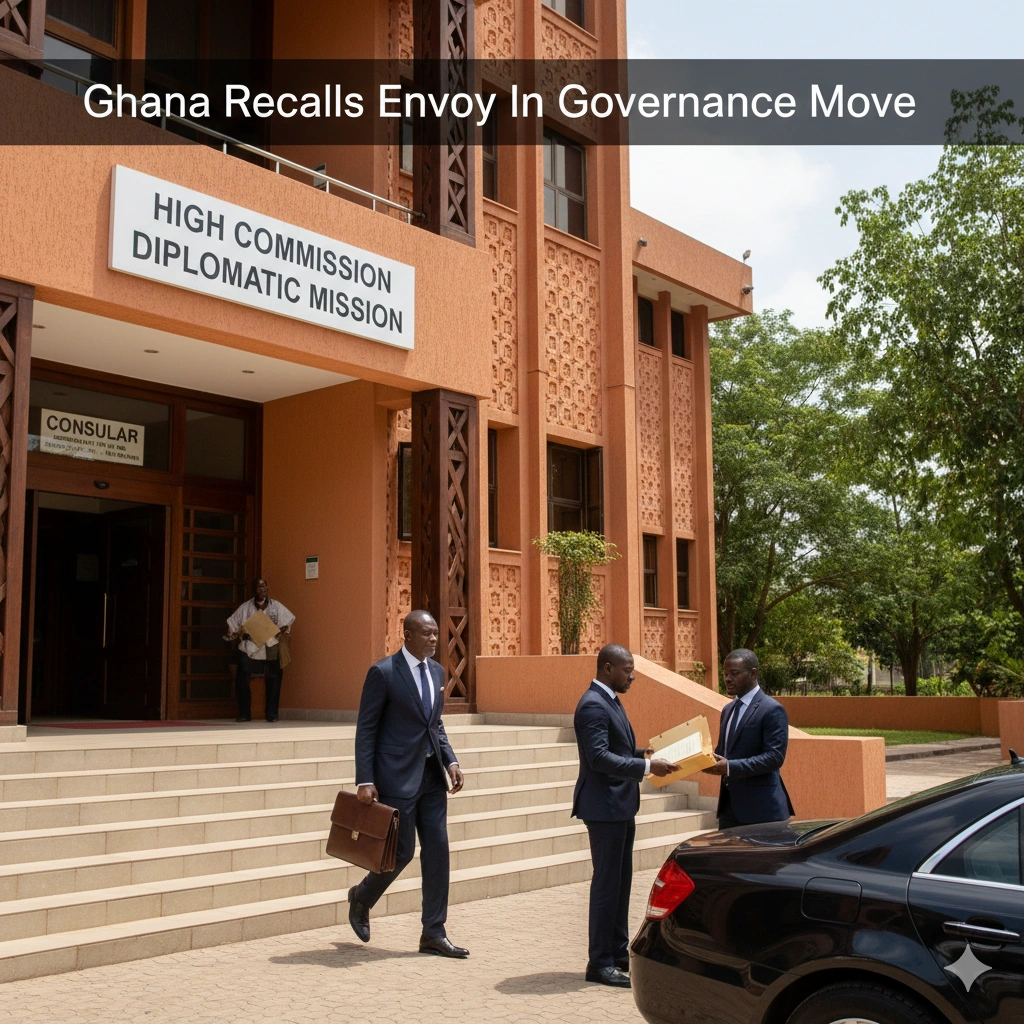
Governance and Accountability Behind the Decision
The presidency confirmed that Baba Jamal was the only serving public officeholder among individuals accused of irregularities connected to internal party processes. According to government communications, the recall was issued without prejudging the outcome of ongoing investigations by the National Democratic Congress (NDC).
Authorities described the step as necessary to protect the credibility of public institutions and reinforce expectations of conduct for senior officials. By acting swiftly, the administration signaled that political appointments remain subject to oversight and ethical scrutiny.
Officials stressed that the measure is procedural rather than punitive at this stage, indicating that the decision is designed to maintain institutional integrity while investigations continue.
Ghana Recalls High Commissioner to Nigeria Without Straining Bilateral Ties
Despite the unusual nature of the decision, Ghanaian authorities have been explicit that Ghana Recalls High Commissioner to Nigeria does not signal diplomatic tension with Abuja. Nigeria remains Ghana’s largest trading partner in West Africa and a core partner in energy cooperation, migration management, and regional security coordination.
Both countries consistently align positions within ECOWAS and other multilateral forums, making sustained diplomatic engagement essential. Government sources emphasized that the recall is an internal governance action and should not be read as a change in Ghana’s foreign policy direction.
This reassurance reflects the long-standing strategic relationship between Accra and Abuja, which has historically endured through periods of domestic political transition in both countries.
Continuity of Diplomatic and Consular Services
To prevent any disruption following the decision that Ghana Recalls High Commissioner to Nigeria, the country’s mission in Abuja is structured to operate institutionally beyond any single envoy. Officials confirmed that an acting head of mission or a newly appointed successor will oversee daily diplomatic and consular operations.
This structure ensures uninterrupted services for citizens and businesses, including visa processing, trade facilitation, and diplomatic coordination. The arrangement reinforces that the step taken after Ghana Recalls High Commissioner to Nigeria is administrative in nature rather than a breakdown in bilateral engagement.
Maintaining operational continuity is particularly important given the high volume of cross-border trade, migration, and commercial activity between Ghana and Nigeria.
Political and Regional Implications of the Recall
The move underscores a broader emphasis on governance reforms and accountability standards within Ghana’s political system. By acting swiftly to recall a senior diplomat amid allegations, the administration appears intent on reinforcing the principle that public officials remain accountable to institutional rules regardless of rank.
At the regional level, the episode highlights how West African governments are increasingly balancing domestic political discipline with the need to preserve stable diplomatic relationships. Analysts note that such actions can strengthen institutional credibility if handled transparently and without escalating into interstate friction.
Outlook
While investigations related to the alleged misconduct are still unfolding, the immediate recall signals a preference for preventive governance measures aimed at protecting institutional reputation. Ghana’s leadership appears focused on demonstrating that accountability mechanisms apply even to high-level diplomatic appointments.
At the same time, reassurances from Accra suggest that cooperation with Nigeria will proceed without interruption. The structure of Ghana’s diplomatic mission and the expectation of a replacement envoy reinforce the message that bilateral engagement is grounded in state institutions rather than individual officeholders.
For more details & sources visit: Business Insider Africa
Read more on Nigeria news: 360 News Orbit – Nigeria.