
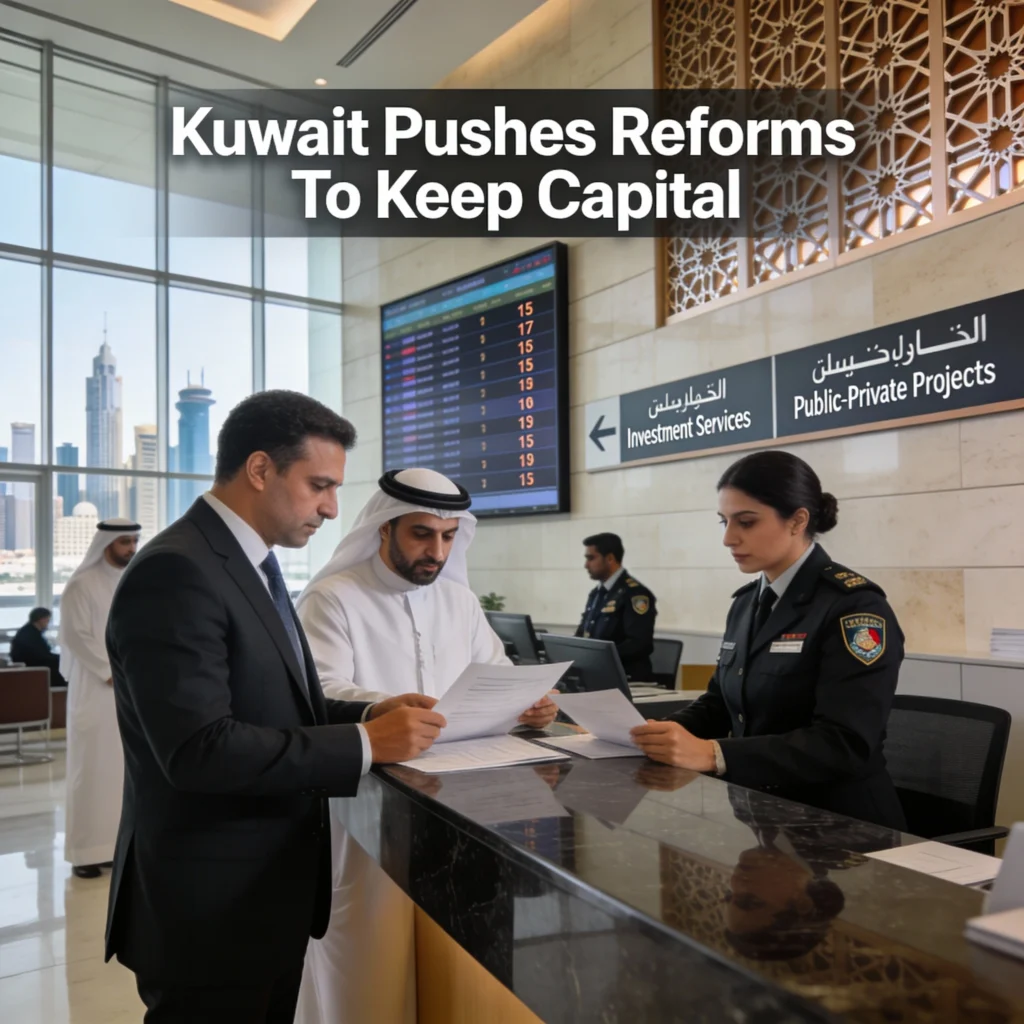
Kuwait capital flight is emerging as a growing structural risk as domestic investors increasingly move funds to neighboring markets amid weak incentives and slow reform at home. A recent policy commentary warns that unless Kuwait improves regulatory quality and modernizes its public-private partnership (PPP) framework, economic diversification efforts may continue to underperform.
The analysis argues that the issue is not a lack of investor appetite, but rather a domestic environment that discourages long-term private sector engagement.
Kuwait Capital Flight Reflects Structural Investment Barriers (H2)
According to the commentary, Kuwaiti investors remain willing to invest domestically, but face persistent obstacles that make regional alternatives more attractive. These include:
- Regulatory opacity and inconsistent enforcement
- Lengthy approval timelines for major projects
- Limited financing and risk-sharing mechanisms
- Underperforming and unclear PPP governance structures
As a result, Kuwait capital flight is not driven by pessimism, but by opportunity cost—capital is flowing to jurisdictions with faster execution and clearer rules.
Oil Dependence Intensifies Pressure on Reform (H2)
The article emphasizes that Kuwait’s heavy reliance on oil revenue has left public finances exposed to volatility. When energy prices weaken, fiscal buffers erode quickly, limiting the state’s ability to sustain growth through public spending alone.
Recent projections by Kuwait’s official news agency underscore this risk. The government has forecast a budget deficit of KD 6.306 billion (USD 22.44 billion) for FY 2025–26, highlighting rising fiscal pressure at a time when diversification remains stalled.
Without mobilizing domestic private capital, the commentary warns, Kuwait risks deeper long-term vulnerability.
PPP Reform Seen as Central to Retaining Capital (H2)
A central argument of the analysis is that PPP reform is essential to slowing Kuwait capital flight. While PPPs are intended to crowd in private investment, Kuwait’s current framework is widely seen as slow, fragmented, and overly complex.
Key shortcomings include:
- Unclear risk allocation between public and private partners
- Weak accountability mechanisms
- Limited scalability for large, multi-sector projects
- Lengthy procurement and approval processes
The commentary calls for a modern, transparent, and investor-friendly PPP model that can support infrastructure, logistics, and non-oil growth sectors.
Regulatory Quality Tied to Economic Diversification (H2)
Beyond PPPs, the article highlights regulatory quality as a decisive factor in reversing Kuwait capital flight. International assessments repeatedly link strong governance, predictable regulation, and institutional efficiency with sustained non-oil growth.
Recommended reforms include:
- Improving regulatory transparency and consistency
- Shortening approval and licensing timelines
- Modernizing customs, trade, and logistics procedures
- Strengthening dispute resolution and contract enforcement
Together, these measures would reduce friction for domestic investors and make long-term projects more viable.
Retaining Local Capital Is as Critical as Attracting Foreign Investment (H2)
The commentary stresses that economic diversification in Kuwait cannot rely solely on foreign capital. Retaining and mobilizing local private capital is equally important, particularly given Kuwait’s substantial domestic savings base.
Allowing capital to continue flowing abroad represents a missed opportunity to:
- Build resilient non-oil sectors
- Expand private-sector employment
- Reduce fiscal dependence on hydrocarbons
Reversing Kuwait capital flight is therefore framed as a prerequisite for sustainable growth, not merely a financial concern.
Conclusion: Kuwait Capital Flight Signals Urgent Need for Reform (H2)
The analysis concludes that Kuwait capital flight is a policy signal, not an inevitability. Domestic investors are not abandoning the country; they are responding rationally to regulatory and structural constraints.
By accelerating PPP reform, improving regulatory quality, and creating a more predictable investment environment, Kuwait could redirect domestic capital toward national development goals and strengthen its long-term economic resilience.
Source:
Gulf International Forum – Rebuilding Confidence at Home: How Kuwait Can Strengthen Its Domestic Investment Climate
For more news, visit 360 News Orbit