
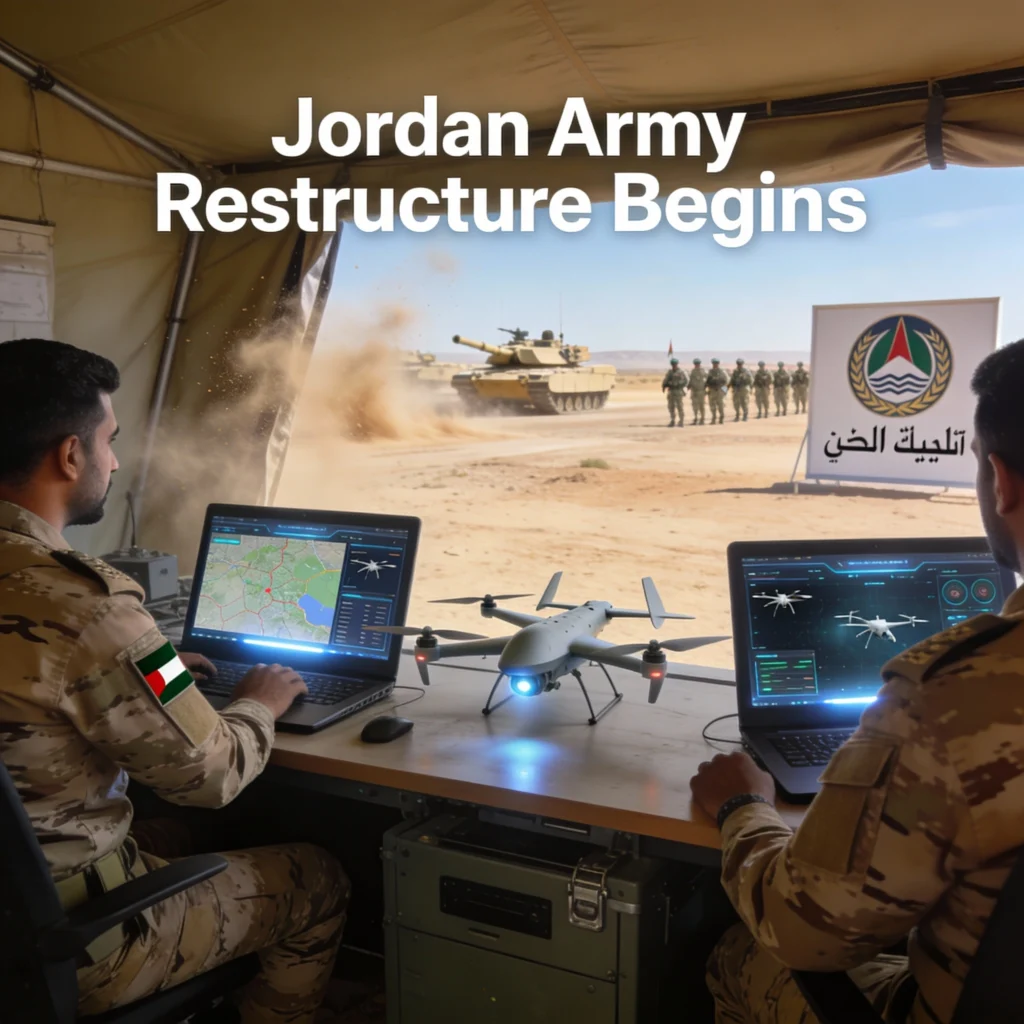
Jordan Armed Forces restructuring is officially underway after King Abdullah II issued royal directives launching a comprehensive three-year overhaul of the Arab Army, aimed at preparing the military for modern, hybrid, and technology-driven warfare.
According to official reporting, implementation has already begun, marking one of the most significant transformations of Jordan’s military structure in recent years. The reforms are designed to strengthen readiness, streamline command structures, and ensure the armed forces remain capable of responding to evolving regional and technological threats.
Jordan Armed Forces Restructuring Targets Modern Warfare Challenges (H2)
The Jordan Armed Forces restructuring focuses on aligning military organisation with contemporary operational demands, particularly as warfare expands beyond traditional battlefields.
Key priorities include:
- Cyber defence and electronic warfare
- Unmanned and autonomous systems
- Artificial intelligence–enabled decision support
- Expanded use of drones and surveillance technologies
Military planners say the restructuring reflects the reality of hybrid warfare, where conventional combat, cyber operations, information warfare, and unmanned systems increasingly intersect.
Royal Directives Shape Jordan Armed Forces Restructuring Roadmap (H2)
King Abdullah II, the Supreme Commander of the Jordan Armed Forces, has personally overseen the direction of the restructuring effort. He instructed Chairman of the Joint Chiefs of Staff Major General Yousef Huneiti to develop a clear and actionable roadmap addressing both current and future security risks.
The King praised the Arab Army as a pillar of national pride and stability, stressing the need for:
- High professionalism
- Operational agility
- Continuous adaptation to technological change
Officials say the royal directives ensure the restructuring is strategic rather than cosmetic, focusing on long-term resilience rather than short-term fixes.
Command, Control, and Integration Central to Jordan Armed Forces Restructuring (H2)
A major component of the Jordan Armed Forces restructuring is improving command, control, and communications (C3) across all branches of the military.
Planned upgrades include:
- Streamlined command chains
- Enhanced interoperability between army, air force, and other units
- Improved real-time data sharing and battlefield awareness
By tightening integration among different service branches, the reforms aim to reduce response times and increase operational efficiency during both peacetime missions and crisis scenarios.
Reserves, Logistics, and Supply Chains Strengthened (H2)
Beyond frontline capabilities, the Jordan Armed Forces restructuring places strong emphasis on structural depth, particularly in reserves, logistics, and sustainment.
Key measures include:
- Reinforcing reserve forces and mobilisation readiness
- Securing military supply chains against disruption
- Improving logistics planning for extended operations
These steps are intended to ensure that Jordan’s armed forces can sustain prolonged operations and remain effective even under pressure from regional instability or supply shocks.
Boosting Local Defense Industries Through Restructuring (H2)
Another strategic pillar of the Jordan Armed Forces restructuring is enhancing defence self-sufficiency by supporting local military industries.
Officials say the reforms seek to:
- Reduce reliance on foreign suppliers
- Improve maintenance and lifecycle support for equipment
- Encourage domestic innovation in defence technologies
Strengthening local defence industries is viewed as both a security and economic objective, supporting efficiency while creating skilled jobs and technological capacity inside Jordan.
Parliamentary Support For Jordan Armed Forces Restructuring (H2)
Members of Jordan’s Parliament have publicly welcomed the restructuring initiative, describing it as a visionary step that positions the armed forces to deter aggression and manage complex security environments.
Lawmakers highlighted the importance of:
- Proactive planning rather than reactive reform
- Balancing technological advancement with human expertise
- Maintaining morale and institutional identity during transformation
Parliamentary backing is expected to support sustained funding and legislative alignment as the three-year plan unfolds.
Regional Context And Strategic Significance (H2)
The Jordan Armed Forces restructuring comes amid heightened regional volatility, rapid military technological advances, and expanding non-traditional threat vectors.
Analysts note that Jordan’s approach reflects a broader regional trend toward:
- Leaner, more agile force structures
- Technology-enabled command systems
- Integrated defence planning across domains
By acting early, Jordan aims to preserve its reputation as a stable and capable security actor in the Middle East.
Conclusion: Jordan Armed Forces Restructuring Signals Long-Term Readiness (H2)
The launch of Jordan Armed Forces restructuring under direct royal guidance signals a deliberate shift toward future-ready defence planning. By combining technology upgrades, organisational reform, reserve strengthening, and defence-industry development, Jordan is positioning its military to meet evolving threats with agility and professionalism.
As implementation progresses over the next three years, the restructuring is expected to redefine how the Arab Army operates, integrates technology, and safeguards national security.
Source:
Arab News – Jordan Armed Forces Restructuring
For more news, visit 360 News Orbit