
Thailand election tensions and Indonesia credit outlook shifts are dimming economic hopes for Southeast Asia’s promising tiger cubs—Thailand, Indonesia, and the Philippines. A recent Bloomberg Economics analysis highlights how political turbulence is eroding investor confidence just as Thailand approaches a critical Thailand election on February 8, 2026, while Indonesia grapples with Moody’s negative outlook under President Prabowo Subianto.
These nations, once hailed as the next high-growth engines after the original Asian Tigers, now face diluted optimism due to governance risks and policy unpredictability. Political risk in Southeast Asia underscores that stability often trumps raw growth figures in attracting capital.
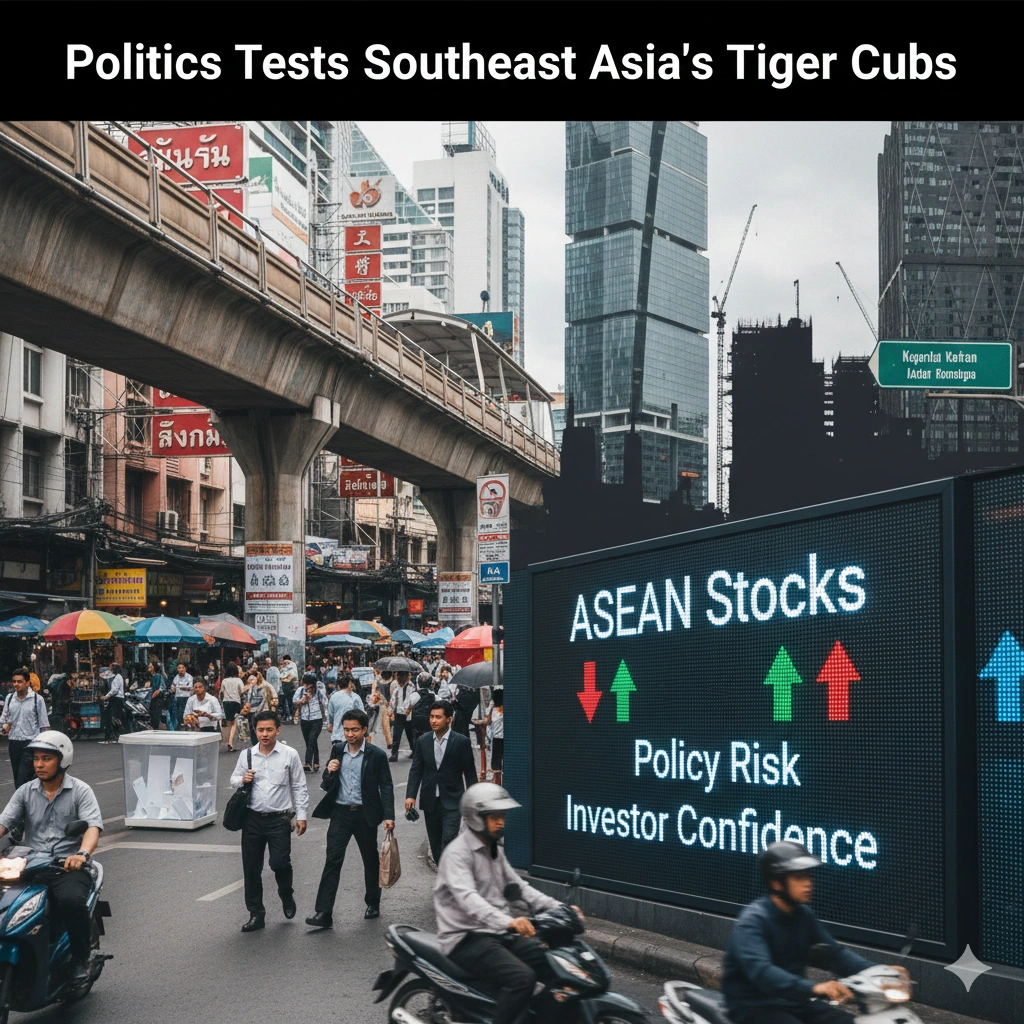
Thailand Election Heats Up Amid Uncertainty
Thailand‘s snap election, called by Prime Minister Anutin Charnvirakul after just 100 days in office, pits reformist forces against establishment players. The contest features the progressive People’s Party, led by favored Natthaphong Ruengpanyawut, against Anutin’s conservative Bhumjaithai and the Pheu Thai party, creating a three-way battle with tricky coalition prospects.
Polls show the People’s Party leading with 34.2% support in one survey, ahead of Bhumjaithai at 16.2% and Pheu Thai at 16.0%, while Natthaphong edges Anutin as preferred premier (24.7% vs. 20.8%). This political drama unfolds against a backdrop of border clashes with Cambodia and domestic issues like floods and scams, limiting the next government’s fiscal and monetary flexibility.
Bloomberg warns that uncertain coalition math post-election could prolong instability, chipping away at economic momentum in this key tiger cub.
Indonesia’s Credit Woes Signal Governance Risks
Indonesia recently suffered a blow as Moody’s downgraded its sovereign credit outlook to negative from stable, citing weaker policymaking predictability and governance concerns under President Prabowo Subianto. The Baa2-rated nation faces risks of higher budget deficits, rupiah depreciation, and capital outflows if issues persist.
Finance Minister Purbaya Yudhi Sadewa pushed back, but markets reacted with selling in stocks, bonds, and the currency, amplifying investor unease. Prabowo’s push for 8% growth—up from steady 5% levels—involves controversial moves like replacing a fiscally conservative minister, fueling transparency doubts flagged by MSCI.
These developments highlight how policy volatility in Indonesia threatens its status among Southeast Asia’s tiger cubs.
Broader Impact on Tiger Cubs and Investor Sentiment
Thailand, Indonesia, and the Philippines are seeing political risk overshadow solid headline growth, deterring capital flows and investment. Budget pressures and governance questions amplify vulnerabilities, even as these economies boast strong fundamentals.
In contrast, Vietnam shines with trade momentum and a stable political environment, proving that credibility and predictability are vital for sustaining investor appetite. For Southeast Asia’s tiger cubs, this serves as a reminder that political stability underpins economic promise amid global uncertainties.
The Thailand election outcome and Indonesia credit outlook trajectory will likely dictate near-term confidence, with implications for regional growth narratives.
Investor Caution Ahead of Thailand Election
Global and regional investors are approaching the Thailand election with heightened caution, reflecting concerns over policy continuity and coalition fragility. Foreign portfolio inflows have slowed in recent weeks, with many fund managers taking a wait-and-see approach until election outcomes clarify the balance of power in parliament. Volatility in sectors like banking, infrastructure, and tourism underscores how investor sentiment is closely tied to perceived stability.
The uncertainty has prompted some multinational companies to temporarily delay expansion plans in Thailand, particularly in high-capital sectors. Analysts note that even incremental policy shifts after the election—ranging from fiscal stimulus to regulatory reform—could significantly sway foreign investment decisions. This demonstrates how electoral outcomes now carry economic weight beyond the ballot box.
Thailand Election and Regional Trade Dynamics
The upcoming Thailand election also has implications for regional trade agreements and economic partnerships. Key stakeholders, including ASEAN neighbors, are monitoring which coalition will shape Thailand’s stance on trade facilitation, investment incentives, and cross-border projects. Any delay or policy reversal could affect supply chains, particularly in electronics, automotive, and agriculture sectors that rely heavily on Thailand as a regional hub.
Furthermore, Thailand’s political choices post-election may influence broader Southeast Asian trade integration. Countries like Malaysia, Singapore, and Vietnam may recalibrate bilateral agreements based on the incoming government’s approach to foreign investment and trade liberalization. For businesses and investors in the region, the Thailand election represents both a risk and a signal of potential policy alignment across ASEAN markets.
Why Stability Matters for Growth
Political turbulence like Thailand’s coalition uncertainties and Indonesia’s rating warnings illustrates a key lesson: even high-potential tiger cubs falter without reliable policies. Investors prioritize environments free from sudden shifts, as seen in Vietnam’s edge through consistent governance.
Headline GDP figures mask these risks, but Bloomberg’s analysis stresses that governance and policy predictability drive capital inflows essential for infrastructure, digital expansion, and consumer markets in these nations. As Southeast Asia competes globally, addressing political risks will be crucial to unlocking true tiger potential.
For more details & sources visit: Bloomberg News (with supporting Reuters reporting on Indonesia ratings outlook)
Read more on global developments: 360 News Orbit – Extended Orbit