
Maldives President Mohamed Muizzu has formally rejected the UK-Mauritius Chagos deal, filing objections and revoking prior recognition of Mauritius’s claims over the Chagos Islands. This bold move, underscores Maldives’ strategic interests in the Indian Ocean amid ongoing geopolitical tensions.
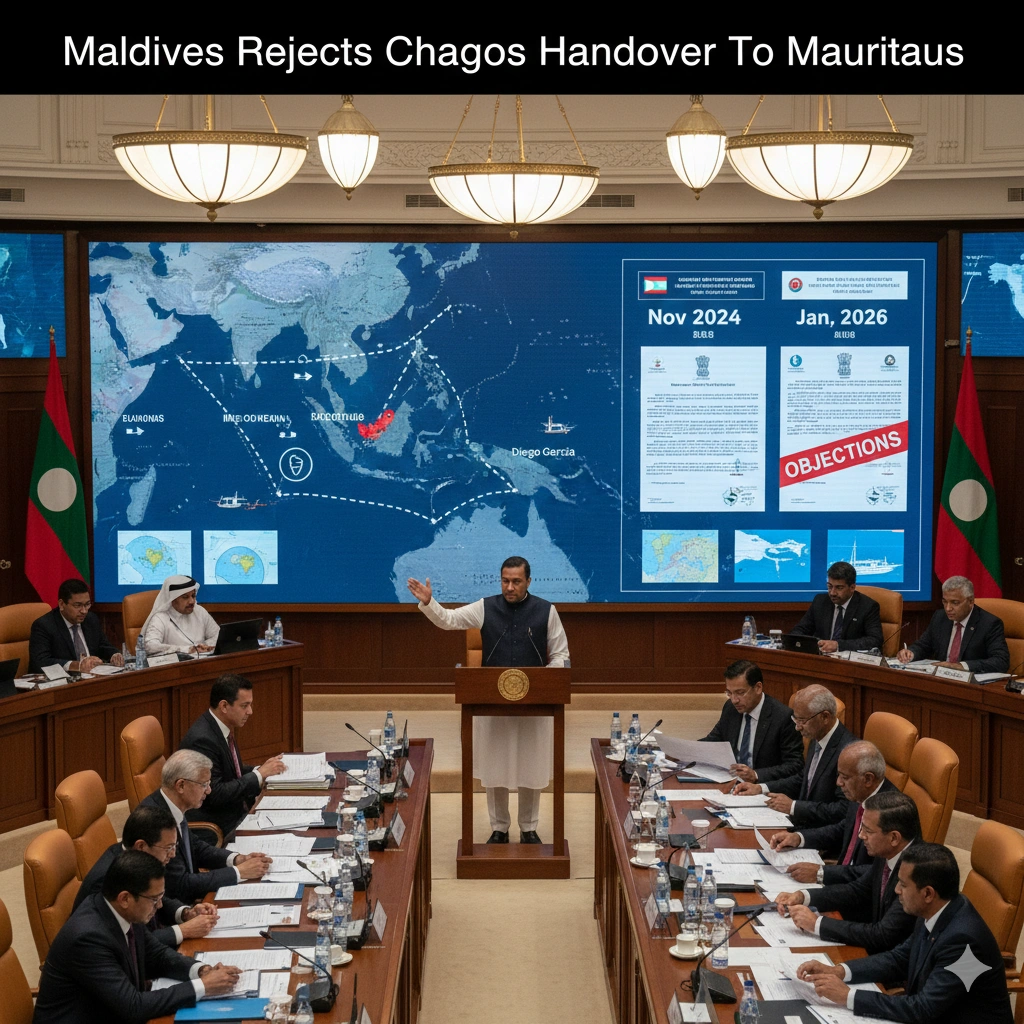
Maldives Lodges Formal Objections
On February 5, President Muizzu addressed parliament, revealing that the Maldives submitted official objections to the UK on November 8, 2024, and January 18, 2026, explicitly rejecting the sovereignty transfer of the Chagos Islands to Mauritius. He highlighted a December 15, 2025, call with UK Deputy Prime Minister David Lammy, where he urged further consultations due to the archipelago’s proximity—mere 500 km south of the Maldives—and deep historical fishing ties.
The government also announced the rescission of a 2022 letter from former President Ibrahim Mohamed Solih, which had recognized Mauritian sovereignty over the Chagos Islands. This reversal signals a shift in policy under Muizzu, prioritizing Maldives’ maritime rights over past concessions.
Legal Push for EEZ Recovery
Maldives has launched legal proceedings to reclaim maritime areas lost following a ruling by the International Tribunal for the Law of the Sea (ITLOS). The tribunal delimited overlapping Exclusive Economic Zones (EEZs), awarding Maldives 47,232 sq km but leaving the nation aggrieved by what it views as negligence in prior delimitations influenced by Chagos boundaries.
Muizzu argues that geographical proximity and historical evidence give Maldives a stronger claim than Mauritius, fueling demands for EEZ restoration. This action aligns with his administration’s pledge to protect Maldives’ original maritime entitlements in the resource-rich Indian Ocean.
Background on the UK-Mauritius Pact
The controversial deal, signed in May 2025 between the UK and Mauritius, stems from a 2019 ICJ opinion urging the end of British rule over the Chagos Archipelago after over two centuries. In exchange for sovereignty, Mauritius grants the US and UK a 99-year lease for the strategic Diego Garcia military base, vital for Indian Ocean operations.
However, the agreement awaits UK parliamentary ratification, delayed by international pushback. Maldives’ objections add complexity, positioning the archipelago’s future amid competing regional claims.
Trump’s Criticism Adds Pressure
US President Donald Trump has slammed the UK-Mauritius Chagos deal as an “act of great stupidity,” prompting delays in UK ratification debates. Despite recent productive talks with UK Prime Minister Keir Starmer, where Trump acknowledged it as the “best possible outcome,” he reserved the right to “militarily secure” Diego Garcia if threatened.
This US-UK friction intersects with Maldives’ stance, amplifying stakes for all parties. Trump’s ire underscores concerns over strategic assets in a geopolitically sensitive region.
Regional Diplomacy Faces New Challenges
The UK-Mauritius Chagos deal is now under increased scrutiny as neighboring countries weigh in on its implications. Maldives’ formal objections have prompted discussions within the Indian Ocean Rim Association, with smaller island nations expressing concerns over precedent-setting sovereignty agreements. Analysts suggest that these diplomatic ripples may influence future regional negotiations on maritime boundaries and resource management.
Beyond formal objections, Maldives is engaging in bilateral talks with both the UK and Mauritius, emphasizing a more inclusive consultation process. By asserting its stake, Maldives aims to ensure that strategic and economic interests, particularly fishing rights and energy exploration zones, are not overlooked in any final settlement.
Economic and Security Stakes in the Chagos Agreement
The UK-Mauritius Chagos deal carries significant economic and security dimensions that extend beyond sovereignty. Diego Garcia, leased to the US and UK for military operations, is central to Indo-Pacific defense strategy, and Maldives’ challenge introduces uncertainty for long-term planning. Regional powers are monitoring whether Maldives’ objections could reshape access and control arrangements around key maritime corridors.
Economic considerations also come into play, as the Chagos Islands sit near rich fisheries and potential seabed mineral reserves. Maldives’ push to reassert its claims could impact licensing, maritime revenue, and regional investment, signaling that the Chagos dispute is as much about resources and economic leverage as it is about legal sovereignty.
Strategic Implications for Indian Ocean
The Chagos Islands, comprising over 60 islands across seven atolls, lie at the heart of Indian Ocean EEZ disputes. Maldives’ proximity fuels its claims, contrasting Mauritius’s historical sovereignty arguments backed by international rulings.
As Maldives presses for consultations and legal recourse, the deal’s fate remains uncertain, potentially reshaping maritime boundaries and alliances. This development highlights rising tensions in the Indo-Pacific, where fishing rights, military bases, and resource control converge.
The Maldives-UK-Mauritius Chagos dispute not only challenges the pact’s viability but also invites broader scrutiny of colonial legacies in ocean governance. With legal battles underway, stakeholders watch closely as President Muizzu asserts Maldives’ rightful position.
For more details & sources visit: Anadolu Agency
Read more on global developments: 360 News Orbit – Extended Orbit