
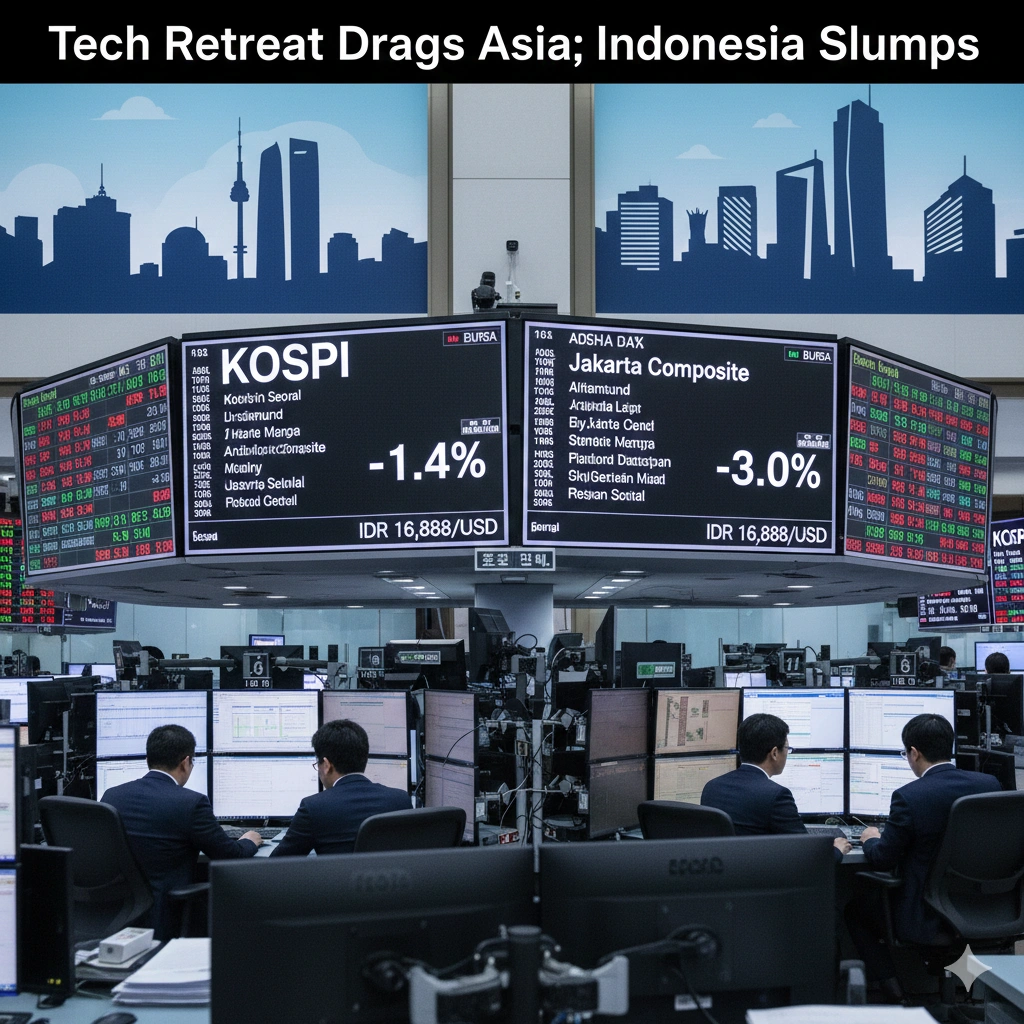
The Indonesia market drop accelerated on February 8, 2026, after Moody’s downgraded the country’s credit outlook. This move added pressure to the rupiah, which weakened to approximately 16,888 per US dollar—the lowest level since January 22. Investors expressed growing concern over policy uncertainty under President Prabowo Subianto, including potential fiscal slippage and questions surrounding the independence of the central bank.
This decline in Indonesian equities also reflected broader regional market pressures, as tech selloffs in South Korea and other Asian markets weighed heavily on investor sentiment. The Jakarta Composite Index saw intraday losses of up to 3%, highlighting heightened volatility in Southeast Asia’s largest economy.
Tech Selloff Hits South Korea and Regional Sentiment
The Asian financial landscape was further shaken by a tech-driven selloff in South Korea, with the KOSPI index falling 1.4% on Friday, ending a six-week winning streak. Leading semiconductor stocks, including Samsung Electronics and SK Hynix, each dropped around 0.4%.
The MSCI Emerging Asia index also moved lower, down 0.6%, while the regional IT gauge declined nearly 3% over the week. Analysts note that these tech-sector pressures have spillover effects on neighboring markets like Indonesia, reinforcing concerns about global market interconnectedness.
Currency Pressure Adds to Indonesia Market Drop
The Indonesia market drop has coincided with a weakening rupiah, which slid to its lowest level in weeks against the US dollar. Currency depreciation is intensifying investor worries about capital outflows and economic stability.
Economic analysts warn that the rupiah’s slide, combined with Moody’s negative outlook, may reduce foreign investment inflows and increase borrowing costs. Market participants are closely monitoring Jakarta’s policy responses to maintain confidence in the country’s financial stability.
Mixed Regional Market Performance
Other Asian markets experienced mixed results, reflecting uneven investor sentiment. Singapore’s benchmark declined, while Thailand saw slight gains. Several regional currencies also experienced modest fluctuations against the US dollar.
This regional volatility underscores the challenges for emerging markets as global tech selloffs and credit rating pressures converge. Investors are expected to remain cautious until clearer policy signals emerge from key economies, including Indonesia.
Investor Sentiment and Foreign Investment Concerns
The Indonesia market drop has raised concerns among foreign investors about the country’s economic outlook. Uncertainty over fiscal policy and regulatory stability is making some multinational companies reconsider short-term investment plans, especially in sectors sensitive to government policy.
Analysts note that reduced investor confidence could affect capital inflows, potentially slowing growth in key industries. Market participants are closely watching Indonesia’s policy signals, with the expectation that any measures promoting transparency and stability could help restore confidence.
Potential Policy Responses and Economic Recovery
In response to the Indonesia market drop, government officials and financial regulators are exploring measures to stabilize markets and support the rupiah. Potential interventions could include targeted fiscal initiatives, adjustments to monetary policy, or clearer guidance on economic reforms.
Experts emphasize that coordinated policy action could help mitigate volatility and reassure both domestic and international investors. Strengthening regulatory frameworks and ensuring transparent decision-making may play a crucial role in supporting long-term economic resilience despite short-term market turbulence.
this my existing content, give 2 more sub heading with each 2 para based on keyword, but not overuse it and do not repeat the existing thing.
Outlook: Managing Investor Confidence
Looking ahead, market watchers emphasize the importance of policy clarity and central bank independence in stabilizing Indonesia’s financial markets. Addressing investor concerns could help mitigate further declines and support long-term economic growth.
While short-term volatility persists, Indonesia’s domestic policies and responses to international credit assessments will play a decisive role in shaping market sentiment throughout 2026.
For more details & sources visit: Reuters (carried by Business Recorder)
For the latest updates from Indonesia, visit our Indonesia news page.