
France recorded a notable improvement in its external trade position in 2025, with the France trade deficit 2025 narrowing as exports grew faster than imports, even against the backdrop of renewed global trade tensions linked to former U.S. president Donald Trump’s trade war policies. The improvement marked a sharp turnaround from the record deficits seen earlier in the decade and highlighted the stabilizing role of services in France’s external accounts.
According to figures cited by Le Monde from the French customs authority, France’s goods trade deficit fell to €69.2 billion in 2025, down from just over €79 billion in 2024. The result represents a substantial recovery from the record €161.7 billion deficit in 2022, when soaring energy prices and disrupted supply chains heavily weighed on trade balances.
Export Growth Drives the Improvement
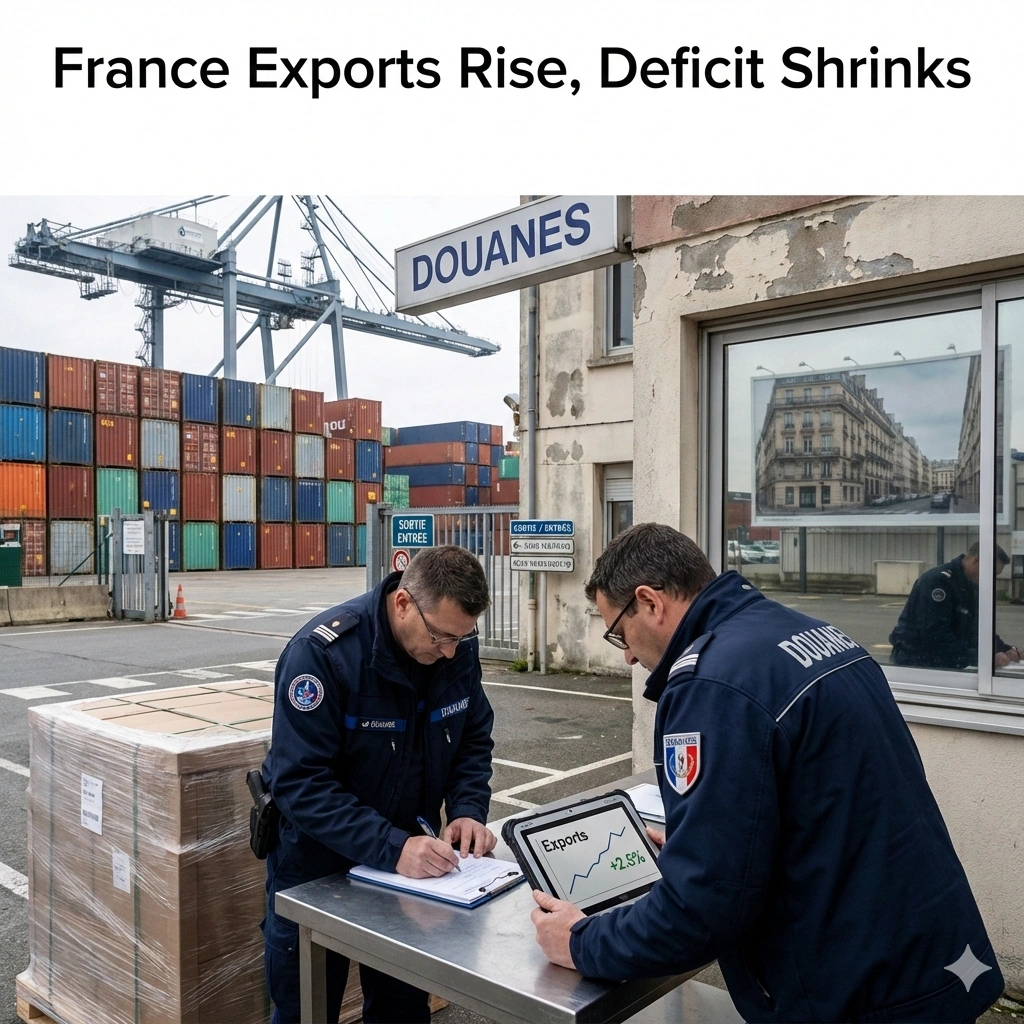
The narrowing of the France trade deficit 2025 was primarily driven by stronger export performance. French exports increased by 2.5% in 2025, reaching €614.7 billion, while imports rose by only 0.7% to €703.6 billion.
This divergence between export and import growth helped compress the trade gap, despite persistent uncertainty in global markets. Analysts note that the resilience of exports is particularly striking given continued trade friction and protectionist pressures, especially from the United States.
The figures suggest that French exporters were able to maintain competitiveness even as geopolitical tensions and tariff risks weighed on international commerce.
Trump Trade War Pressure Still Looms
The rebound in French foreign trade comes despite the lingering effects of Trump-era trade policies, which continue to influence global trade dynamics. While not directly targeting France, renewed uncertainty around U.S. trade posture has affected supply chains, investor sentiment, and export planning across Europe.
That France managed to improve its trade balance under these conditions has been interpreted by some economists as a sign of structural resilience rather than a short-term statistical rebound.
Agri-Food Sector Shows Signs of Weakness
Despite the overall improvement, French customs officials flagged agri-food trade as a weak spot. The sector’s surplus declined to just €200 million in 2025 — still positive, but the lowest level since the 2000s.
This erosion highlights challenges facing French agricultural exports, including rising input costs, competition from lower-cost producers, and changing demand patterns in key export markets. While the sector remains a net contributor to trade, officials warned that its shrinking surplus could limit future gains unless competitiveness improves.
Services Surplus Cushions External Position
A crucial stabilizing factor for France’s external accounts remains the services sector. According to the Bank of France, the country posted a €55.6 billion services trade surplus in 2025, only slightly below the €56.7 billion surplus recorded in 2024.
Services — including tourism, transport, finance, and professional services — continued to offset a significant portion of the goods deficit. Economists widely agree that without this surplus, France’s external position would be far more exposed to global trade volatility.
France Trade Deficit 2025 Seen as More Durable
Economist Anthony Morlet-Lavidalie of Rexecode noted that the improvement in France’s external balance appears structurally stronger than in previous cycles. He pointed out that the overall external gap narrowed to 0.4% of GDP in 2025, down from around 0.8% of GDP during 2017–2019.
This reduction suggests that the narrowing of the France trade deficit 2025 is not solely the result of temporary factors, such as lower energy prices, but may reflect deeper adjustments in trade flows and competitiveness.
Outlook for 2026 Remains Cautious
While the 2025 figures point to progress, analysts remain cautious about the outlook. Global trade conditions remain fragile, with geopolitical risks, protectionist tendencies, and slowing growth in key markets posing potential headwinds.
Still, the combination of export resilience and a strong services surplus has strengthened France’s position as it enters 2026, offering a buffer against external shocks.
For more details & sources visit: Le Monde
For the latest updates from France, visit our France news page.