
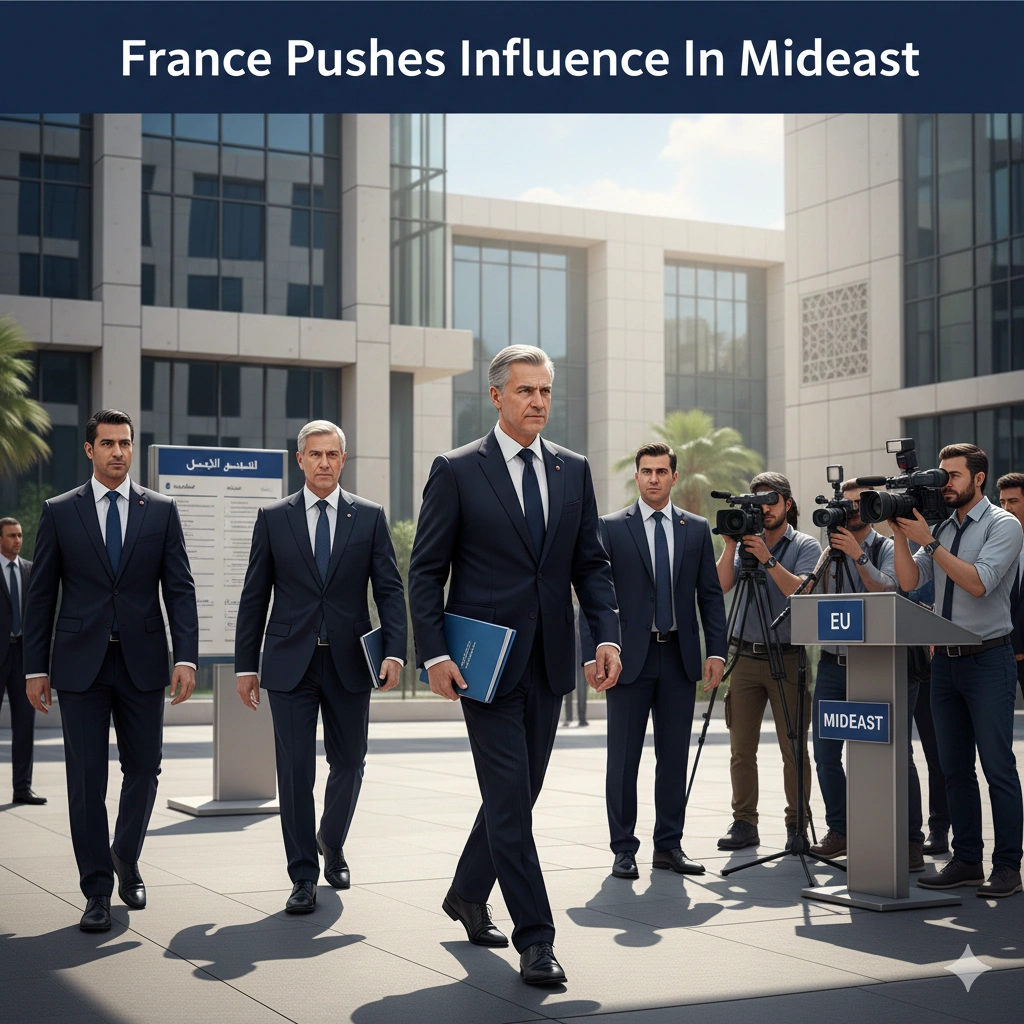
France is seeking to reinforce its diplomatic footprint in the Middle East as France Middle East role comes under renewed scrutiny following a regional tour by Foreign Minister Jean-Noël Barrot. The diplomatic push has sparked debate over Europe’s declining global influence and Paris’s determination to remain a relevant strategic actor in an increasingly competitive international environment.
An analysis published by Atalayar frames Barrot’s tour as part of a broader French effort to project influence beyond Europe at a time when France’s standing has weakened in parts of Africa and when the European Union is often perceived as hesitant or fragmented on foreign policy matters.
Reasserting Influence Amid Strategic Competition
According to the Atalayar analysis, France’s renewed engagement in the Middle East reflects concerns that rival global and regional powers could fill strategic spaces Paris still considers vital. By maintaining a visible diplomatic presence, France aims to prevent erosion of its influence in a region central to global security, energy routes, and geopolitical balance.
The push is also portrayed as a signal of European “strategic autonomy”, a concept long championed by Paris. Through high-level visits and public diplomacy, France seeks to demonstrate that Europe can act independently rather than remaining a secondary player shaped by external powers.
France Middle East Role Linked to Wider European Debate
The France Middle East role Jean-Noël Barrot initiative is closely tied to a broader debate unfolding across Europe in 2025–2026 regarding the continent’s ability to shape global security and foreign policy. European leaders have increasingly warned that the EU risks marginalization if it fails to act with unity and decisiveness.
Atalayar notes that Barrot’s tour is not an isolated diplomatic gesture but part of a larger narrative questioning whether Europe still possesses the political will and institutional capacity to defend its interests in a multipolar world. The Middle East, with its overlapping conflicts and power rivalries, has become a key testing ground for that question.
Macron Warns of Europe’s “Erasure”
The analysis also connects France’s diplomatic push to President Emmanuel Macron’s January 2026 address at the Conference of Ambassadors, where he delivered a stark warning about Europe’s future. Macron described a global landscape in which multilateral institutions are weakening, and traditional alliances are under strain.
He cautioned that Europe faces a real risk of “erasure” if it does not assert itself as a power capable of defending its political, economic, and security interests. Macron’s remarks reinforced long-standing French calls for deeper European cooperation on defense, sovereignty, and industrial policy.
Strategic Autonomy at the Core of French Policy
Macron outlined priorities centered on European sovereignty, enhanced defense capabilities, and stronger economic protection mechanisms, framing them as essential pillars for sustaining Europe’s influence. France’s diplomatic activism in the Middle East aligns with these objectives, presenting foreign engagement as inseparable from Europe’s internal cohesion and strategic ambition.
For Paris, the Middle East offers an arena where diplomacy, security, and economic interests intersect — and where France believes it can still shape outcomes if it acts decisively.
Challenges to European Credibility
Despite France’s efforts, the Atalayar analysis highlights skepticism surrounding Europe’s ability to convert diplomatic engagement into lasting influence. Fragmentation among EU member states, competing national priorities, and slow decision-making processes continue to undermine Europe’s credibility as a unified actor.
France’s push therefore carries broader implications: it tests whether a single European power can effectively project influence while also pulling the EU toward greater cohesion.
A Signal to Allies and Rivals
Ultimately, the France Middle East role Jean-Noël Barrot tour serves as a signal — to allies, rivals, and domestic audiences — that Paris is unwilling to retreat from regions it considers strategically essential. It reflects France’s belief that visibility, presence, and engagement remain critical tools in an era of shifting power balances.
As debates over European decline intensify, France’s actions in the Middle East may offer insight into whether Europe can still shape global affairs — or whether warnings of diminishing influence will continue to gain traction.
For more details & sources visit: Atalayar
For the latest updates from France, visit our France news page.