
The Canada-U.S. rivalry at Milano Cortina 2026 is already showing signs of intensifying, even before athletes take to the ice. What has traditionally been one of the Olympics’ fiercest sporting matchups is now intersecting with political rhetoric, highlighting how international sports rivalries increasingly reflect broader geopolitical tensions.
At Team Canada’s opening press conference ahead of the Milano Cortina Winter Olympics, officials were confronted with a pointed question: would Canadian athletes compete “elbows up” against the United States? The phrase, widely recognized in Canada as a symbol of toughness and defiance—particularly in hockey—has taken on renewed significance amid strained cross-border discourse.
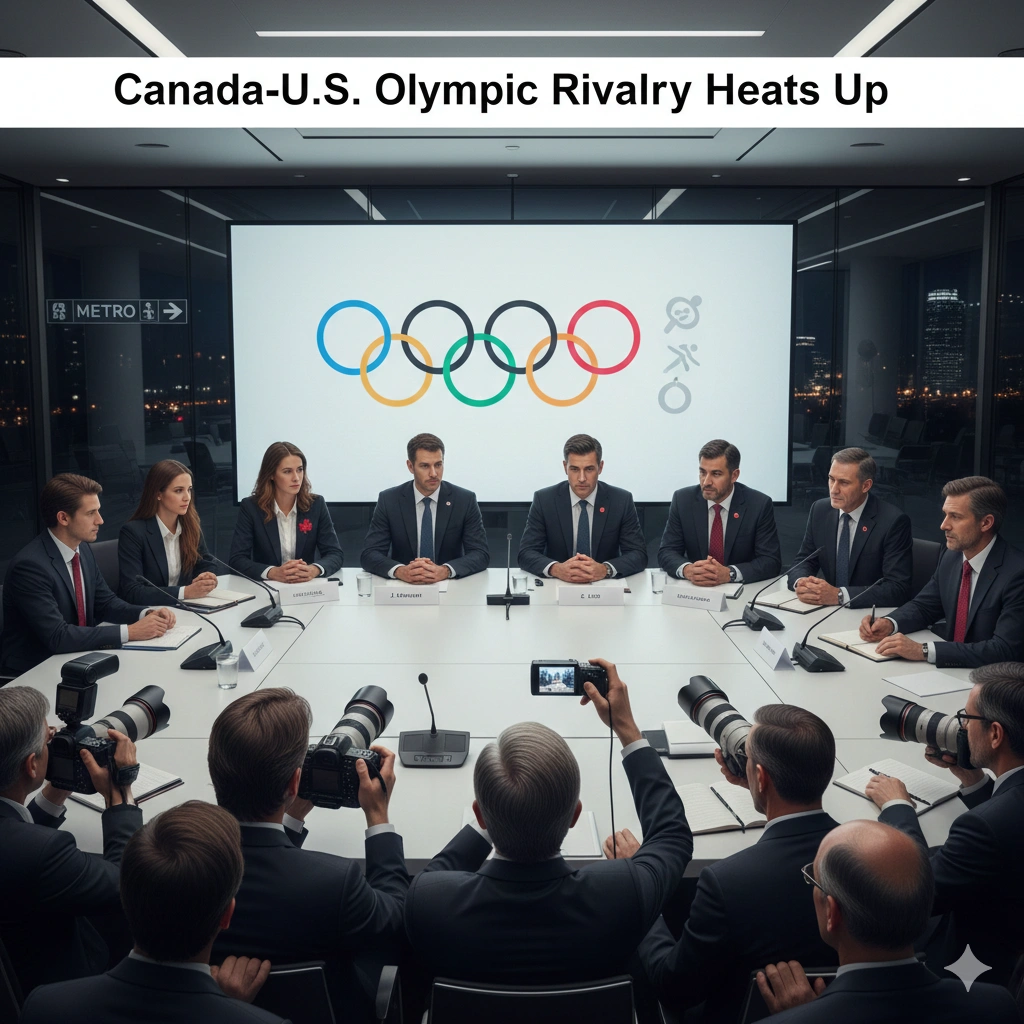
“Elbows Up” Question Dominates Team Canada Presser
The question immediately drew attention because “elbows up” has evolved beyond its sporting origins. In recent months, it has circulated as a defiant slogan in Canadian political and cultural spaces, reflecting frustration with U.S. rhetoric toward Canada.
Canadian Olympic Committee CEO David Shoemaker responded by emphasizing that athletes remain focused on performance rather than political messaging. However, he acknowledged that the rivalry with the United States currently feels more emotionally charged than usual, given the broader political climate surrounding bilateral relations.
While Shoemaker avoided endorsing the slogan directly, his comments reflected an awareness that the Canada-U.S. rivalry is no longer confined to sport alone.
Political Rhetoric Adds New Dimension to Olympic Rivalry
According to Reuters, the heightened atmosphere has been fueled in part by remarks from U.S. President Donald Trump, who has once again floated the idea of Canada becoming the “51st state.” Though widely dismissed in Ottawa, the comments have resonated strongly within Canadian public discourse.
As a result, what might once have been playful Olympic banter is now being interpreted through a geopolitical lens. The Canada-U.S. rivalry at Milano Cortina 2026 is emerging as a symbolic battleground where national identity, political tensions, and sporting excellence intersect.
This dynamic illustrates a broader trend in international sport, where high-profile competitions increasingly mirror diplomatic relationships between nations.
Women’s Hockey: The Premier Olympic Rivalry
Nowhere is the rivalry more intense than in women’s hockey, which Shoemaker described as the premier rivalry in the sport globally. Since women’s hockey debuted at the Olympics in 1998, Canada has captured five Olympic gold medals, while the United States has won the remaining two.
Canada enters Milano Cortina as the reigning Olympic champion, reinforcing expectations of another high-stakes showdown. The two teams have been drawn into the same preliminary group and are scheduled to meet early in the tournament, creating one of the most anticipated matchups of the Games.
The early clash ensures that political subtext and competitive pressure will collide well before the medal rounds begin.
Men’s Hockey Record Highlights Canadian Dominance
On the men’s side, historical results also favor Canada. Reuters notes that Canada has won nine Olympic gold medals, compared to just two for the United States. Despite that record, both nations failed to reach the podium at the 2022 Beijing Winter Olympics, adding further urgency to their Milano Cortina campaigns.
The shared disappointment in Beijing has intensified expectations that both programs will seek redemption in Italy, further sharpening the competitive edge of their encounters.
Sport, National Identity, and Geopolitics Converge
The evolving narrative around the Canada-U.S. rivalry at Milano Cortina 2026 highlights how global sporting events increasingly serve as platforms for national expression. While athletes and officials continue to emphasize competition over politics, external rhetoric has made complete separation difficult.
For Canada, maintaining focus while navigating heightened symbolism will be a delicate balance. For audiences worldwide, the rivalry offers a compelling lens through which to view how sport reflects shifting geopolitical realities.
Conclusion
As the Milano Cortina Winter Olympics approach, the Canada-U.S. rivalry is already taking on added significance. The “elbows up” question at Team Canada’s press conference underscores how political narratives are bleeding into one of the Olympics’ most storied sporting relationships.
With early matchups looming in both women’s and men’s hockey, the rivalry is poised to deliver not only elite competition but also moments shaped by national pride and political context.
For more details & sources visit: Reuters
For more updates and related stories, visit our Canada News page.