
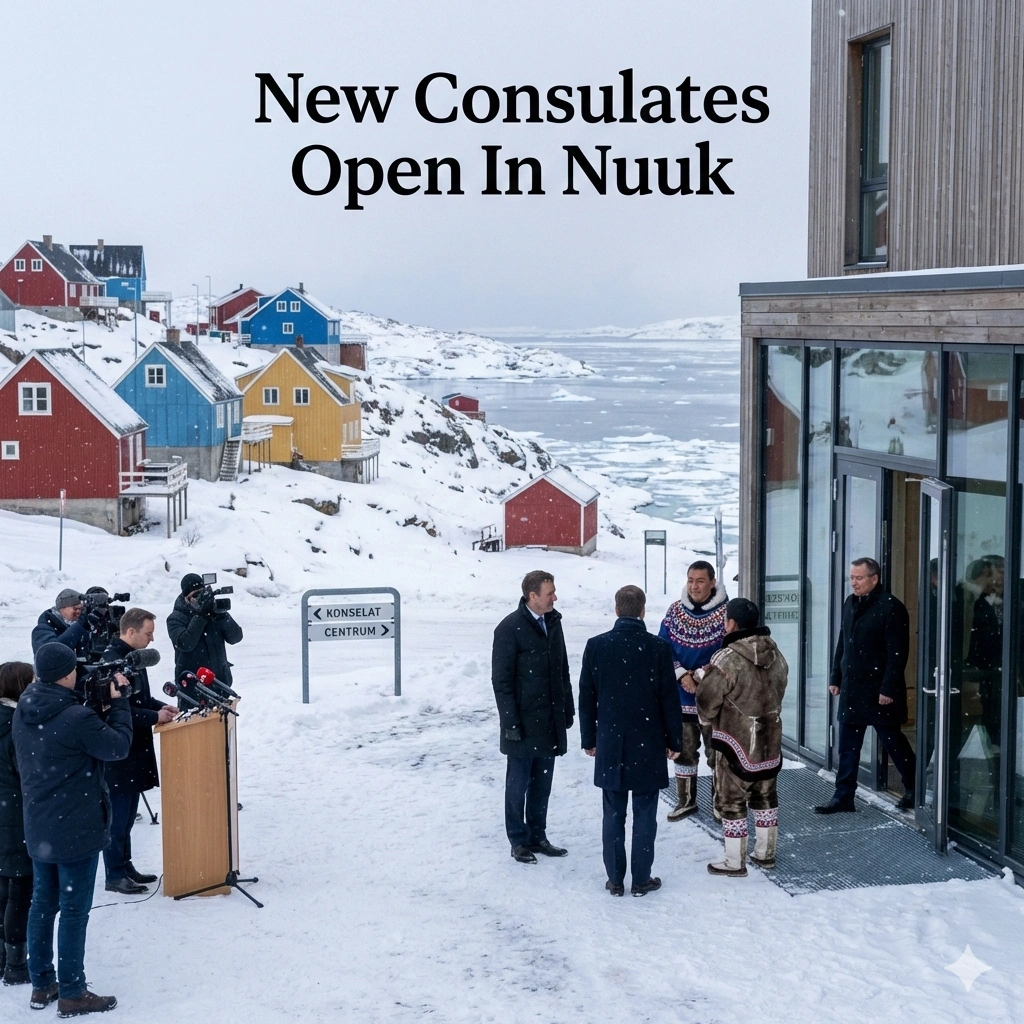
France and Canada open Nuuk consulates in a clear signal that Greenland has moved to the center of global geopolitical attention. The decision reflects rising international competition in the Arctic, renewed U.S. interest in Greenland, and growing concerns over security, sovereignty, and strategic access in the High North.
The opening of these diplomatic missions marks a significant shift in how Western allies are engaging with Greenland, a semi-autonomous territory within the Kingdom of Denmark whose strategic importance continues to grow as climate change opens new Arctic routes and intensifies military interest in the region.
Why France and Canada Open Nuuk Consulates Now
The timing of the consulate openings is far from coincidental. Greenland has been under renewed global scrutiny following former U.S. President Donald Trump’s revived interest in acquiring the island, a move that unsettled European allies and reignited debates over Arctic sovereignty.
By choosing to deepen their presence in Nuuk, France and Canada are reinforcing their commitment to Greenland’s political status within Denmark, while also signaling that Arctic security can no longer be treated as a peripheral issue.
Canada’s Foreign Minister Anita Anand, alongside Governor General Mary Simon, is attending the inauguration of Canada’s new consulate. The visit includes high-level meetings with Denmark’s Foreign Minister Lars Løkke Rasmussen and Greenland’s Foreign Minister Vivian Motzfeldt, underscoring a coordinated diplomatic push across allied capitals.
Arctic Security and the Growing Strategic Value of Greenland
Greenland’s importance lies not only in its geography but also in its role as a gateway between North America and Europe. As ice coverage continues to retreat, the Arctic is becoming more accessible for shipping, resource exploration, and military operations.
When France and Canada open Nuuk consulates, they are positioning themselves closer to a region that is rapidly evolving into a strategic crossroads. Arctic security discussions now extend beyond environmental concerns to include:
- Military mobility and surveillance
- Critical infrastructure protection
- Allied coordination within NATO frameworks
- Monitoring increased activity from Russia and China
These developments make diplomatic engagement on the ground more essential than ever.
France’s Expanding Naval Presence in the High North
France’s move into Nuuk aligns with its broader military posture in the North Atlantic. Recent reporting highlights the deployment of the aircraft carrier Charles de Gaulle toward northern waters as part of allied exercises.
This expanded naval presence sends a strong message: France intends to remain a serious Arctic actor, capable of projecting power and contributing to regional stability. The diplomatic footprint in Greenland complements this military strategy, reinforcing France’s long-term interest in the High North.
Canada’s Arctic Strategy and Indigenous Diplomacy
For Canada, opening a consulate in Nuuk reflects both strategic and cultural priorities. Canada views itself as an Arctic nation, and strengthening ties with Greenland supports cooperation on Indigenous issues, environmental protection, and regional governance.
Governor General Mary Simon’s participation is particularly symbolic, highlighting shared Inuit heritage across Arctic communities. This approach blends hard security concerns with people-to-people diplomacy, reinforcing Canada’s credibility as a responsible Arctic stakeholder.
Denmark and Greenland Welcome Allied Engagement
From Copenhagen’s perspective, the decision by France and Canada to expand their diplomatic presence reinforces Denmark’s sovereignty over Greenland at a time of increasing external pressure.
Greenland’s government has also welcomed the move, viewing it as an opportunity to diversify partnerships, attract investment, and gain a stronger voice in international forums discussing Arctic affairs.
The presence of multiple allied consulates helps normalize Greenland’s role as a diplomatic hub rather than a geopolitical prize.
What This Means for Arctic Geopolitics
As France and Canada open Nuuk consulates, the Arctic is entering a new phase of international engagement. The region is no longer a distant frontier but a central arena where diplomacy, security, and climate change intersect.
Key implications include:
- Stronger Western coordination on Arctic security
- Reduced space for unilateral pressure on Greenland
- Greater emphasis on multilateral governance
- Long-term diplomatic competition in the High North
These shifts suggest that Arctic diplomacy will intensify in the coming years, with Greenland playing an increasingly influential role.
Conclusion
The decision by France and Canada to open Nuuk consulates is more than a diplomatic formality—it is a strategic response to rising Arctic tensions and growing global competition. By strengthening ties with Greenland and Denmark, both countries are reinforcing allied unity while adapting to a rapidly changing geopolitical landscape.
As security concerns, climate realities, and great-power interests converge in the Arctic, Nuuk is emerging as a key diplomatic focal point in the High North.
For more details & sources visit: Reuters
For more updates and related stories, visit our Canada News page.