
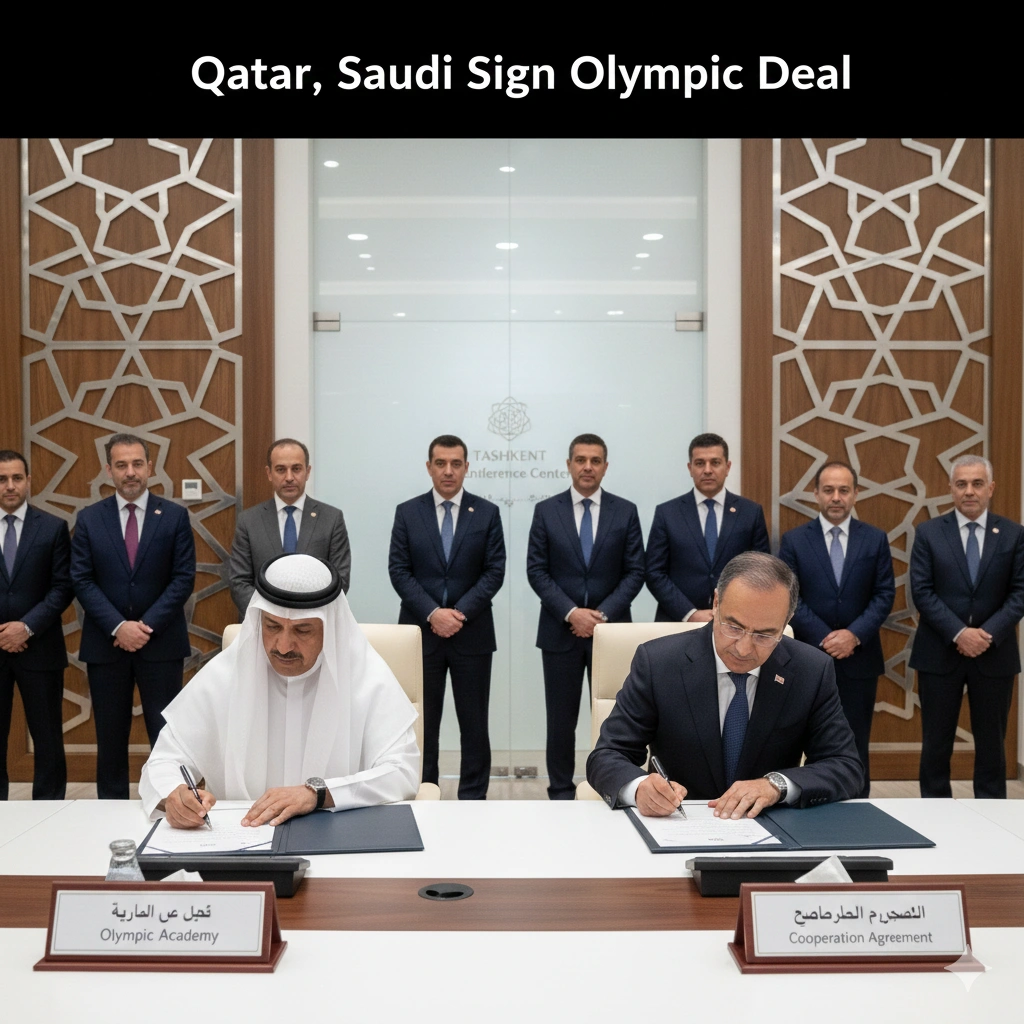
The Qatar Saudi Olympic cooperation agreement marks a major step in enhancing sports training, education, and leadership development across the Gulf. Signed at the 46th General Assembly of the Olympic Council of Asia (OCA) in Tashkent, the deal formalizes collaboration between the Qatar Olympic Academy and the Saudi Olympic Academy, aligning with Qatar National Vision 2030 and Saudi Vision 2030 objectives.
Joint Training and Knowledge Exchange Initiatives (H2)
A central pillar of the Qatar Saudi Olympic cooperation is joint training programs designed to develop the next generation of sports professionals. Both academies will host courses, seminars, and workshops for coaches, administrators, and sports staff across a range of disciplines.
The agreement includes:
- Mutual invitations to attend each country’s programs and events
- Joint training sessions emphasizing advanced methodologies
- Workshops on priority issues such as sports education, program development, and administrative challenges
These initiatives aim to address regional and global shortages of qualified sports professionals, enhancing the overall quality of sports leadership in the Gulf.
Building Future Sports Leaders (H2)
Through the Qatar Saudi Olympic cooperation, both academies plan to roll out specialized programs to qualify and certify sports staff. This includes developing coaching expertise across disciplines, fostering leadership skills, and promoting knowledge transfer between professionals in Qatar and Saudi Arabia.
By focusing on human resource development in sports, the agreement ensures sustainable growth and strengthens regional capacity to host international competitions and support athlete performance.
Strategic Alignment with Vision 2030 (H3)
The partnership reflects broader national priorities:
- Qatar National Vision 2030: Emphasizes sport as a driver of human and social development, promoting health, education, and community engagement
- Saudi Vision 2030: Aims to diversify the economy through sports, entertainment, and youth empowerment
The cooperation demonstrates how sports can serve as both a cultural bridge and a strategic economic tool, fostering regional collaboration while supporting national development agendas.
Expanding Gulf and Regional Collaboration (H3)
By enhancing sports cooperation between Qatar and Saudi Arabia, the academies are strengthening Gulf regional ties. Knowledge-sharing, collaborative training, and professional exchanges help unify standards across academies and improve competitive performance in regional and international events.
Joint workshops and programs are expected to include:
- Curriculum development for sports education
- Administrative training for academy managers
- Exchange of best practices for coaching, athlete management, and program evaluation
This partnership is poised to create a ripple effect, raising sports standards across the Gulf and increasing global visibility for regional talent.
Responding to Global Sports Challenges (H2)
The Qatar Saudi Olympic cooperation also addresses broader challenges in the sports sector, including:
- Post-pandemic recovery for training programs
- Shortages of qualified coaches and administrators
- Evolving technical requirements for high-performance sports
By collaborating, the academies can pool resources, adopt innovative approaches, and implement solutions that benefit athletes, coaches, and administrators throughout the Gulf region.
Conclusion: Qatar Saudi Olympic Cooperation as a Model for Gulf Sports Development (H2)
The Qatar Saudi Olympic cooperation initiative represents a strategic approach to advancing sports training, education, and leadership in the Gulf. By combining expertise, knowledge, and human capital, both countries are paving the way for stronger regional collaboration, enhanced professional development, and alignment with their respective Vision 2030 goals.
This partnership not only strengthens the sports ecosystem but also demonstrates the role of regional cooperation in fostering sustainable development, social growth, and international competitiveness in athletics.
For more details, see the Qatar News Agency report.
For more news, visit 360 News Orbit.