
Iraq post-crisis economic hurricane risks pushing the country toward widespread social fragmentation and institutional breakdown unless urgent, transparent reforms are implemented, according to leading Iraqi economist Manar Al-Obaidi. In a stark warning issued on January 31, 2026, Al-Obaidi argued that Iraq has moved beyond a traditional economic crisis into a far more dangerous and uncontrollable phase.
He described the current situation as a “post-crisis hurricane” — a stage where exhausted state resources, eroded public trust, and unresolved corruption converge to threaten national stability. Without decisive action, he warned, Iraq could face severe social disintegration and long-term security risks.
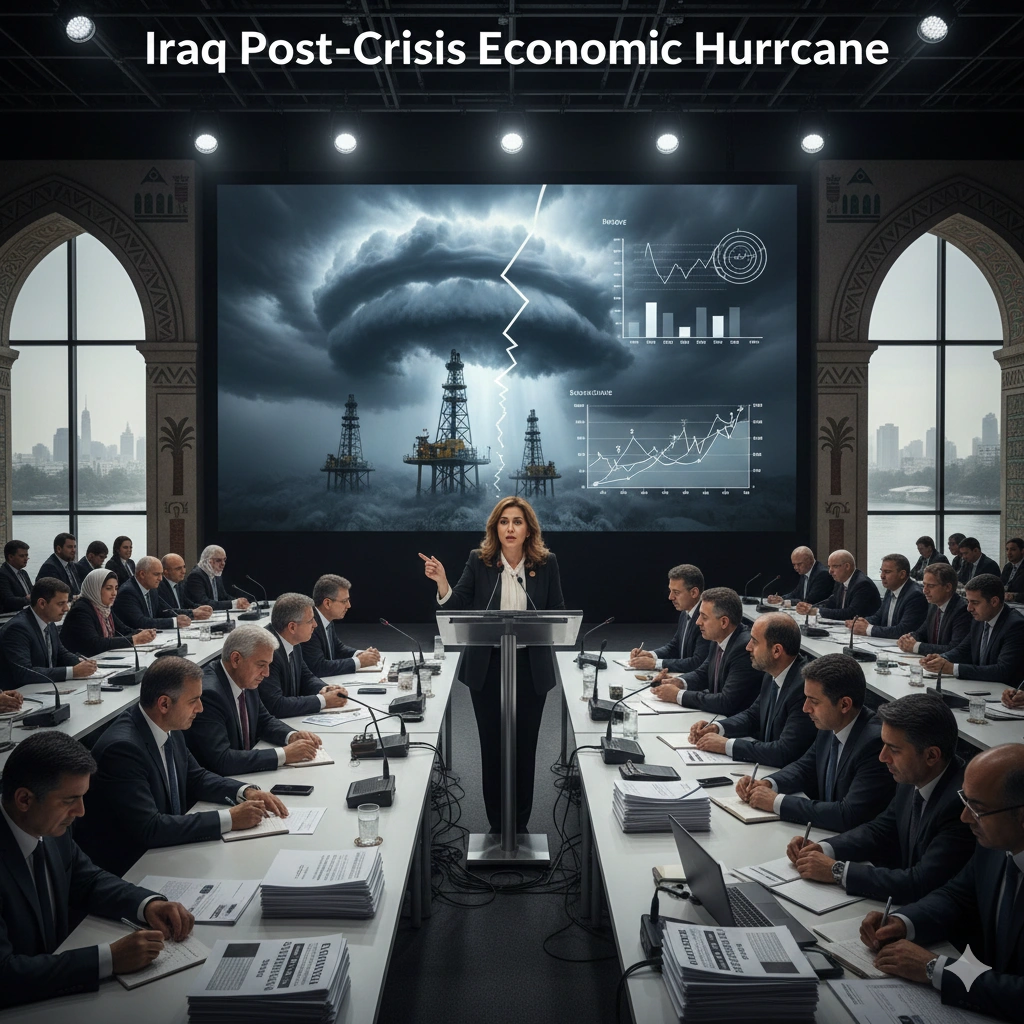
Iraq’s Economy Beyond Crisis: Entering the “Hurricane Phase”
Al-Obaidi emphasized that Iraq is no longer dealing with short-term financial stress or cyclical downturns. Instead, the country has entered a phase where economic shocks compound existing institutional weaknesses, leaving the state with few remaining tools to stabilize society.
Public trust, he noted, has deteriorated to such an extent that citizens now view government salary payments as their only tangible connection to the state. This fragile relationship places enormous pressure on Iraq’s finances, especially as payroll obligations continue to grow without corresponding productivity or revenue diversification.
According to Al-Obaidi, the illusion of stability maintained through temporary fixes has reached its limit. Delaying structural reforms, he warned, will only intensify the damage once financial buffers are depleted.
Transparency as the Only Exit Strategy
At the heart of Al-Obaidi’s warning lies a call for radical transparency. He urged Iraqi authorities to fully disclose all national budgets dating back to 2003, arguing that accountability is essential to restoring credibility and halting institutional decay.
Reopening long-dormant corruption files, he stressed, is not optional but a prerequisite for survival. Without confronting past financial mismanagement, Iraq risks remaining trapped in a cycle of mistrust where reforms are blocked by public skepticism and political resistance.
Symbolic gestures alone, such as austerity measures targeting ordinary citizens, would be insufficient. Instead, Al-Obaidi proposed cutting elite privileges as an initial confidence-building step, signaling that sacrifices will be shared rather than imposed from the top down.
Structural Weaknesses Fueling the Economic Storm
The Iraq post-crisis economic hurricane is being intensified by long-standing structural flaws, many of which remain unaddressed. Chief among them is Iraq’s overdependence on oil revenues, which leaves the economy highly vulnerable to global price fluctuations.
In addition, public-sector payroll bloat continues to drain state finances, while revenue leakages — driven by inefficiency and corruption — undermine fiscal sustainability. Economists warn that Iraq’s economic model prioritizes consumption over production, limiting growth and employment opportunities.
This imbalance has left the country with few shock absorbers. When oil prices fall or external pressures mount, the consequences are immediate and severe, accelerating the downward spiral described by Al-Obaidi.
Rejecting “Sedation” and Facing Hard Truths
One of the most striking elements of Al-Obaidi’s warning was his rejection of what he termed the “sedation of public anger.” Attempts to calm public discontent without addressing root causes, he argued, only postpone the inevitable reckoning.
He cautioned against denial, political procrastination, and avoidance of necessary sacrifices. Ignoring the economic storm, he warned, could transform financial distress into a broader national security crisis, marked by social unrest, weakened state authority, and increased vulnerability to instability.
This perspective has been echoed by other Iraqi economists, who argue that the cost of inaction now far outweighs the political risks of reform.
What the Warning Means for Iraq’s Future
If left unaddressed, the Iraq post-crisis economic hurricane could reshape the country’s political and social landscape. Continued erosion of trust may block reform entirely, while economic stress could amplify divisions across class and regional lines.
However, Al-Obaidi stressed that the crisis still presents a narrow window of opportunity. Transparent governance, real accountability, and structural economic reform could stabilize Iraq and prevent collapse — but only if action is swift and comprehensive.
As Iraq stands at this critical juncture, the choice is stark: confront the storm head-on or risk being overwhelmed by it.
For more details & sources visit: Iraqi News