
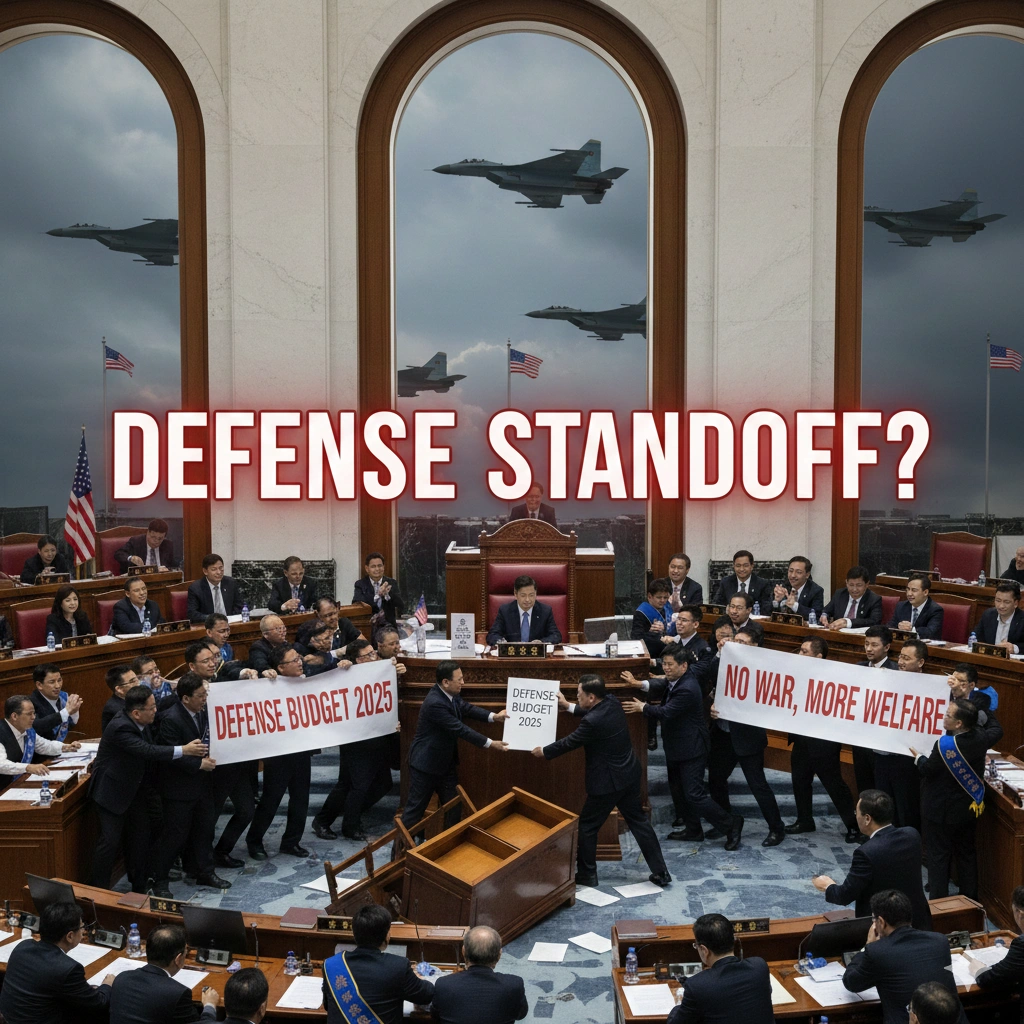
Taiwan defense spending has become the center of a fierce political confrontation as President Lai Ching-te’s proposed $40 billion military funding package faces repeated rejection from opposition lawmakers. The prolonged standoff is raising serious concerns about Taiwan’s national security preparedness at a time of escalating pressure from China and heightened expectations from the United States.
As President Lai marked his first year in office, he emphasized the urgency of strengthening Taiwan’s military capabilities to deter potential aggression from Beijing. His administration proposed an eight-year, $40 billion special defense fund aimed at modernizing the armed forces and increasing defense expenditures to 5% of Taiwan’s GDP by 2030—a benchmark increasingly viewed by security experts as necessary for credible deterrence.
What the Defense Spending Plan Includes
The proposed boost in Taiwan defense spending focuses on asymmetric warfare capabilities designed to counter China’s rapidly expanding military power. Key investments include:
- Advanced missile defense systems
- Precision-guided munitions
- Unmanned aerial vehicles (drones)
- Enhanced surveillance and command systems
Defense planners argue these systems are essential to offset China’s numerical and technological advantages, particularly as Beijing continues to expand its naval, air, and missile forces in the Taiwan Strait.
Opposition Resistance and Legislative Gridlock
Despite the administration’s warnings, opposition parties—the Kuomintang (KMT) and the Taiwan People’s Party (TPP)—have blocked the bill more than eight times since December. Lawmakers from both parties have cited concerns over transparency, fiscal discipline, and executive overreach.
Opposition leaders have demanded that President Lai personally appear before the legislature to provide a detailed breakdown of how the funds would be allocated. Some critics have labeled the proposal a “blank check,” arguing that such large-scale Taiwan defense spending could undermine social programs or worsen long-term debt.
These objections come amid broader political tensions, including disputes over budget authority and the balance of power between Taiwan’s executive and legislative branches.
Historical Parallels Raise Alarm
The current impasse closely mirrors political gridlock from the early 2000s under former President Chen Shui-bian, when similar partisan disputes delayed or weakened major arms procurement deals with the United States. Those delays ultimately reduced Taiwan’s military readiness during a critical period.
Experts warn that repeating this pattern today would be far more dangerous. Unlike two decades ago, China now possesses advanced missile systems, stealth aircraft, cyberwarfare capabilities, and a rapidly modernizing navy—dramatically altering the strategic landscape.
U.S. Pressure and Alliance Stakes
The United States has openly supported President Lai’s defense initiative, viewing increased Taiwan defense spending as a key indicator of Taipei’s commitment to self-defense. U.S. officials have noted that an $11 billion arms sale currently in progress requires Taiwan to secure sufficient domestic funding to proceed.
Under renewed strategic pressure from Washington—particularly amid a Trump-led U.S. administration—Taiwan faces growing expectations to demonstrate resolve. Failure to pass the defense package could strain U.S.–Taiwan relations and weaken deterrence against Beijing.
At the same time, opposition-led impeachment efforts against members of the executive branch have further deepened institutional rifts, complicating any path toward compromise.
A Strategic and Political Dilemma
Analysts describe the situation as a high-stakes dilemma. Blocking the bill could signal weakness to both allies and adversaries, potentially emboldening China. Passing it without broader consensus, however, risks domestic backlash and long-term political fallout.
Ultimately, the debate over Taiwan defense spending underscores a larger challenge: whether Taiwan’s political system can unite in the face of mounting external threats. As tensions in the region continue to rise, internal divisions may prove just as consequential as military hardware.
For more, visit 360 News Orbit