
The Trump–Nawrocki Davos meeting has ignited intense debate across Europe, as U.S. President Donald Trump held a rare closed-door discussion with Polish President Karol Nawrocki during the World Economic Forum in Davos. The high-profile encounter has fueled speculation that Washington may be encouraging a sovereigntist bloc within the European Union—one that could weaken Brussels’ unity at a critical geopolitical moment.
The meeting, notable for its exclusivity, places Poland at the center of a growing transatlantic political realignment driven by nationalism, defense autonomy, and skepticism toward EU federalism.
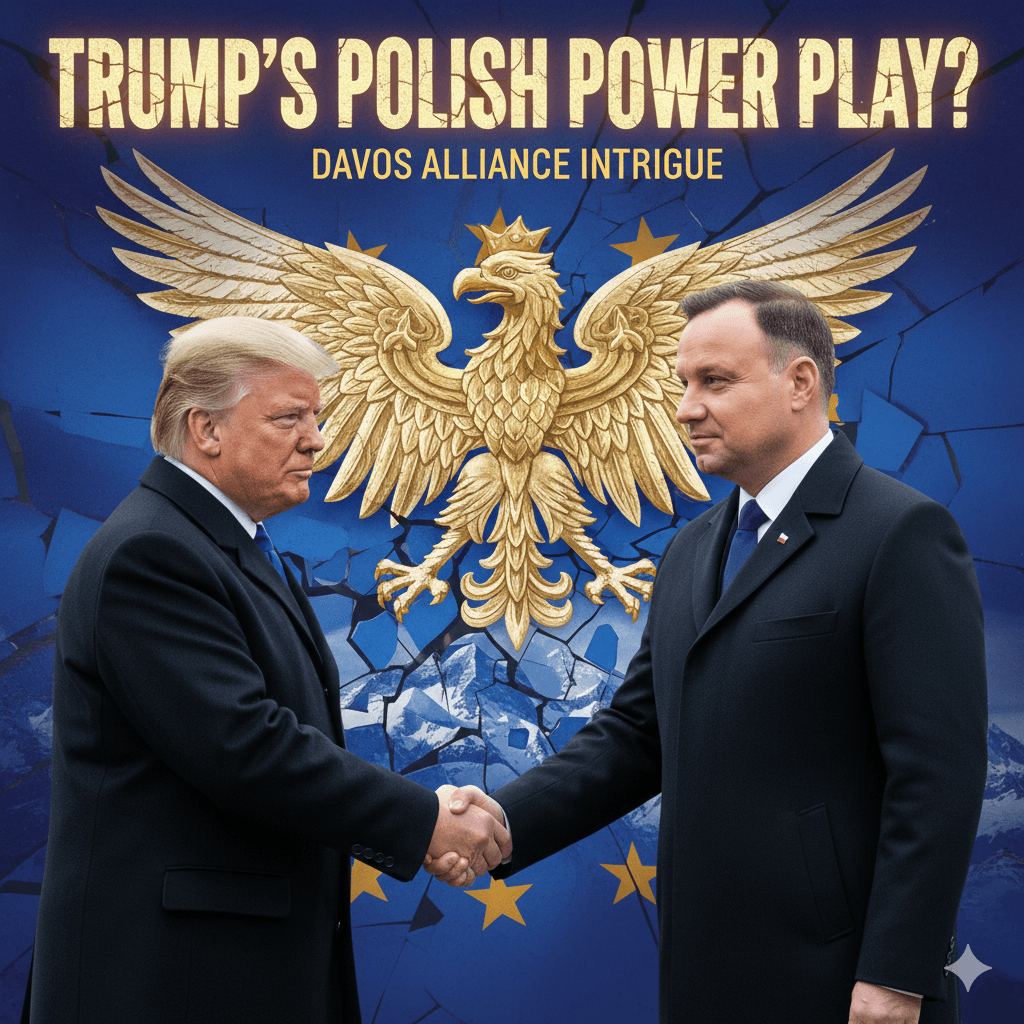
A Rare One-on-One at Davos Raises Eyebrows
Trump’s private meeting with Nawrocki stood out amid a packed Davos schedule that included leaders such as Ukrainian President Volodymyr Zelenskyy, NATO Secretary-General Mark Rutte, and the heads of Switzerland, Egypt, and Belgium. Unlike standard diplomatic encounters, the Trump–Nawrocki discussion took place without press access or official readouts, intensifying speculation about its purpose.
Nawrocki later shared a celebratory photo from the meeting on social media, calling the talks “successful” while praising Trump’s leadership on global security and sovereignty.
Poland’s Nationalist Pivot and NATO First Strategy
President Nawrocki has positioned himself as one of Europe’s most outspoken nationalist leaders, frequently criticizing what he describes as the EU’s “wrong direction.” At Davos, he reiterated Poland’s commitment to:
- Spending 5% of GDP on defense
- Strengthening bilateral ties with the United States
- Relying on NATO over EU defense structures
Nawrocki has repeatedly argued that only Trump can effectively deter Russian President Vladimir Putin, a stance that resonates with right-leaning governments across Central and Eastern Europe.
The “Board of Peace” Controversy
A key topic surrounding the Trump–Nawrocki Davos meeting is Trump’s proposed “Board of Peace,” an alternative global security forum that critics say could undermine existing institutions such as the United Nations.
Poland has reportedly received an invitation to join the initiative, following Hungary’s participation. However, the proposal has sparked internal friction within Poland, where Prime Minister Donald Tusk’s pro-EU government must approve any formal involvement.
France and other EU states have sharply criticized the Board of Peace, warning it could legitimize authoritarian regimes and fracture international consensus.
Brussels Fears an Emerging Euroskeptic Axis
Political analysts believe Trump’s outreach to Nawrocki is part of a broader strategy to engage nationalist leaders who challenge Brussels’ authority. According to European affairs commentators, the meeting signals:
- Growing U.S. support for EU-skeptical governments
- Increased pressure on EU cohesion ahead of key elections
- A shift toward bilateral power politics over multilateral governance
The concern is that such alliances could weaken coordinated EU responses on defense, sanctions, and foreign policy.
Poland’s Domestic Political Tensions Deepen
While Nawrocki’s meeting with Trump bolsters his standing among conservative voters, it has widened rifts at home. The Polish Foreign Ministry has expressed caution over deepening ties with Trump-led initiatives, particularly those that could strain relations with Brussels or Paris.
This internal divide mirrors broader European tensions between nationalist and federalist visions of the continent’s future.
Why the Trump–Nawrocki Davos Meeting Matters
The significance of the Trump–Nawrocki Davos meeting extends beyond symbolism. It highlights a potential realignment where:
- National sovereignty trumps EU integration
- Defense policy shifts toward U.S.-led frameworks
- Populist leaders gain legitimacy on the global stage
As Europe grapples with war in Ukraine, economic uncertainty, and security challenges, the emergence of parallel power structures could reshape the continent’s political landscape for years to come.
Outlook: A Fractured or Reforged Europe?
Whether the Trump–Nawrocki relationship leads to lasting geopolitical change remains uncertain. However, the Davos meeting has already sent a clear signal: Europe’s internal divisions are no longer theoretical—they are being actively courted and amplified on the world stage.
With elections approaching across the EU and NATO facing renewed pressure, the ripple effects of this alliance may only just be beginning.
For more news, visit 360 News Orbit