
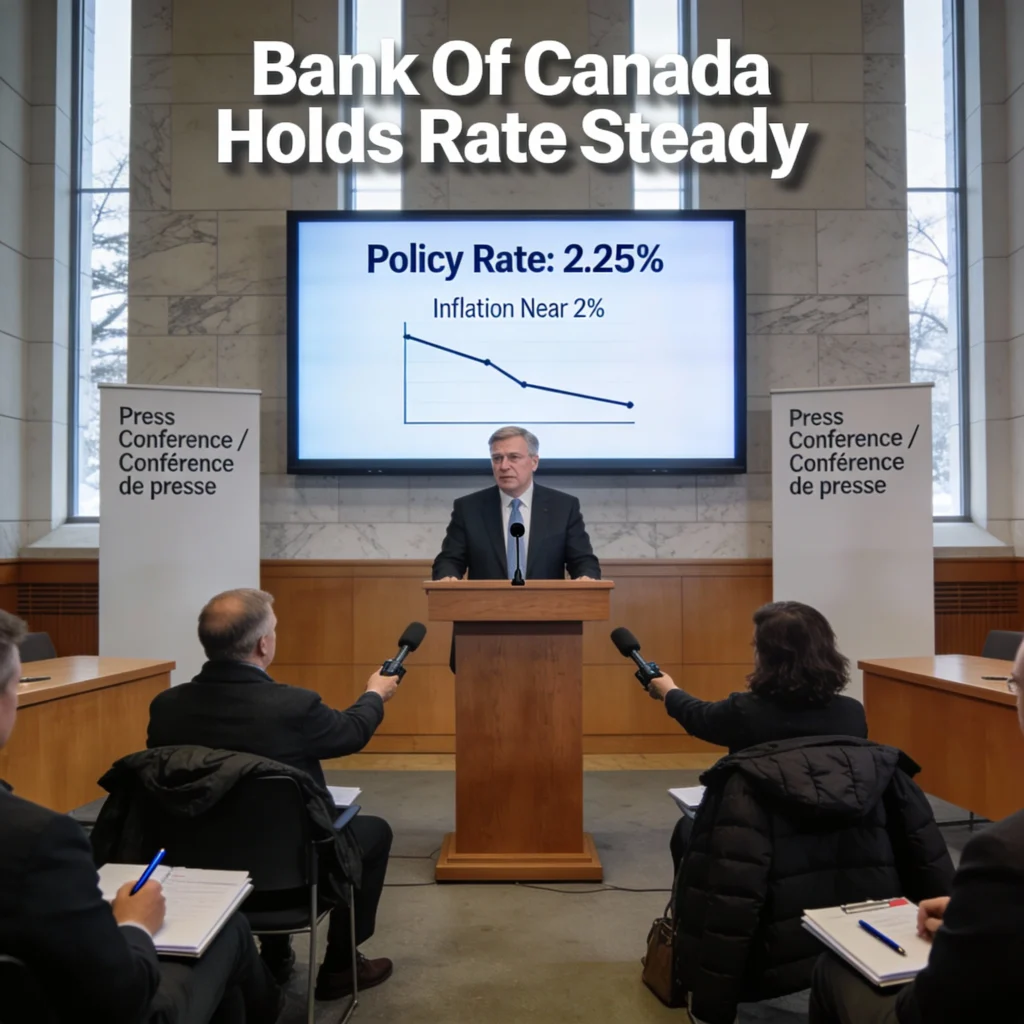
The Bank of Canada interest rates were kept unchanged at 2.25% on January 30, 2026, reflecting ongoing uncertainty in the economy as businesses adjust to U.S. tariffs and trade-policy risks. This marks the second consecutive rate hold, consistent with market expectations, as Governor Tiff Macklem emphasized that it is still “too early” to determine the full impact of tariffs on Canadian economic activity.
The central bank also maintained its Bank Rate at 2.5% and deposit rate at 2.20%. The decision underscores a cautious approach, balancing moderate inflation near the 2% target with slower domestic growth and trade-related pressures.
Economic Outlook: Modest Growth Amid Trade Pressures
In its January 2026 outlook, the Bank projected Canada’s GDP growth at 1.1% for 2026 and 1.5% for 2027. The economy is adjusting to U.S. protectionist measures, slower population growth, and softer domestic demand. These projections highlight the central bank’s expectation of modest expansion, rather than a rapid rebound, over the coming years.
Governor Macklem also cited the upcoming Canada–U.S.–Mexico agreement review as a key risk factor, noting that ongoing trade negotiations could influence both business investment and overall economic performance. Businesses are being advised to prepare for continued volatility in import and export costs.
Inflation Trends and Rate Decision Rationale
December 2025 inflation rose slightly to 2.4%, partially due to base-year effects linked to the previous winter’s GST/HST holiday. Meanwhile, core inflation measures eased to a range of 2.5%–2.7% by year-end.
The Bank of Canada interest rates decision reflects a balancing act: while trade-related costs could drive prices up, excess supply and softer demand help offset inflationary pressures. The central bank forecasts inflation to remain close to its 2% target throughout its projection period, ensuring price stability while supporting measured economic growth.
Market and Business Implications
The decision to hold rates steady provides clarity to financial markets but highlights ongoing uncertainties for Canadian businesses. Companies facing higher costs from tariffs must adapt gradually to remain competitive, while investors monitor how monetary policy interacts with economic growth forecasts.
Financial analysts emphasize that while overnight rates remain moderate, the trajectory of Bank of Canada interest rates will depend heavily on trade developments, inflation trends, and population-driven demand shifts. Market participants are advised to stay alert for the next scheduled rate announcement on March 18, 2026.
Preparing for Future Rate Adjustments
While the rate hold indicates short-term stability, businesses and households should plan for potential adjustments if trade tensions intensify or inflation deviates from expectations. Maintaining liquidity, revising budgets, and anticipating interest-sensitive costs will be essential strategies for navigating this uncertain period.
The central bank’s cautious stance also signals its willingness to respond incrementally, rather than rushing rate hikes or cuts, as Canada navigates both global trade risks and domestic economic adjustments.
Conclusion
The Bank of Canada interest rates decision to hold at 2.25% demonstrates a careful approach in managing inflation and growth amid U.S. tariff pressures and trade-policy uncertainties. By maintaining rates, the central bank aims to support the economy while monitoring risks that could affect Canadian businesses and households.
As the economy adjusts, future Bank of Canada interest rates announcements will remain closely watched, with implications for borrowing costs, investment decisions, and the overall stability of the Canadian financial system.
For more details & sources visit: Bank of Canada
For more updates and related stories, visit our Canada News page.