
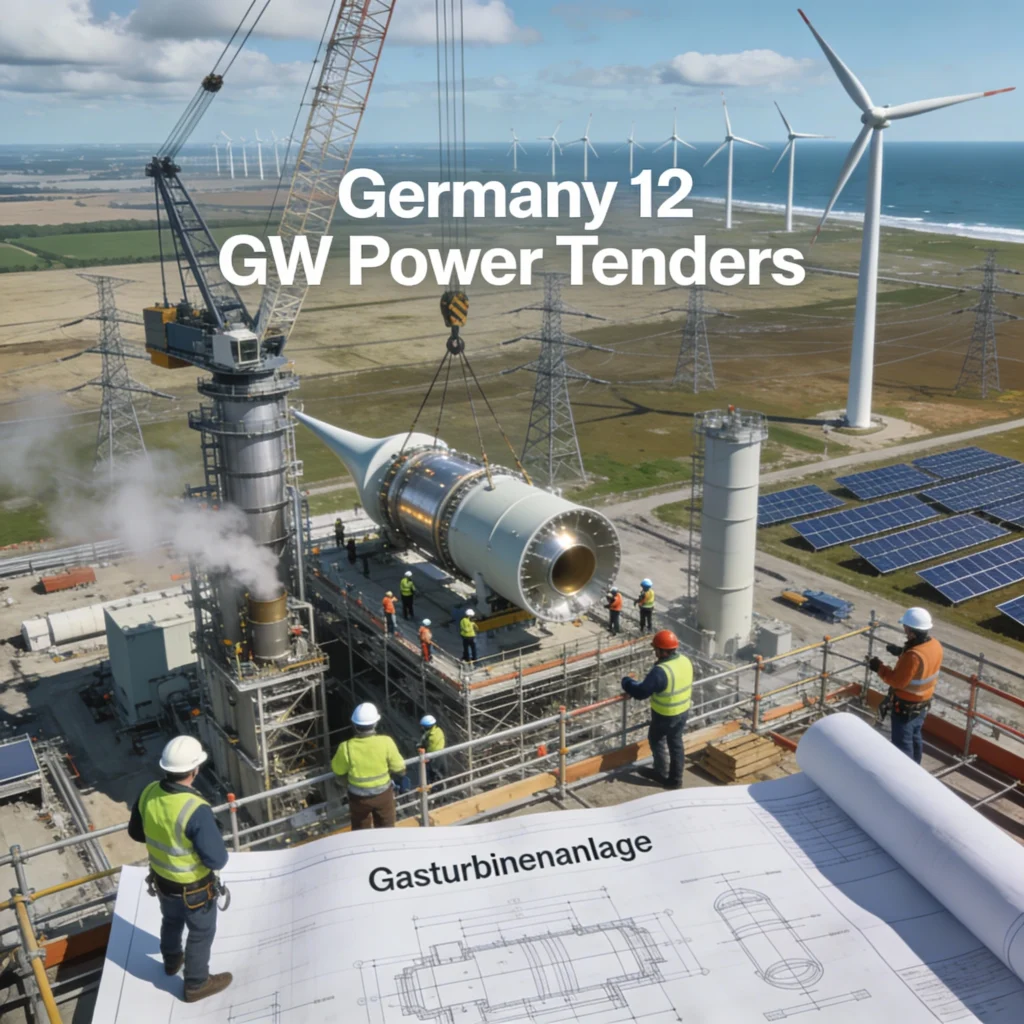
The German government is moving ahead with Germany gas power plant tenders, announcing plans to launch bids for 12 gigawatts (GW) of new gas-fired power capacity in 2026. The initiative is aimed at stabilizing the country’s electricity system as renewable energy sources expand and coal generation continues to be phased out.
Economy Minister Katherina Reiche confirmed the plan while speaking at the Handelsblatt Energy Summit in Berlin, describing the new plants as a critical support mechanism during periods when wind and solar output falls sharply.
New Capacity to Back Up Variable Renewables
According to Reiche, the Germany gas power plant tenders will prioritize flexible gas-fired facilities, which are considered well-suited to complement renewable energy due to their ability to ramp output up or down quickly.
She noted that in 2025 there were around 40 days when renewable generation dropped below 20% of total electricity output, exposing vulnerabilities in the power system. These shortfalls, she said, underscored the need for dependable backup capacity to maintain grid stability and prevent supply disruptions.
The new plants are expected to operate primarily during low-renewable periods rather than as constant baseload generators.
Hydrogen-Ready Design Supports Climate Targets
A central feature of the Germany gas power plant tenders is the requirement that new facilities be hydrogen-ready, allowing them to transition to low-carbon fuels as hydrogen infrastructure develops.
Germany has committed to achieving carbon neutrality by 2045, and officials say the tender strategy aligns with that long-term objective. By designing plants that can later shift from natural gas to hydrogen, Berlin aims to balance near-term energy security with future decarbonization.
Reiche emphasized that gas-based generation is being positioned as a transitional solution, not a reversal of Germany’s climate commitments.
Multi-Year Tender Plan Extends Beyond 2026
While the initial 12 GW of capacity will be tendered this year, Reiche confirmed that additional bidding rounds are planned for 2027 and 2028. The phased approach is intended to provide clarity to investors and ensure that sufficient capacity comes online as coal-fired plants are retired.
The framework builds on European Union–approved mechanisms, allowing Germany to support power generation investments while remaining compliant with EU competition and state-aid rules.
Energy Security and Industrial Competitiveness
The Germany gas power plant tenders are also framed as a measure to protect industrial competitiveness, particularly for energy-intensive sectors affected by power price volatility.
With renewable capacity expanding rapidly, officials argue that backup generation is essential to avoid supply bottlenecks that could undermine economic stability. Reiche highlighted that ensuring a reliable power system is critical as Germany restructures its energy mix and accelerates its transition away from coal.
Conclusion
Germany’s decision to advance gas power plant tenders marks a significant step in managing the challenges of an energy system increasingly dominated by renewables. By combining flexible gas capacity with hydrogen-ready technology, Berlin aims to secure electricity supplies while keeping its 2045 net-zero target firmly in sight.
As the tenders progress and additional rounds follow, the strategy is expected to play a key role in maintaining grid reliability during Germany’s ongoing energy transition.
For more details & sources visit: DW
For the latest news from Germany, visit our Germany news page.