
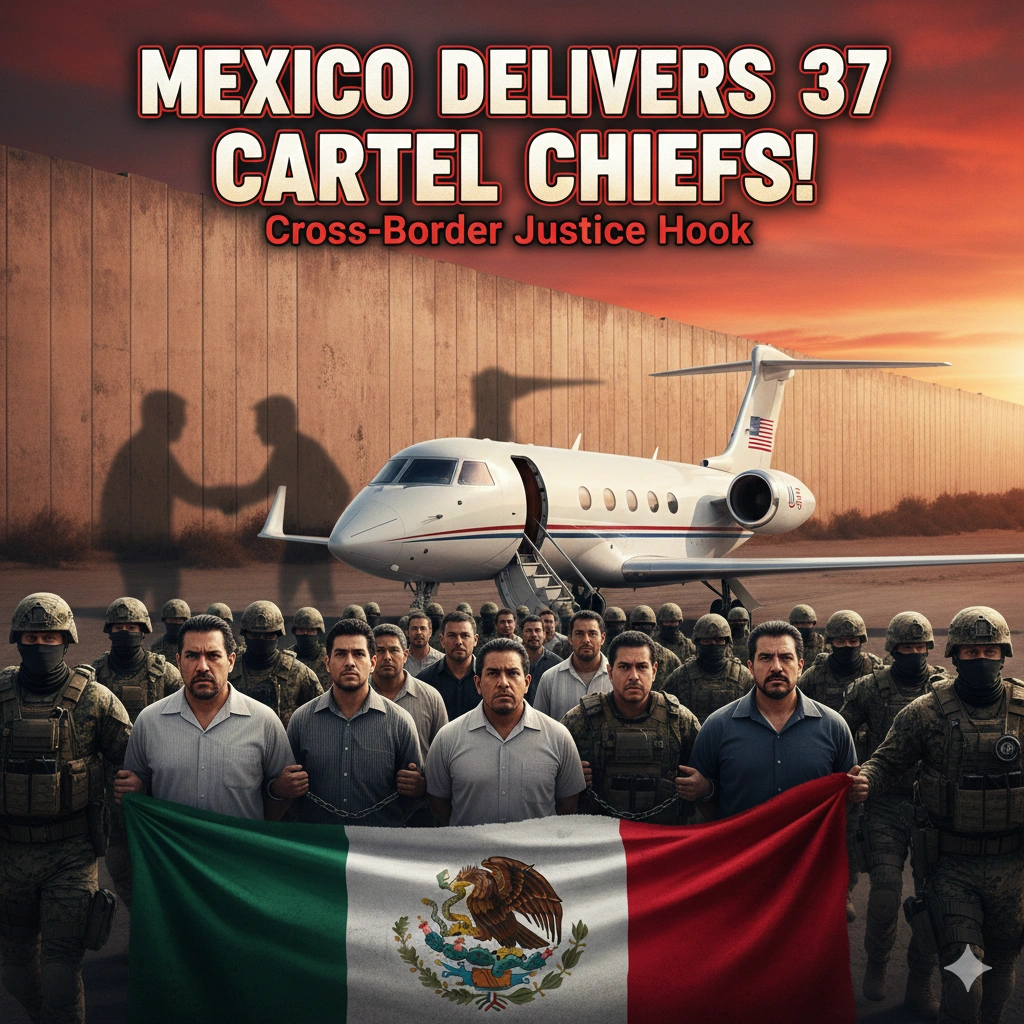
Mexico Hands 37 Kingpins to Trump in a high-profile law enforcement action that has ignited debate over sovereignty, bilateral cooperation, and national security. On January 20, 2026, Mexico transferred 37 alleged leaders and operatives of major drug cartels — including the Jalisco New Generation Cartel (CJNG) and the Sinaloa Cartel — to the United States to face prosecution under American federal law. Mexican President Claudia Sheinbaum framed the move as a sovereign decision designed to bolster Mexico’s own security framework rather than capitulate to external pressure.
This latest transfer marks the third such mass relocation of cartel figures during Sheinbaum’s administration, bringing the total to at least 92 individuals handed over to U.S. authorities on cartel-related charges. The operation has drawn significant attention in both countries for its size, legal implications, and political symbolism amid an evolving U.S.–Mexico security partnership.
A Strategic Choice Amid Increasing U.S. Pressure
The 37 individuals were delivered into U.S. custody following legal requests from the U.S. Department of Justice, which has labeled the CJNG, the Sinaloa Cartel, and other groups involved in narcotics trafficking as terrorist-linked organizations. At least one key figure — Armando Gómez Núñez, a senior CJNG operative — reportedly faces charges involving drugs, machine guns, and explosives in U.S. courts.
While critics accused Mexico of yielding to pressure from President Donald Trump’s administration — which has repeatedly warned of escalated action against cartel networks, including threats of armed intervention — Sheinbaum maintained that the decision emerged from analysis by Mexico’s National Security Council and was “convenient for Mexico’s security” rather than dictated by Washington. She emphasized that the move was sovereign in nature and aligned with national interests.
Diplomatic Dynamics and Domestic Debate
The timing of the transfers comes amid frosty rhetoric over U.S. military pressure following operations such as the U.S. raid in Venezuela — actions that have reverberated across Latin America and raised concerns about sovereignty and non-intervention. In this context, Mexico’s decision reflects a delicate balancing act: cooperating with U.S. justice systems while asserting national authority in its security policymaking.
Supporters argue that removing high-level cartel suspects helps dismantle transnational criminal enterprise networks and reduces the risk of violence and corruption within Mexican prisons. U.S. officials, including Attorney General Pam Bondi, celebrated the move as a “landmark” victory in the broader war against terror-linked cartels, underscoring gains for law enforcement cooperation.
Legal and Security Implications
The transfer of cartel kingpins bypassed standard extradition procedures in some cases, instead relying on legal frameworks such as Mexico’s National Security Law, which permits expedited removal of individuals deemed serious threats to public safety. This approach has generated debate among legal experts, who note the complexities of sovereignty, due process, and international legal norms in cross-border law enforcement cooperation.
Despite political critiques at home — including from opposition lawmakers who argue Mexico should retain jurisdiction — Sheinbaum’s administration defended the operation as part of an integrated strategy to combat illicit trafficking, dismantle trafficking structures, and curb cartel influence both domestically and regionally. She insisted that many of those transferred were already subject to U.S. indictment and that the decision was evaluated through a sovereign lens.
Broader Context and Future Outlook
This mass transfer is part of a broader pattern of U.S.–Mexico collaboration on cartel prosecutions, even as tensions remain over military and security policy. Analysts view the operation not simply as a concession but as a pragmatic response to shared challenges, including the trafficking of fentanyl and other hard drugs that have contributed to public health crises in the United States and violence in Mexico.
Whether this approach represents a lasting framework for bilateral cooperation or sparks deeper debates over autonomy and cross-border security policy remains to be seen. What is clear is that Mexico Hands 37 Kingpins to Trump symbolizes a significant moment in the contested and high-stakes effort to confront organized crime across the hemisphere.
For more news, visit 360 News Orbit