
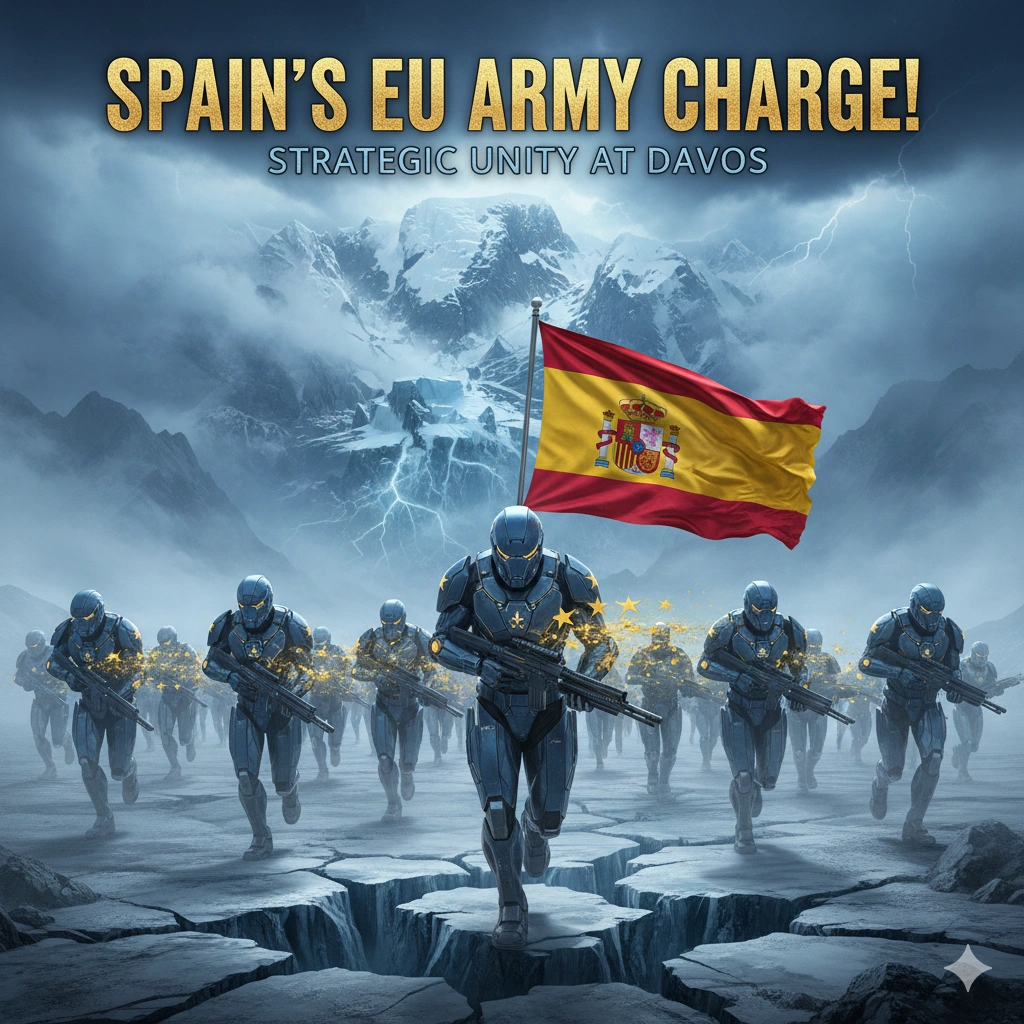
Spain is spearheading a push for a unified EU Army, signaling a bold strategy to consolidate European defense capabilities amid geopolitical tensions following the U.S.-Netherlands “Greenland truce.” Spanish Foreign Minister Jose Manuel Albares emphasized that Europe must move beyond 27 independent national forces toward a coordinated “coalition of willing” capable of rapid, decisive action in crises.
The announcement, delivered ahead of the Davos 2026 summit, reflects Spain’s commitment to strengthening Europe’s strategic autonomy and reducing vulnerability to external political pressures. Albares underscored that pooling defense assets, integrating military-industrial capacity, and coordinating operations are essential for Europe to remain both militarily and economically uncoercible.
From Delhi to Davos: Spain’s Defense Diplomacy
Albares’s EU Army proposal comes shortly after strategic talks with India’s External Affairs Minister Subrahmanyam Jaishankar during his visit to Delhi. He stressed that Europe must demonstrate independence first through industrial coordination and defense production before relying on political agreements.
“The citizen debate is legitimate,” Albares noted, acknowledging domestic scrutiny over national sovereignty and military contributions. Nevertheless, he insisted that EU institutional momentum surpasses fragmented national agendas, reinforcing Spain’s leadership in advancing continental defense integration.
Historical Roots and NATO Considerations
The concept of a European army has deep historical roots. Albares framed the EU Army initiative as a modern revival of post-World War II integration efforts, which faced setbacks such as the French veto in 1954.
Despite advocating for independent EU capabilities, Spain emphasizes that cooperation with NATO remains crucial. Albares welcomed the possibility of dialogue pathways with NATO allies, signaling a balanced approach that harmonizes EU ambitions with transatlantic commitments.
The recent Brussels emergency huddle in response to the Greenland developments demonstrates Europe’s urgent need to assert unity, even under U.S. pressure. Leaders are focused on ensuring the bloc can act decisively while maintaining diplomatic channels with NATO members.
EU Army: Deterrence, Industry, and Strategic Autonomy
The proposed EU Army is envisioned as a deterrent force capable of collective action rather than relying on fragmented national militaries. By pooling resources, integrating industrial capacities, and establishing rapid-response units, Europe could achieve significant military and economic leverage.
Spain emphasizes that integrated defense strengthens Europe’s diplomatic influence, allowing the bloc to negotiate from a position of strength rather than dependency. Albares highlighted that such a structure would future-proof Europe against coercion like that experienced during the Greenland negotiations.
Political and Economic Implications
Beyond military readiness, the EU Army could drive industrial innovation, boost employment in high-tech defense sectors, and ensure that Europe maintains competitive advantage in aerospace, cyber, and emerging technologies. Spain argues that this approach strengthens not just defense, but also Europe’s broader economic sovereignty.
Next Steps and Summit Outlook
The EU Army proposal will be a key topic at the upcoming EU summit, where member states will discuss operational feasibility, budget allocation, and command structures. Spain aims to implement pilot programs under the “coalition of willing” framework, allowing motivated countries to lead early integration efforts.
By combining political will, industrial coordination, and military capability, Spain’s vision for a unified EU Army represents a decisive step toward true European strategic autonomy.
For more news, visit 360 News Orbit