
Trump Chagos Islands controversy erupted after former U.S. President Donald Trump condemned the UK’s decision to hand over sovereignty of the Chagos Islands to Mauritius, calling the move a “great stupidity” and linking it to wider U.S. strategic concerns.
Trump accused Britain of undermining Western security by relinquishing control of the strategically vital archipelago, while simultaneously urging Denmark and the European Union to “wise up” over what he framed as urgent U.S. geopolitical needs.
The remarks stunned UK officials, coming after earlier indications that Trump had privately endorsed the Chagos deal during a February White House meeting with Prime Minister Keir Starmer.
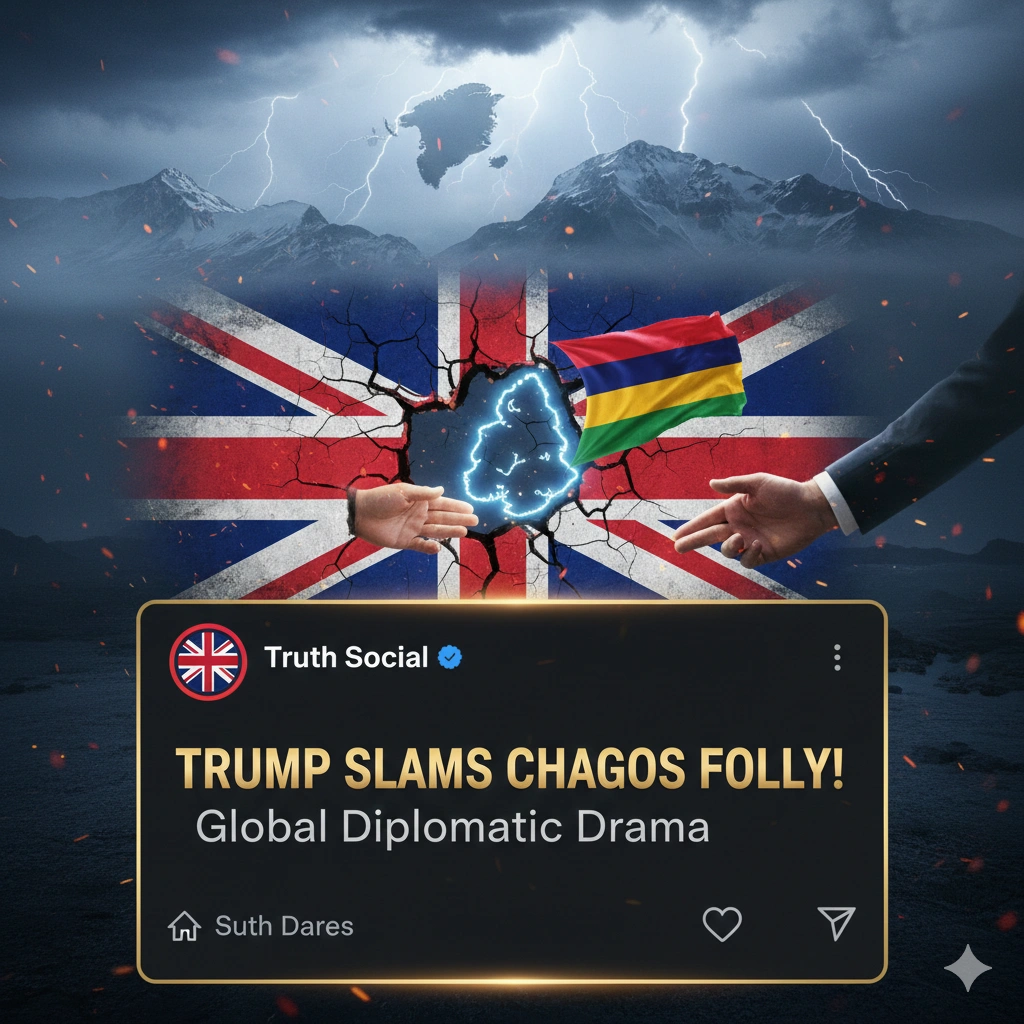
Trump Chagos Islands Criticism Sparks Transatlantic Tension
Trump’s attack centered on Britain’s agreement with Mauritius, under which London formally ends its claim over the British Indian Ocean Territory (BIOT)—a possession held since 1814—while retaining access to the critical Diego Garcia military base.
Under the deal:
- The UK will lease Diego Garcia for 99 years
- Britain will pay approximately £101 million per year
- Total lease cost reaches £3.4 billion
- Chagossians will be allowed resettlement on other islands, though not Diego Garcia itself
Trump dismissed the arrangement as unnecessary and dangerous, arguing it weakens Western leverage at a time of rising Chinese influence in the Indian Ocean.
Greenland Returns to Trump’s Strategic Narrative
In an unexpected escalation, Trump linked the Chagos decision to his broader critique of Europe’s resistance to U.S. strategic ambitions—reviving his controversial call for American control of Greenland.
Trump suggested that European allies routinely misjudge global security priorities, framing Greenland as vital to Arctic defense, energy routes, and missile tracking. His renewed rhetoric echoes his 2019 proposal to purchase Greenland, which was flatly rejected by Denmark and widely mocked at the time.
By pairing the Chagos handover with Greenland, Trump signaled a return to his transactional foreign policy worldview, where territorial control and hard power dominate diplomatic considerations.
UK Government Defends the Chagos Agreement
The UK government has firmly rejected Trump’s characterization of the deal, arguing that the Trump Chagos Islands criticism overlooks key legal and security considerations. Officials insist the agreement was reached to:
- Comply with international law
- Protect long-term U.S. and UK security interests
- Resolve decades-long disputes linked to Britain’s colonial legacy
In 2019, the International Court of Justice (ICJ) issued a non-binding advisory opinion urging the UK to end its administration of the Chagos Islands as rapidly as possible. While successive Conservative governments resisted implementing the ruling, the Labour government under Keir Starmer moved forward after securing firm security guarantees.
UK officials stress that the deal has backing from the United States, Five Eyes intelligence partners, as well as India and Japan. They also emphasize that Diego Garcia remains fully operational as a joint UK–U.S. military facility, despite concerns raised in the Trump Chagos Islands debate.
Political Fallout in London
The agreement has ignited fierce debate within the UK. Conservative critics argue the handover represents a dangerous precedent, potentially emboldening rivals such as China.
Labour, however, maintains that resolving the Chagos issue strengthens Britain’s moral authority while preserving defense infrastructure. Officials point to forced evictions of Chagossians in the 1960s, when islanders were removed to make way for the base, as a longstanding injustice that demanded resolution.
Trump’s reversal—after reportedly approving the deal earlier—has added to political unease in Westminster, especially amid broader transatlantic strains.
Why Trump’s Chagos Comments Matter
Trump’s remarks are significant for three reasons:
- They signal a possible shift in U.S. foreign policy tone should he regain power.
- They revive unresolved debates about territorial sovereignty vs. strategic necessity.
- They expose growing fractures between the U.S. and Europe on global security priorities.
Analysts warn that such rhetoric could complicate diplomatic cooperation at a time when Western allies face mounting pressure across multiple regions.
For more details & sources visit: The Independent
For more updates about the United Kingdom, visit our UK news page.