
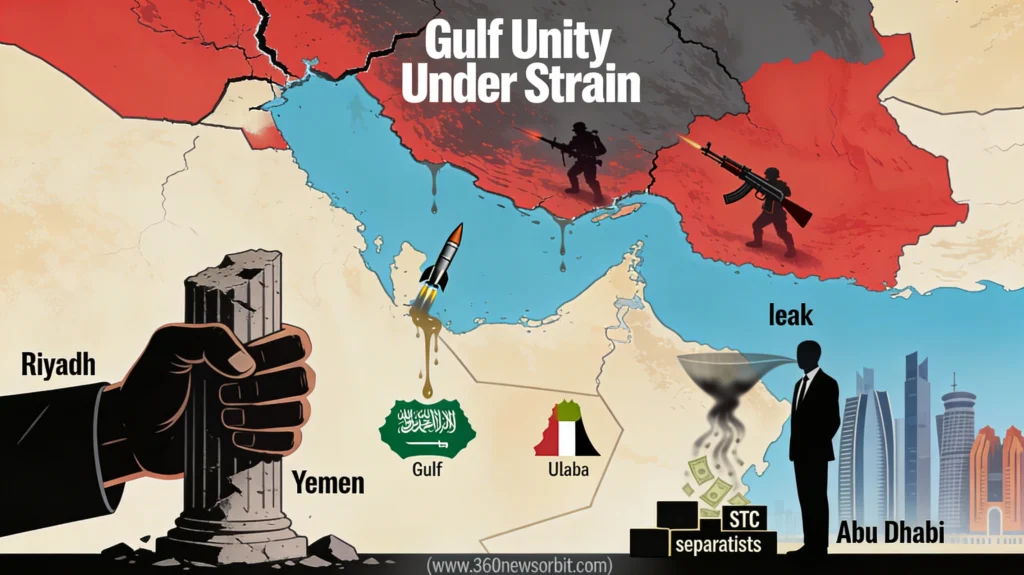
Saudi op-ed UAE proxy plays have drawn renewed attention after Saudi commentator Ali Shihabi warned that funding militias across fragile Middle Eastern states is fueling long-term instability rather than security. Written by prominent Saudi commentator Ali Shihabi, the article argues that regional chaos is not caused by flawed states, but by their collapse, often accelerated by the funding of militias and non-state actors.
The commentary urges Gulf and regional powers to prioritize strong, legitimate states over armed factions, warning that short-term tactical gains achieved through proxy forces often lead to long-term instability, fragmentation, and insecurity across the region.
Saudi Op-Ed UAE Proxy Plays and Regional Disorder
In the op-ed, Shihabi outlines how the Middle East’s most persistent crises stem from the erosion of state authority. When governments collapse or weaken, the vacuum is quickly filled by militias, traffickers, and extremist groups. These actors thrive in disorder, turning instability into a self-sustaining system.
The Saudi position, as described in the article, emphasizes preserving borders, institutions, and state legitimacy. From Riyadh’s perspective, even imperfect governments are preferable to total collapse, which often results in refugee flows, arms smuggling, and cross-border militancy that destabilizes neighboring countries.
This worldview places Saudi Arabia in the role of a regional buffer, absorbing the consequences of failed states more directly than many others.
Criticism of UAE’s Militia-Based Strategy
A central theme of the Saudi op-ed criticizing UAE proxy plays is the concern over what Shihabi refers to as “checkbook militarization.” He argues that funding and empowering militias in fragile states such as Yemen, Libya, Sudan, and Somalia may offer tactical influence but ultimately undermines national institutions.
According to the op-ed, backing separatist or factional forces can:
- Create war economies dependent on prolonged conflict
- Hollow out civilian governance structures
- Delay political settlements by fragmenting authority
Shihabi contrasts this approach with state-centered investment, pointing to examples such as development and economic support for Egypt as a more sustainable path to influence.
Yemen as the Core Flashpoint
Yemen is presented as the most urgent and sensitive case. The op-ed highlights how advances by the Southern Transitional Council (STC) weaken unity among anti-Houthi forces and complicate peace negotiations.
Given Saudi Arabia’s direct geographic exposure along the Yemeni border, instability there carries immediate security risks. These include missile threats, cross-border attacks, and humanitarian spillovers.
Shihabi suggests that Riyadh’s interventions are driven not by dominance, but by necessity. From this perspective, fragmentation in Yemen directly threatens Saudi national security, making militia-driven strategies especially dangerous.
Geography Shapes Saudi Security Concerns
The article emphasizes that geography magnifies Saudi Arabia’s exposure to regional crises. Yemen lies directly along its southern border, while instability in Sudan affects Red Sea security and trade routes.
Because of this proximity, Saudi Arabia bears a disproportionate share of the consequences when states fail. Refugee movements, weapons trafficking, and extremist spillovers tend to impact neighboring countries first, making state preservation a strategic imperative, not an ideological choice.
Call for UAE Strategic Restraint
Rather than calling for confrontation, the op-ed urges strategic discipline and restraint, particularly from the UAE. Shihabi argues that Gulf security is best served through alignment, not competition, and that coordinated policies focused on state-building would strengthen regional influence. He warns that UAE proxy plays risk undermining this alignment, as reliance on militias can weaken institutions and destabilize neighboring states.
He stresses that Saudi-UAE alignment has historically been a source of Gulf strength. Allowing proxy rivalries to continue through UAE proxy plays could reduce both countries’ strategic leverage in the region.
Influence Comes From Governable Societies
The op-ed concludes with a broader argument about power and legitimacy. True regional influence, Shihabi contends, is not measured by control over militias or strongman figures, but by the ability to support governable, stable societies. He highlights that UAE proxy plays may create short-term influence but do not build lasting credibility or resilient institutions.
States that function, deliver services, and maintain legitimacy are far more resilient than territories controlled by armed factions. For Gulf powers seeking long-term stability and credibility, the choice is clear: states over militias.
For more details & sources visit: Arab News Pakistan
For the latest updates from Saudi Arabia, visit our Saudi Arabia page.