
Indian stocks plunge sharply as investor sentiment deteriorated on January 20, 2026, pushing benchmark indices to their lowest levels in over three months. Heavy selling pressure gripped Dalal Street after disappointing earnings from Reliance Industries, IT majors, and ICICI Bank, combined with aggressive foreign investor outflows and renewed global trade tensions.
The sell-off signals rising anxiety over India’s near-term growth outlook as global uncertainties—particularly U.S. tariff threats under President Donald Trump—rattle emerging markets worldwide.
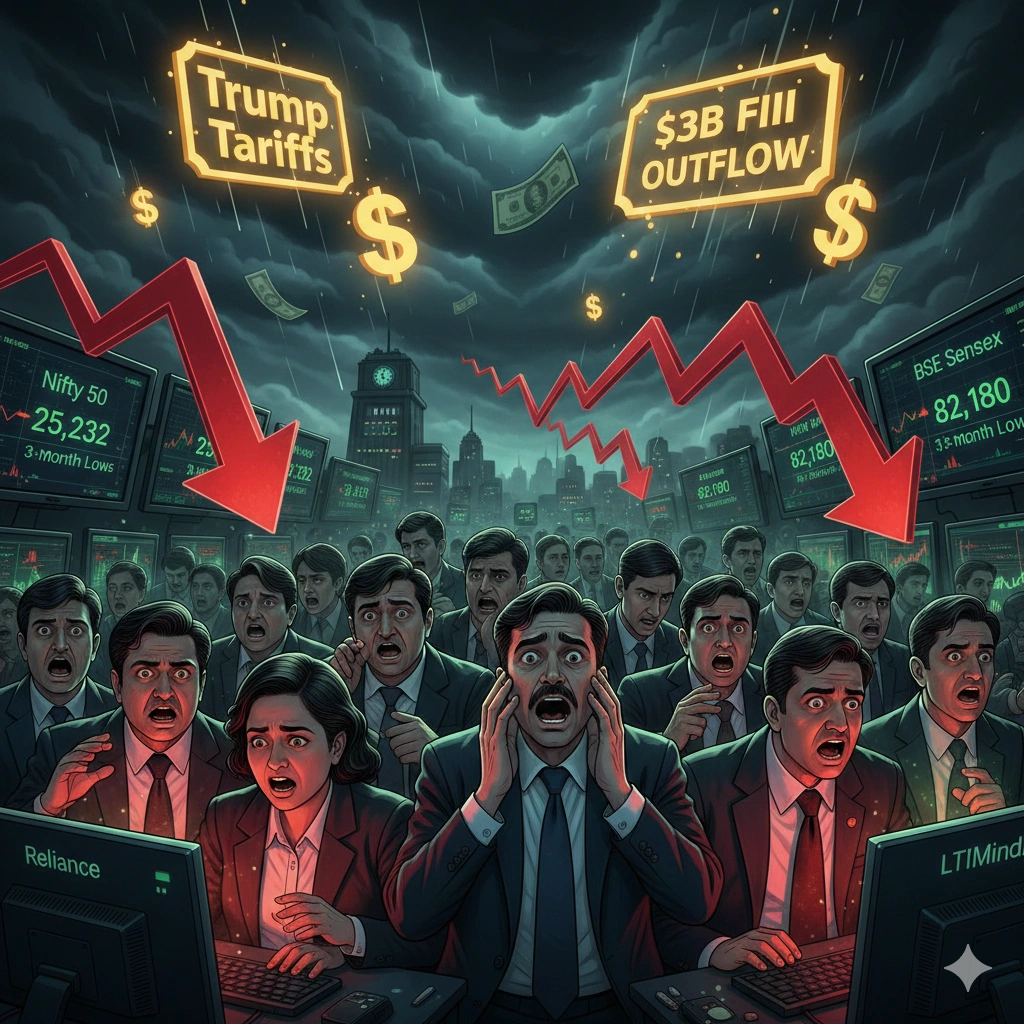
Benchmark Indices Hit 3-Month Lows
The market rout was broad and relentless:
- Nifty 50 fell 1.38% to close at 25,232.5
- BSE Sensex declined 1.28% to 82,180.47
Both indices marked their weakest closing levels in more than three months, reflecting widespread risk aversion. Selling intensified in the afternoon session as institutional investors continued to offload large-cap stocks.
IT Sector Leads Losses Amid Earnings Pressure
The IT sector bore the brunt of the decline, sliding 2.1%, as companies warned of margin pressure stemming from India’s new labor codes and softer global demand.
Key laggards included:
- LTIMindtree, which plunged 6.7%
- Wipro, down 2.5%
Analysts noted that higher compliance costs and slower deal conversions in the U.S. and Europe have begun to weigh on IT profitability. Since IT stocks are heavily dependent on overseas revenues, global trade instability further amplified investor concerns.
Reliance Industries and Banking Stocks Disappoint
Adding to the gloom, Reliance Industries slipped 1.4% after missing Q3 earnings estimates, dampening confidence in one of India’s most influential market bellwethers. Weakness in its retail and energy segments raised questions about near-term earnings momentum.
Meanwhile, ICICI Bank also reported below-par results, triggering selling across the banking sector and deepening the overall market decline. Financial stocks, often seen as economic barometers, failing to deliver strong numbers further unsettled investors.
Small-Cap and Mid-Cap Stocks Crash Harder
Beyond the benchmarks, the pain was even more severe:
- Small-cap index plunged 2.9%, hitting an eight-month low
- Mid-cap index dropped 2.6%, touching a three-month low
Out of the Nifty 500, only 28 stocks ended in positive territory, highlighting the depth and breadth of the sell-off. All 16 major sectoral indices closed in the red, signaling systemic weakness rather than stock-specific corrections.
Foreign Investors Exit Aggressively
One of the biggest drivers behind why Indian stocks plunge so sharply is sustained foreign institutional investor (FII) selling. In January alone, foreign investors have dumped nearly $3 billion worth of Indian equities, marking the largest monthly outflow since August.
The selling has been fueled by:
- Rising U.S. bond yields
- Stronger dollar trends
- Renewed tariff threats by U.S. President Donald Trump, particularly targeting the EU
- Broader concerns over global trade fragmentation
These factors have made emerging markets less attractive compared to safer developed-market assets.
Global Trade Fears Shake Investor Confidence
Global markets have been on edge as trade tensions resurface. Trump’s warnings of new tariffs on European nations have reignited fears of a broader trade slowdown, which could hurt export-driven economies like India.
As explained in global market analysis on platforms such as The Hindu BusinessLine and international financial policy coverage by organizations like the World Trade Organization (WTO), rising protectionism tends to trigger capital flight from riskier assets—something Indian markets are now experiencing firsthand.
Will This Trigger a Broader Market Rout?
Market experts caution that if foreign outflows persist and earnings disappointments continue, Indian equities could face further downside pressure in the coming weeks. While long-term fundamentals remain intact, short-term volatility is expected to stay elevated.
Investors are now closely watching:
- Global trade policy developments
- Upcoming corporate earnings
- Inflation and interest rate signals from major economies
Until clarity emerges, markets may remain under stress.
Conclusion: Indian Stocks Plunge Signals Rising Uncertainty
The sharp decline on January 20 underscores how vulnerable markets remain to a mix of earnings shocks, foreign capital exits, and global trade fears. As Indian stocks plunge to three-month lows, investor confidence is being tested across all segments—from blue-chip giants to small-cap names.
Whether this downturn evolves into a prolonged correction or stabilizes will depend largely on global cues and domestic earnings recovery in the weeks ahead.
For more details & sources visit: The Hindu BusinessLine
For the latest updates from India, visit our India news page.