
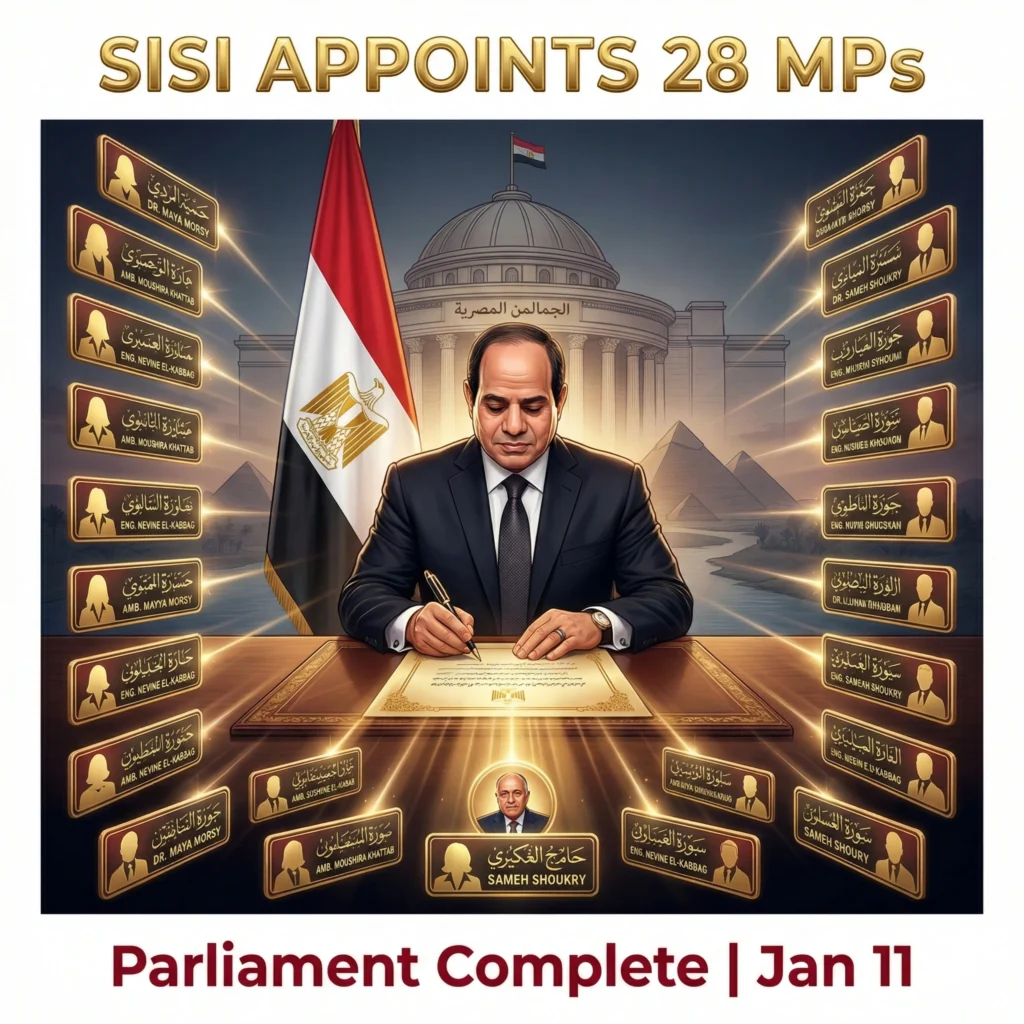
The names of appointed members of Egypt’s Parliament have officially been announced after President Abdel Fattah al-Sisi issued Decree No. 16 of 2026, appointing 28 new members to the House of Representatives. This move completes the formation of the new parliament following lengthy legislative elections and fulfills constitutional requirements related to representation, expertise, and gender balance.
Among the most notable appointees is former Foreign Minister Sameh Shoukry, whose inclusion has drawn wide attention due to his long diplomatic career and international experience. The appointments mark the final step in forming Egypt’s 596-seat parliament, reinforcing its legislative and oversight role for the coming term.
Why These Parliamentary Appointments Matter
Under Article 102 of the Egyptian Constitution, the president is permitted to appoint up to 5 percent of the total parliamentary seats. In a chamber of 596 members, this allows for a maximum of 28 appointed MPs, a limit that has now been fully utilized.
These appointments are designed to:
- Strengthen parliamentary expertise
- Include professionals from law, economics, culture, and public policy
- Ensure representation of women and underrepresented groups
- Enhance legislative oversight after elections
The names of appointed members of Egypt’s Parliament therefore carry political and institutional significance, shaping the balance and competence of the legislature.
Full List Highlights: Key Names Among the Appointees
While the full list includes 28 figures from diverse professional backgrounds, some of the most prominent names include:
- Sameh Hassan Shoukry Salim (former Minister of Foreign Affairs)
- Adila Mohamed Abdel Salam Ragab
- A total of 14 women, accounting for 50 percent of the appointees, in line with constitutional and legal requirements
The inclusion of senior diplomats, legal experts, academics, and cultural figures is intended to enrich parliamentary debate and policymaking.
Notably, the law requires that at least half of presidential appointees be women, a condition that has been fully met in this round of appointments.
Gender Representation in the New Parliament
One of the most important aspects of this decision is its impact on women’s representation. By appointing 14 women, President Sisi reinforced Egypt’s stated commitment to increasing female participation in political life.
This move aligns with broader national strategies aimed at empowering women in leadership and governance, and it strengthens Egypt’s standing on representation within legislative institutions across the region.
Election Background: How the Parliament Was Formed
The appointments come after a 99-day election process, described as one of the longest parliamentary election cycles in Egypt’s modern history.
According to the National Elections Authority, chaired by Judge Hazem Badawi:
- 69.9 million citizens were registered to vote
- 22.6 million voters participated
- 21.15 million votes were deemed valid
- Voter turnout stood at 32.41 percent
Runoff elections were required in 27 districts, delaying the final formation of parliament and extending the electoral timeline.
Seat Distribution After Elections and Appointments
With the presidential appointments finalized, Egypt’s House of Representatives now consists of:
- Nation’s Future Party: 227 seats
- Homeland Defenders Party: 87 seats
- National Front Party: 65 seats
- Independents: 103 seats
- Presidential Appointees: 28 seats
The dominance of the Nation’s Future Party highlights strong pro-government alliances, while the appointed members add non-partisan expertise to the chamber.
Role of Appointed MPs in Legislative Oversight
The names of appointed members of Egypt’s Parliament are not symbolic. Appointed MPs traditionally play a critical role in:
- Drafting and reviewing complex legislation
- Providing technical input on economic and legal reforms
- Strengthening parliamentary committees
- Addressing gaps left by electoral politics
Following election-related controversies and earlier investigations into voting irregularities, these appointments are also seen as a stabilizing factor for the new legislature.
Political Implications of the 2026 Appointments
The inclusion of high-profile figures such as Sameh Shoukry signals the leadership’s intention to integrate experienced policymakers into the legislative process. Analysts view this as an effort to:
- Enhance Egypt’s parliamentary diplomacy
- Improve the quality of foreign policy and economic legislation
- Reinforce executive-legislative coordination
At the same time, the gender balance among appointees reflects growing pressure to align governance structures with constitutional and social expectations.
Conclusion
The announcement of the names of appointed members of Egypt’s Parliament marks the final chapter in forming the 2026 House of Representatives. With 28 presidential appointees, including former Foreign Minister Sameh Shoukry and 14 women, President Sisi has completed the chamber in line with constitutional rules and political priorities.
As Egypt’s new parliament begins its work, these appointments are expected to play a key role in shaping legislation, oversight, and governance during the coming term.
For more details & sources visit: CNN Arabic
For the latest updates from Egypt, visit our Egypt news page.