
Pakistan’s two largest gas utilities are under intense scrutiny after fresh data revealed that Pakistan gas giants rake 21% profits under the current fixed-return pricing framework regulated by the Oil and Gas Regulatory Authority (Ogra). The controversy, surfacing on January 12, 2026, has reignited debate over whether guaranteed returns are stifling efficiency while inflating consumer gas bills during an ongoing energy crisis.
According to official figures, Sui Northern Gas Pipelines Limited (SNGPL) and Sui Southern Gas Company (SSGC) recorded a combined Rs56 billion in profits in FY25, prompting policymakers, energy experts, and private sector players to question the sustainability and fairness of Ogra’s pricing formula.
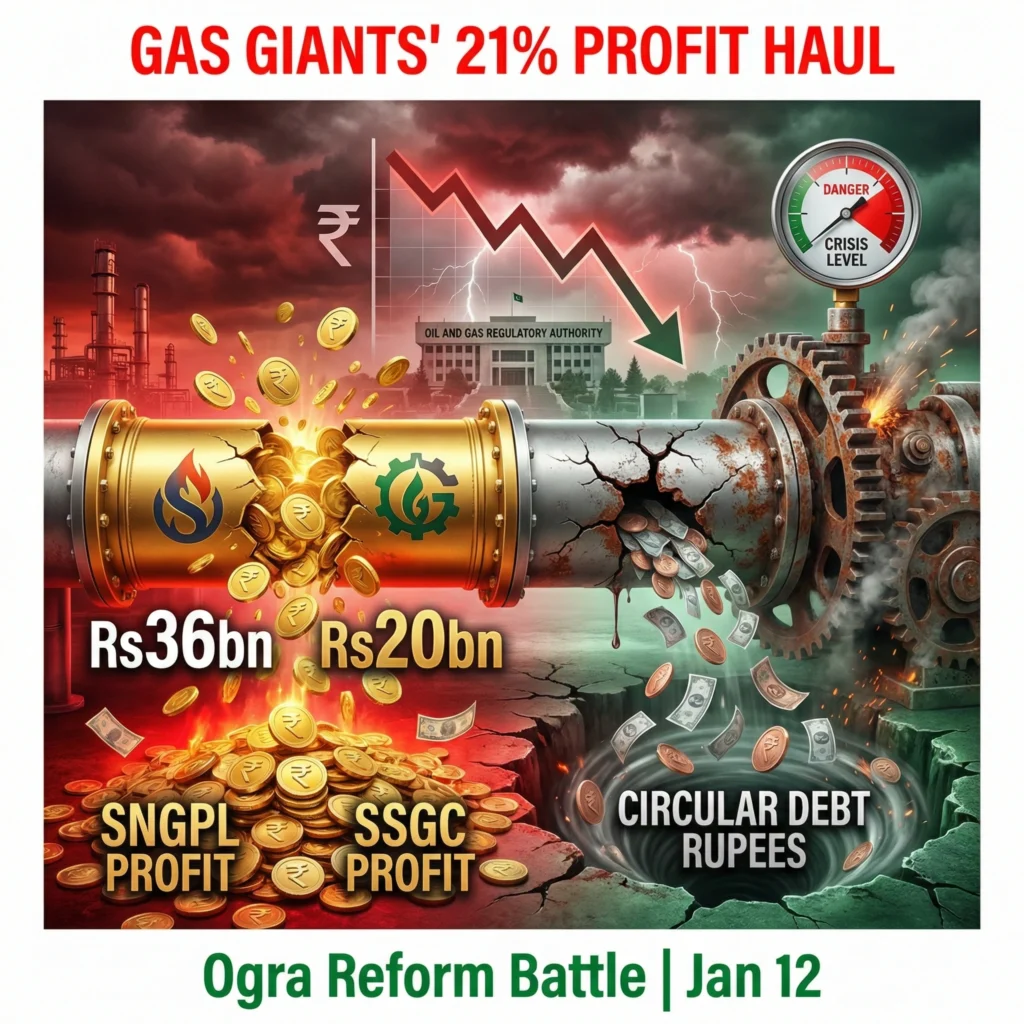
How Pakistan Gas Giants Rake 21% Profits Under Fixed Returns
At the heart of the debate is Ogra’s long-standing fixed-return-on-assets model, which allows gas utilities to earn guaranteed profits regardless of operational efficiency. Under this system, SNGPL posted Rs36.8 billion, while SSGC earned Rs20 billion from local gas sales alone. An additional Rs14 billion combined profit came from handling re-gasified liquefied natural gas (RLNG).
Critics argue that this structure rewards asset accumulation rather than performance, allowing utilities to expand pipelines and infrastructure without sufficient incentive to reduce losses, improve service delivery, or cut costs. As Pakistan gas giants rake 21% profits, consumer tariffs continue to rise, fueling public frustration.
Energy Experts Slam Lack of Transparency
Energy sector voices have raised serious concerns about transparency and cost allocation. Shahid Karim of Tabeer Energy criticized the absence of a clear separation between RLNG and local gas accounting, calling the system opaque and resistant to accountability.
Similarly, private sector player UGDC highlighted that inflated financial and depreciation costs are routinely passed on to consumers. According to UGDC, these costs ultimately serve to protect shareholder dividends rather than reduce inefficiencies or benefit end users.
As a result, many analysts argue that the current model ensures Pakistan gas giants rake 21% profits while households and industries absorb the financial burden.
KPMG Proposes Performance-Linked Pricing Reform
In response to mounting criticism, consulting firm KPMG proposed a revised pricing framework based on the Capital Asset Pricing Model (CAPM). The proposal recommends:
- 80% base equity return guaranteed
- 20% return linked to efficiency and performance targets
Supporters believe this hybrid approach could preserve financial stability while encouraging utilities to cut losses, improve governance, and modernize operations.
However, the proposal has triggered strong resistance from gas utilities, who warn that abrupt changes could destabilize an already fragile sector.
Utilities Defend Profits and Warn of Sector Risk
SSGC Managing Director Amin Rajpoot rejected claims that profits stem from inefficiency. He argued that returns are largely driven by high interest rates, inflation, and massive investments in more than 200,000 kilometers of pipeline infrastructure.
Rajpoot also noted that gas tariffs have remained effectively frozen for nearly three years, limiting revenue flexibility despite rising costs. From the utilities’ perspective, guaranteed returns act as a buffer against policy uncertainty and delayed government payments.
Meanwhile, SNGPL Managing Director Faisal Iqbal defended the existing pricing structure as essential for tariff predictability and investor confidence. He described KPMG’s proposal as unrealistic in the current economic climate, warning that reduced guaranteed returns could worsen circular debt, already a major challenge in Pakistan’s energy sector.
Circular Debt Fears Loom Large
Energy consultants caution against drawing direct comparisons with the power sector, where reforms have reduced debt exposure through lower leverage. Gas utilities, by contrast, remain highly leveraged and cash-constrained, making them vulnerable to sudden pricing shocks.
Analysts warn that aggressive reform could trigger payment defaults, delayed maintenance, and supply disruptions. Instead, they advocate gradual, data-driven reform, emphasizing transparency, efficiency benchmarks, and phased implementation.
As the debate intensifies, the central question remains whether Pakistan can reform its gas pricing without undermining supply security.
Final Takeaway: Reform Needed, but Not Reckless
The controversy surrounding Ogra’s pricing formula highlights a deeper structural problem in Pakistan’s energy sector. As Pakistan gas giants rake 21% profits, public trust erodes and reform pressure mounts. Yet dismantling the fixed-return model without safeguards could unleash financial instability with nationwide consequences.
The path forward likely lies in measured reform, blending performance incentives with financial protection. Whether Ogra can navigate this narrow path will shape not only gas tariffs, but the future credibility of Pakistan’s energy regulation framework.
For more details & sources visit: The Express Tribune
For the latest updates from Pakistan, visit our Pakistan news page.