
NASA has initiated an unprecedented ISS early evacuation after a serious medical issue arose with one Crew-11 astronaut. The unnamed crew member is reported to be stable but requiring immediate attention, prompting NASA to prioritize health over mission schedule. This marks the first time in ISS history that a crew has been recalled prematurely.
The decision led to the cancellation of a planned spacewalk and adjustments to ongoing experiments, with scientists warning that some research may face delays. NASA emphasized that all safety protocols are being followed to ensure a smooth and safe return.
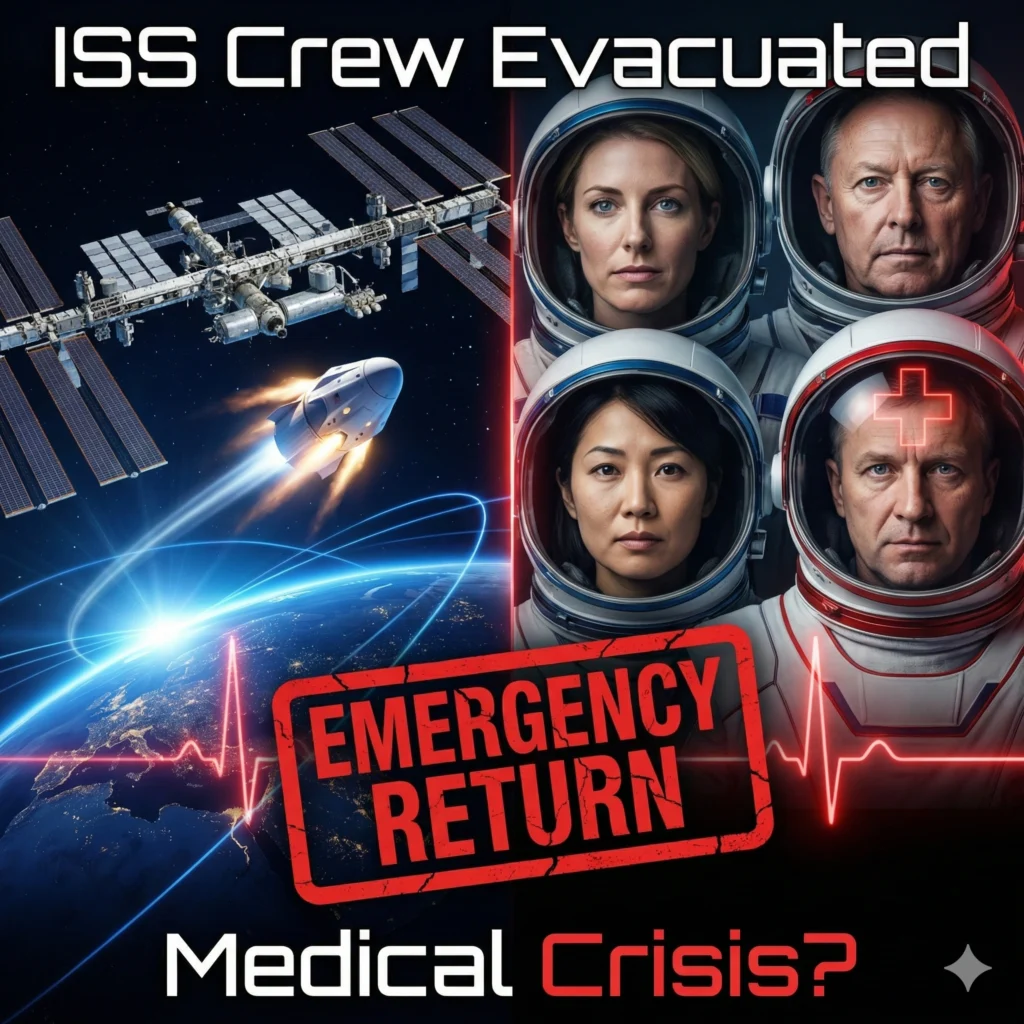
Crew-11 Faces Premature Mission End
The Crew-11 team—comprising NASA astronauts Zena Cardman and Mike Fincke, JAXA’s Kimiya Yui, and Russia’s Oleg Platonov—launched in August 2025 aboard the SpaceX Crew Dragon for a planned six-month mission. Due to the medical concern, their stay aboard the ISS will end approximately one month early, with undocking now planned no earlier than January 14 off the California coast.
NASA has assigned one U.S. astronaut to remain with the two Russian crew members temporarily, maintaining minimal station operations until the full Crew-12 rotation arrives. Administrator Jared Isaacman and health chief Dr. James Polk reassured the public that the situation is under control and all astronauts are stable.
Impact on Science and Station Operations
While the ISS is equipped with advanced medical tools allowing real-time Earth consultations, experts warn that the early evacuation could scale back ongoing science and maintenance. Dr. Simeon Barber highlighted that experiments may be paused or slowed until the next crew arrives next month.
Despite these challenges, the station’s resilience and operational protocols ensure that essential systems continue running. NASA emphasizes that safety remains the top priority, even if scientific output is temporarily affected.
ISS Early Evacuation Highlights NASA’s Safety Commitment
This historic ISS early evacuation underscores NASA’s dedication to astronaut safety. The agency acted swiftly, cancelling non-essential activities and coordinating a safe return with the SpaceX Crew Dragon. The move highlights how robust contingency plans protect crew members while maintaining critical station functions.
NASA continues to monitor the returning astronauts and prepares the next mission to resume full operations. The unprecedented event reflects both the risks and resilience inherent in long-duration space missions.
Spacewalk Cancellations and Research Adjustments
The ISS early evacuation led to the immediate cancellation of a scheduled spacewalk, a move aimed at prioritizing astronaut health over non-essential mission tasks. This decision, while disappointing for space enthusiasts, ensures that all crew members receive proper attention and that safety protocols remain uncompromised.
Several ongoing experiments aboard the ISS have been temporarily scaled back. Scientists note that while the station’s core systems continue to function, research requiring hands-on intervention may be postponed until the next crew rotation, emphasizing the operational impact of an ISS early evacuation on scientific output.
Role of SpaceX Crew Dragon in Safe Return
The SpaceX Crew Dragon spacecraft plays a critical role in facilitating this ISS early evacuation, providing a secure and efficient return path for the astronauts. Its advanced life-support systems and rapid deployment capability enable NASA to respond quickly to unforeseen medical emergencies in orbit.
Experts highlight that the smooth operation of the Crew Dragon demonstrates the importance of having reliable spacecraft ready for contingency missions. This successful evacuation reinforces confidence in both NASA’s operational planning and the spacecraft’s capability to support an ISS early evacuation safely and effectively.
Conclusion: Historic, Safe, and Precedent-Setting
The early recall of Crew-11 is a first in the ISS’s 65-year operational history, demonstrating NASA’s unwavering commitment to astronaut health and mission safety. While some research and experiments face temporary delays, the safe return of the astronauts remains the primary achievement.
As the space station adapts to reduced crew capacity, NASA’s swift response sets a precedent for handling medical emergencies in orbit, ensuring the ISS remains both a hub for science and a model for safety in human spaceflight.
For more details & sources visit: BBC News
For the latest updates from the United States, visit our U.S. news page.