
The launch of an AI-driven immersive museum in Pakistan marks a major shift in how the country presents and preserves its cultural heritage. Introduced at the Islamabad Museum, the new Digital Immersive Gallery transforms the traditional museum experience by combining artificial intelligence, 3D projection, and virtual storytelling to recreate the ancient Gandhara civilization in an engaging and interactive way.
Unveiled in September 2025 and gaining wider attention in early 2026, the project positions Pakistan at the forefront of digital heritage innovation in South Asia, blending history with cutting-edge technology to attract modern audiences.
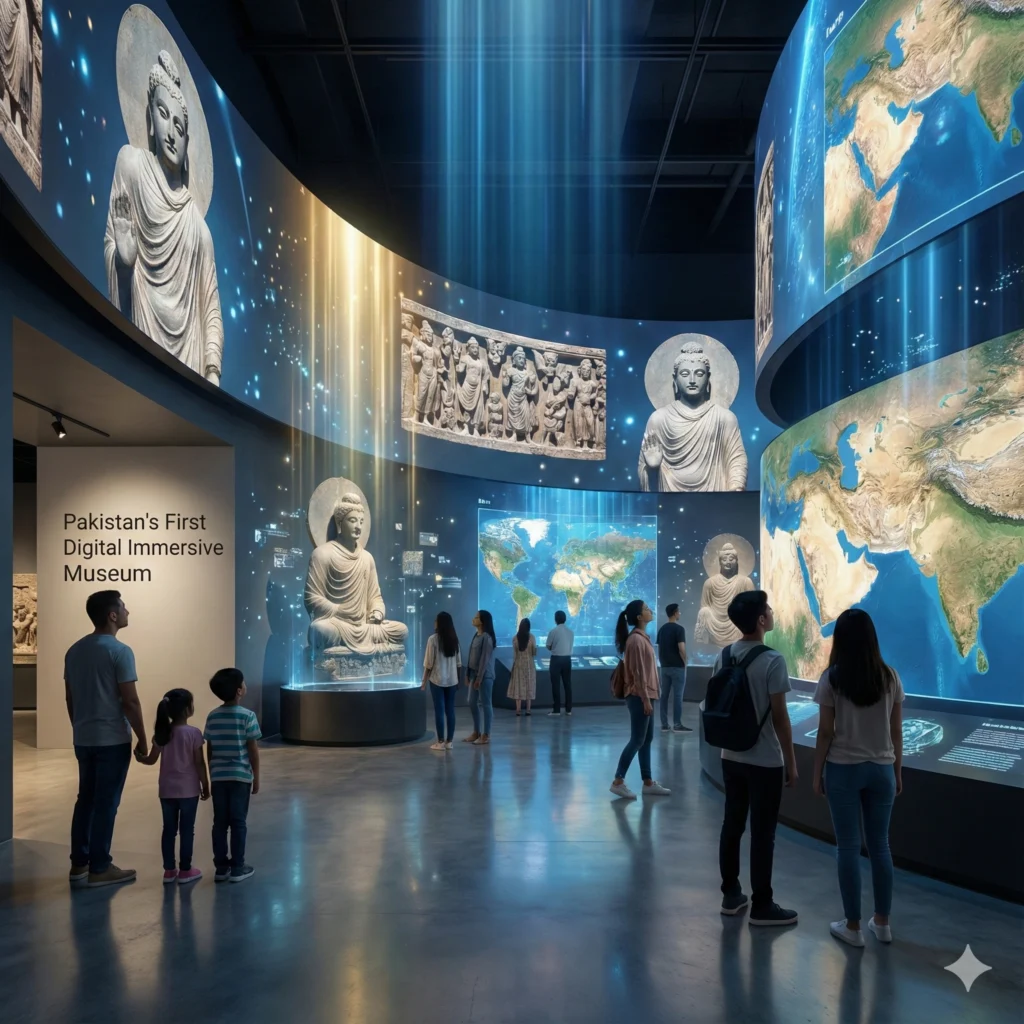
A First-of-Its-Kind Digital Museum Experience
The AI-driven immersive museum in Pakistan is the first initiative of its kind in the country. Developed through a collaboration between Pakistan’s Department of Archaeology and the Korea Heritage Agency, the gallery replaces static displays with dynamic visual narratives driven by light, sound, and motion.
Instead of simply observing artifacts behind glass, visitors are surrounded by large-scale projections and AI-generated visuals that respond to movement and storytelling cues. This approach allows history to unfold as a lived experience rather than a passive lesson.
Reviving the Gandhara Civilization Through Technology
At the heart of the AI-driven immersive museum in Pakistan is the story of the Gandhara civilization, a region historically significant for its role in the spread of Buddhism. Using immersive visuals and interactive sequences, the exhibition traces the rise of Gandhara and its influence across Asia.
AI-powered storytelling brings ancient monasteries, sculptures, and trade routes to life, helping visitors understand how Gandhara became a cultural and spiritual crossroads. The experience is designed to appeal not only to historians but also to students, families, and international tourists.
Beyond Gandhara: Showcasing Pakistan’s Wider Heritage
While Gandhara remains the central focus, the AI-driven immersive museum in Pakistan also highlights other major heritage sites through 3D storytelling. Visitors can explore visually rich presentations of:
- Mohenjo-Daro, one of the world’s oldest urban settlements
- Makli Necropolis, a UNESCO World Heritage site
- Shalimar Gardens, a symbol of Mughal-era architecture
These segments aim to present Pakistan’s diverse historical timeline in a cohesive and engaging format, encouraging deeper interest in the country’s archaeological legacy.
Making History Accessible and Engaging
Officials involved in the project say the primary goal of the AI-driven immersive museum in Pakistan is to make history more accessible to the public. Traditional museums can feel distant or academic, especially to younger audiences. By using immersive technology, the gallery turns learning into an interactive journey.
The use of AI also allows content to be updated and expanded over time, opening the door for future exhibitions that adapt to visitor interests and educational needs.
A Model for Future Museums in Pakistan
Cultural authorities view the Islamabad Museum’s Digital Immersive Gallery as a pilot project that could inspire similar initiatives across the country. If replicated in cities like Lahore, Taxila, and Peshawar, immersive galleries could play a key role in promoting cultural tourism and digital education.
The project also demonstrates how international partnerships can strengthen heritage preservation while introducing global best practices in museum technology.
Technology Meets Cultural Preservation
The AI-driven immersive museum in Pakistan reflects a growing global trend where museums use advanced technology to remain relevant in the digital age. By merging innovation with tradition, Pakistan is redefining how its history is told, preserved, and shared with the world.
This approach not only protects cultural narratives but also ensures they resonate with future generations raised in interactive and digital environments.
Final Takeaway
The AI-Driven Immersive Museum in Pakistan represents a powerful fusion of culture, technology, and education. By bringing the Gandhara civilization and other heritage sites to life through AI and 3D storytelling, the Islamabad Museum has set a new benchmark for cultural engagement in the country.
As Pakistan continues to explore digital innovation in heritage preservation, the AI-driven immersive museum in Pakistan stands as a promising model for how history can be experienced, not just observed.
For more details & sources visit: Arab News
For the latest updates from Pakistan, visit our Pakistan news page.