
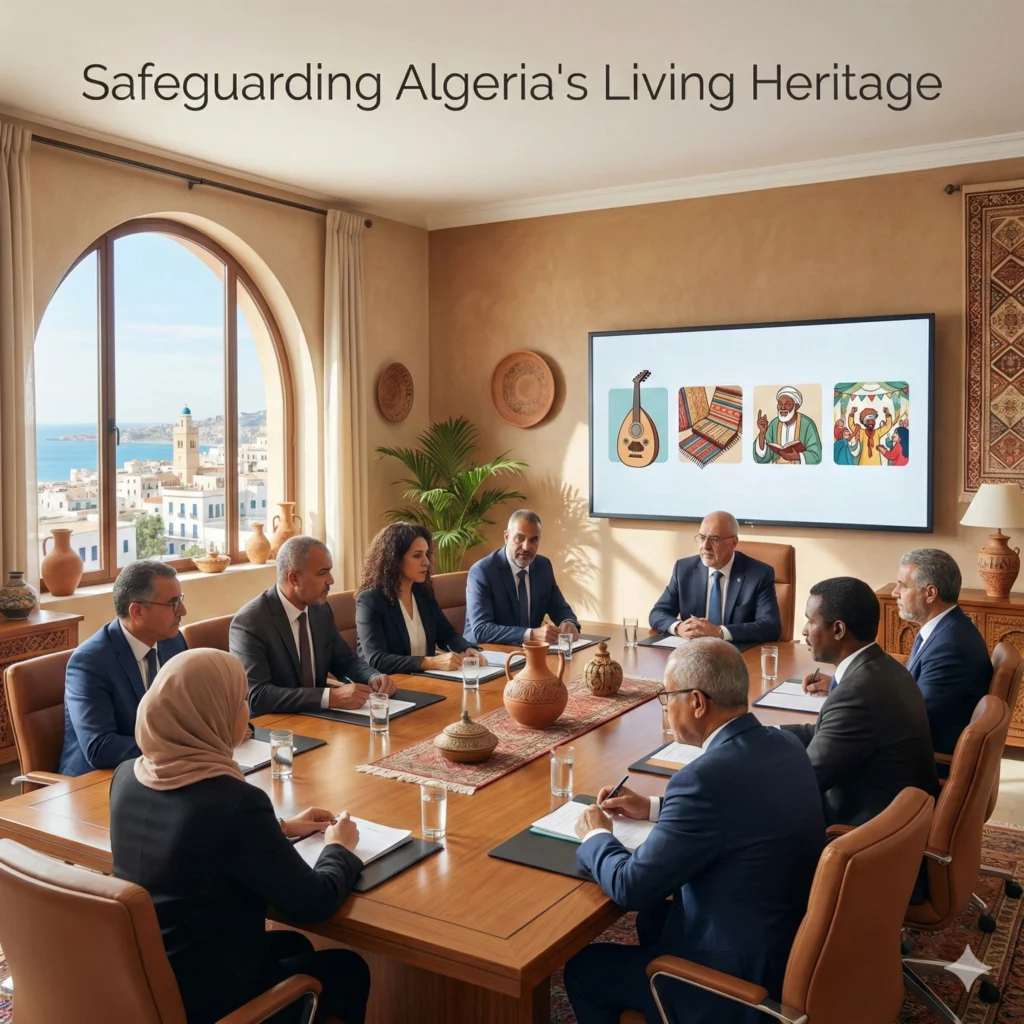
Algeria has officially launched a National Committee for Monitoring Intangible Cultural Heritage Files in Algiers, aiming to safeguard the country’s rich traditions, practices, and knowledge that form the foundation of its national identity. The committee is tasked with overseeing documentation, inventories, and the preparation of UNESCO submissions, ensuring a long-term, strategic approach to cultural preservation rather than relying on temporary or ad hoc measures.
Culture and Arts Minister Malika Bendouda inaugurated the body, emphasizing that the committee represents a significant step in Algeria’s efforts to valorize its intangible heritage. The ministry described the initiative as part of a broader cultural policy combining scientific inventory methods with continuous monitoring, guaranteeing that traditions are accurately documented and preserved for future generations.
Strategic Monitoring and Documentation
The National Committee will manage Algeria’s national inventory of intangible cultural elements, setting priorities for documentation and follow-up actions. This centralized approach ensures uniform standards across institutions, creating consistent records that can be efficiently updated and maintained. By implementing strict methodologies, the committee aims to protect fragile traditions from being lost amid rapid social and technological changes.
The body will also supervise the development of heritage dossiers, guiding institutions to maintain coherent, accurate, and comprehensive records. This proactive management ensures that Algeria’s cultural heritage is systematically preserved, enabling long-term research, public awareness, and educational initiatives to promote understanding and appreciation of local traditions.
Preparing for UNESCO Recognition
One of the committee’s key roles is to prepare submissions for UNESCO inscription, helping Algeria showcase its intangible heritage on the global stage. By unifying documentation standards and streamlining submission processes, the committee ensures that dossiers meet international expectations and are competitive for recognition.
Bendouda highlighted that international visibility is crucial for safeguarding Algeria’s cultural legacy. UNESCO recognition not only validates the significance of these traditions but also provides legal and institutional support to protect them from neglect or disappearance. The committee acts as both a guardian and an advocate, bridging national policy and global cultural frameworks.
Promoting Cultural Tourism and Economic Opportunities
The creation of the National Committee also opens avenues for cultural tourism, connecting Algeria’s intangible heritage to economic growth. By documenting and promoting traditional arts, crafts, and local customs, the committee provides a framework for heritage-focused tourism initiatives that attract domestic and international visitors. Festivals, exhibitions, and interactive heritage trails can showcase Algeria’s unique cultural landscape, creating sustainable revenue streams for communities while preserving authentic practices.
Beyond tourism, safeguarding intangible heritage supports local artisans and cultural practitioners, giving them recognition and opportunities to monetize their skills. By integrating heritage preservation with economic incentives, Algeria encourages younger generations to continue traditional crafts, music, dance, and storytelling. This approach ensures that cultural preservation and economic development go hand in hand, making Algeria’s rich traditions not only a source of national pride but also a contributor to social and financial resilience.
Preserving Algeria’s National Identity
Algeria’s cultural heritage including oral traditions, performing arts, rituals, and social practices—is a core pillar of national identity. Bendouda emphasized that safeguarding these elements is essential for maintaining Algeria’s cultural continuity and reinforcing social cohesion. By creating a dedicated watchdog, the state is institutionalizing protection, ensuring that vulnerable cultural expressions are shielded through coordinated legal and regulatory measures.
The initiative also reflects a growing global trend of recognizing the importance of intangible heritage, which, unlike physical monuments, requires active stewardship, documentation, and promotion. Algeria’s committee represents a forward-thinking approach to cultural sustainability, demonstrating that modern policy can successfully protect and celebrate heritage in a rapidly changing world.
Final Thoughts
Algeria’s launch of the National Committee for Monitoring Intangible Cultural Heritage marks a historic step in preserving the country’s traditions and knowledge. By combining scientific methods, centralized monitoring, and strategic UNESCO submissions, Algeria is ensuring that its cultural legacy endures for future generations.
This initiative positions Algeria as a leader in intangible heritage protection, offering a model for other nations looking to safeguard fragile traditions. Through careful oversight, public awareness, and international collaboration, Algeria is transforming its rich cultural heritage into a living, sustainable resource that strengthens national identity while sharing its treasures with the world.
For more details & sources visit: AL24 News
For more updates about Algeria, visit the Algeria News Section.