
Nalanda inscription history gained new attention in 2025 as Indonesia received a replica of the ancient copperplate from India, highlighting centuries-old cultural ties. The replica has been installed at the Muarajambi Museum, located within the Muarajambi National Cultural Heritage Area in Jambi Province, Sumatra.
The historic handover highlights the deep-rooted cultural, educational, and religious ties between Indonesia and India that date back more than a millennium. It also strengthens Indonesia’s ongoing efforts to gain UNESCO World Heritage recognition for the Muarajambi site.
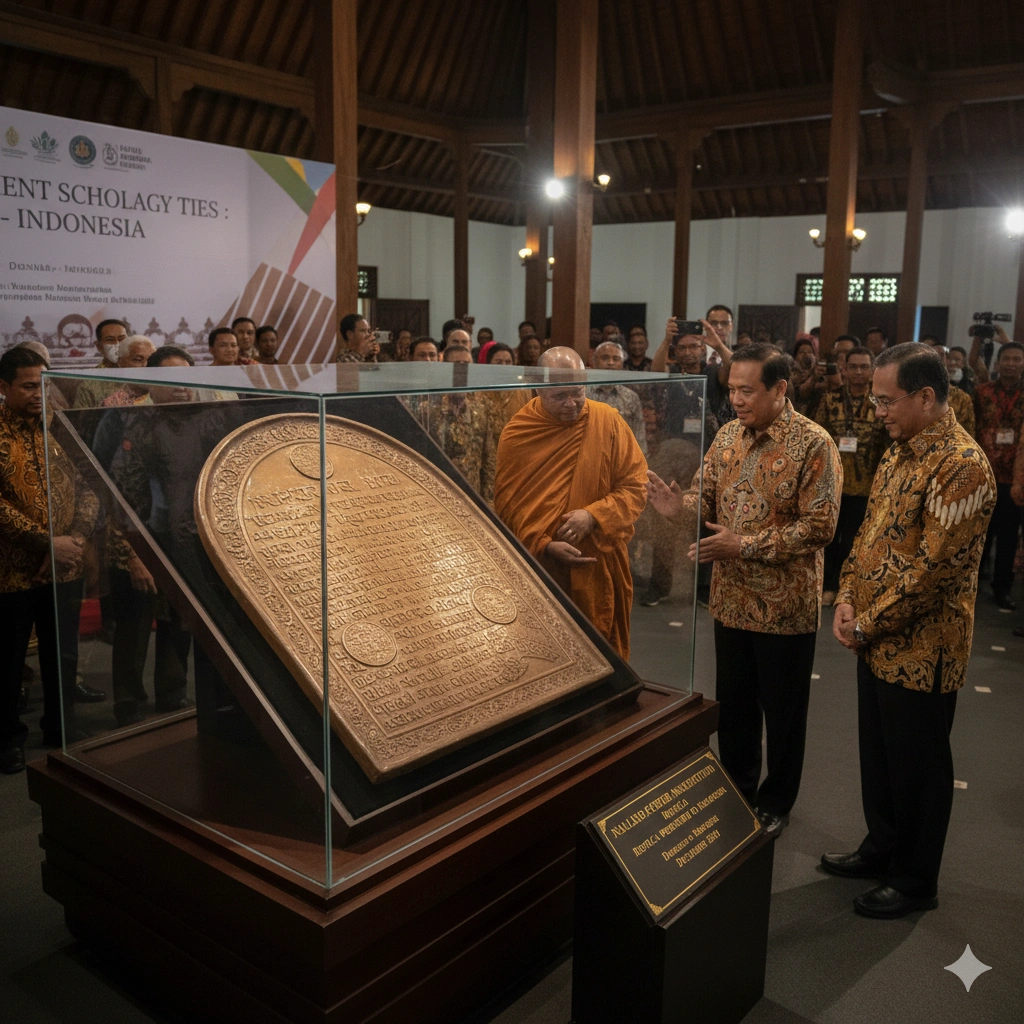
Nalanda Inscription Highlights Ancient Scholarly Exchange
The Nalanda Copperplate Inscription, dated 860 CE, is a crucial historical document that records a land grant issued by a ruler of the Pala Dynasty in India. The grant was made to support Indonesian Buddhist monks who were studying at Nalanda University, one of the world’s earliest and most influential centers of learning.
Nalanda University, located in present-day Bihar, India, was renowned across Asia for its advanced scholarship in Buddhist studies, philosophy, astronomy, and medicine. Students from regions including Srivijaya and Java traveled long distances to study there, reflecting the strong intellectual networks that existed across Asia during the early medieval period.
The inscription specifically references support for monks from the Syailendra Dynasty, which ruled parts of Indonesia and played a significant role in spreading Buddhism across Southeast Asia.
Strengthening Indonesia–India Cultural Relations
Indonesia’s Minister of Culture, Fadli Zon, emphasized that the inscription is more than just a historical artifact. According to him, it serves as tangible proof of longstanding civilizational ties between the two nations.
He noted that the artifact connects Muarajambi, an ancient Buddhist learning center in Sumatra, with Nalanda University, reinforcing the idea that Muarajambi was once part of a global network of Buddhist scholarship.
The official handover of the replica took place on December 9, 2025, during the session of UNESCO’s Intergovernmental Committee for the Safeguarding of the Intangible Cultural Heritage in New Delhi. The event followed months of diplomatic engagement and cultural cooperation between the two countries.
Diplomatic Momentum After Presidential Visit
The transfer of the replica also followed President Prabowo Subianto’s state visit to India, which focused on strengthening bilateral cooperation across multiple sectors, including culture, education, and heritage preservation.
Indian officials described the gesture as a sign of mutual respect for shared history, while Indonesian representatives welcomed it as a meaningful contribution to national heritage promotion.
Such cultural diplomacy initiatives are increasingly being used by both nations to reinforce people-to-people connections and promote historical understanding beyond modern political boundaries.
Boost for Muarajambi’s UNESCO Bid
One of the most significant outcomes of this development is its impact on Muarajambi’s nomination for UNESCO World Heritage status. The Muarajambi temple complex, spread across thousands of hectares, is considered one of the largest and most important ancient Buddhist sites in Southeast Asia.
The presence of the Nalanda Copperplate Inscription replica strengthens Indonesia’s argument that Muarajambi was not an isolated religious center, but part of an international academic and spiritual network.
Cultural experts believe that such historical evidence is critical in supporting Indonesia’s push to include Muarajambi on UNESCO’s Tentative List of World Heritage Sites, a key step toward full recognition.
Preserving History for Future Generations
By displaying the replica at the Muarajambi Museum, Indonesian authorities aim to educate the public, particularly younger generations, about the region’s global historical significance. The exhibit provides valuable insight into how knowledge, faith, and culture once moved freely across borders long before the modern nation-state existed.
The Nalanda inscription provides rare historical evidence of educational exchange between India and Indonesia during the 9th century. The collaboration between Indonesia and India demonstrates how shared heritage can be preserved through cooperation, setting an example for other countries with interconnected histories.
As cultural exchanges continue to grow, artifacts like the Nalanda Copperplate Inscription serve as enduring reminders that Asia’s past was shaped by dialogue, learning, and mutual respect. By showcasing the Nalanda inscription replica at Muarajambi Museum, Indonesia strengthens its claim as a historic center of Buddhist learning.
Source: ANTARA
For the latest updates from Indonesia, visit our Indonesia news page.