
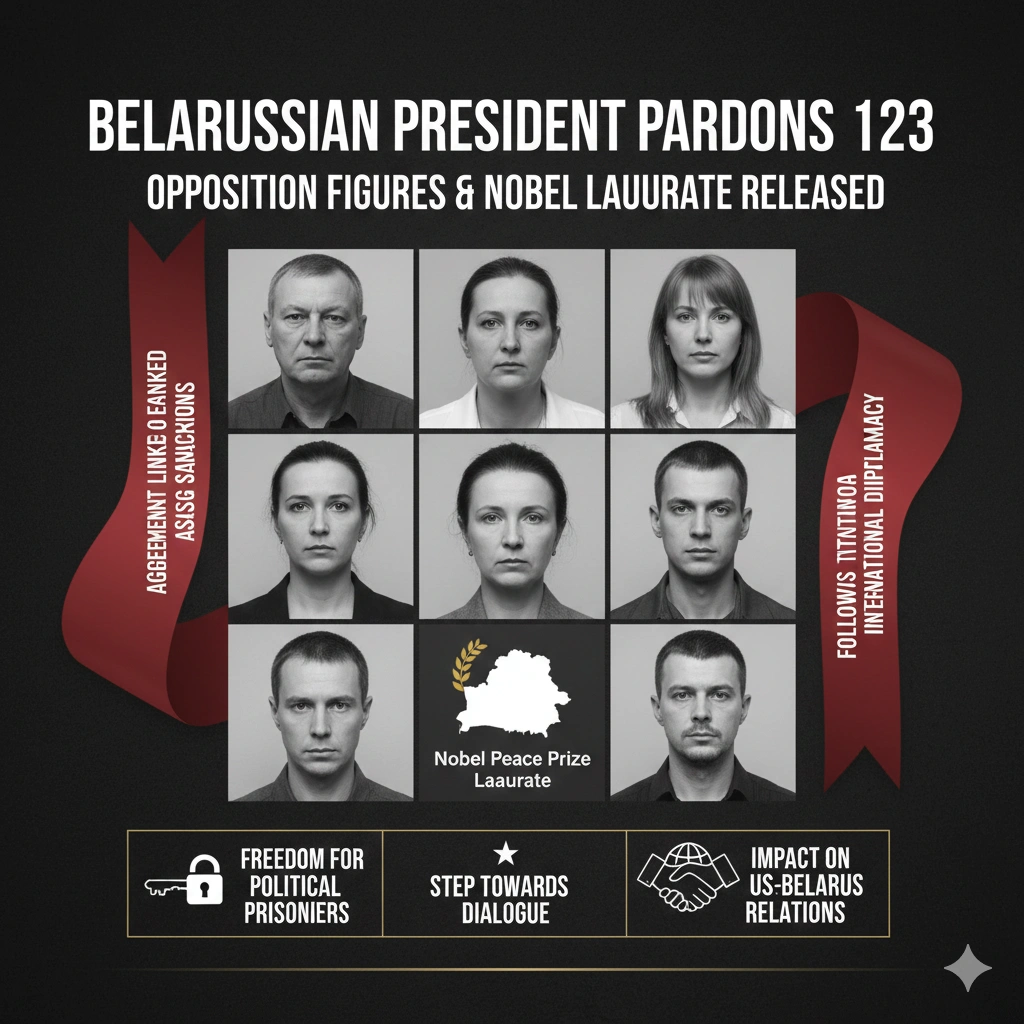
мария колесникова, one of the most prominent symbols of Belarus’s pro-democracy movement, has been released from prison following a sweeping pardon ordered by President Alexander Lukashenko. The decision, which also freed more than 120 other detainees, marks the most significant political shift in Belarus since the brutal crackdown on opposition protests in 2020.
The mass release follows a behind-the-scenes agreement linked to partial relief of U.S. sanctions, signaling a rare moment of diplomatic recalibration after years of isolation, repression, and human rights abuses.
мария колесникова Among Most High-Profile Prisoners Released
Belarusian authorities confirmed that мария колесникова was among 123 political prisoners pardoned under the decree. Kolesnikova, a cultural activist and opposition leader, became an international symbol of resistance after tearing up her passport in 2020 to avoid forced exile during the mass protests against Lukashenko’s disputed re-election.
She was later sentenced to 11 years in prison on charges widely condemned by human rights organizations as politically motivated. During her detention, concerns over her health and treatment intensified, making her release a major moment for Belarusian civil society and the international community.
Alongside мария колесникова, the pardon included Nobel Peace Prize laureate Ales Bialiatski and former presidential candidate Viktar Babaryka—two of the most influential figures jailed after the 2020 uprising.
Sanctions Relief Tied to Prisoner Releases
Officials confirmed that the prisoner releases were linked to the easing of selected U.S. sanctions, particularly those targeting Belaruskali, the state-owned fertilizer giant and a key source of foreign currency for the Belarusian economy.
Belaruskali sanctions had severely impacted Belarus’s export revenues and access to global markets. The partial sanctions relief appears to have been exchanged for what rights groups describe as a near-total clearing of high-profile political prisoners from Belarusian jails.
While Washington has not formally confirmed all details of the arrangement, the timing suggests a calculated move by Minsk to reduce international pressure without committing to broader democratic reforms.
мария колесникова and the Fate of Freed Prisoners
Although the release of мария колесникова is being hailed as a victory, Belarusian authorities imposed immediate conditions on most detainees. The majority of those pardoned were expelled from the country shortly after their release, preventing them from resuming political activity inside Belarus.
Ukrainian officials reported that more than 100 of the freed prisoners crossed into Ukraine, while others were transferred to Lithuania. This tactic mirrors earlier practices used by the Lukashenko government to neutralize opposition figures by forcing them into exile.
Rights organizations warn that while prisons may be emptying, repression inside Belarus remains firmly intact.
International Reaction to мария колесникова’s Release
The release of мария колесникова has drawn cautious praise from Western governments, human rights groups, and Belarusian opposition leaders abroad. Amnesty International and Human Rights Watch described the pardons as “overdue,” while stressing that thousands of Belarusians continue to face intimidation, surveillance, and arbitrary detention.
Opposition leader-in-exile Sviatlana Tsikhanouskaya welcomed the news but emphasized that true political change requires systemic reforms, free elections, and the safe return of exiled activists.
For many observers, мария колесникова’s freedom represents both hope and a reminder of how much remains unresolved in Belarus.
What This Means for Belarus’s Political Future
The mass pardon, including the release of мария колесникова, represents a tactical shift rather than a transformation of the political system. Analysts say Lukashenko is seeking economic relief and diplomatic breathing room without relinquishing control.
By removing high-profile prisoners, Belarus reduces one of the most visible sources of international criticism while keeping opposition movements fragmented and largely outside the country.
Still, the move could reshape Belarus’s external relations, particularly with the U.S. and EU, at a time when regional geopolitics—especially the war in Ukraine—are forcing difficult recalculations.
мария колесникова’s Enduring Symbolism
Despite exile and enforced silence, мария колесникова remains a powerful symbol of civic courage and resistance. Her refusal to leave Belarus in 2020, even under threat of imprisonment, made her an enduring figure in the country’s democratic struggle.
Her release does not mark the end of that struggle, but it does represent a rare crack in a system defined by repression.
For supporters inside and outside Belarus, мария колесникова’s freedom is both a moment of relief and a renewed call for accountability, justice, and genuine political change.
For more regional updates and industry insights, visit our Russia News Page.