
Japan stocks slide November 2025 as both equities and government bonds faced steep declines, reflecting rising investor anxiety over fiscal pressures and escalating diplomatic tensions with China. The Nikkei 225 suffered its sharpest fall since April, while long-duration Japanese government bond (JGB) yields surged to unprecedented highs, amplifying worries about the stability of Japan’s financial markets.
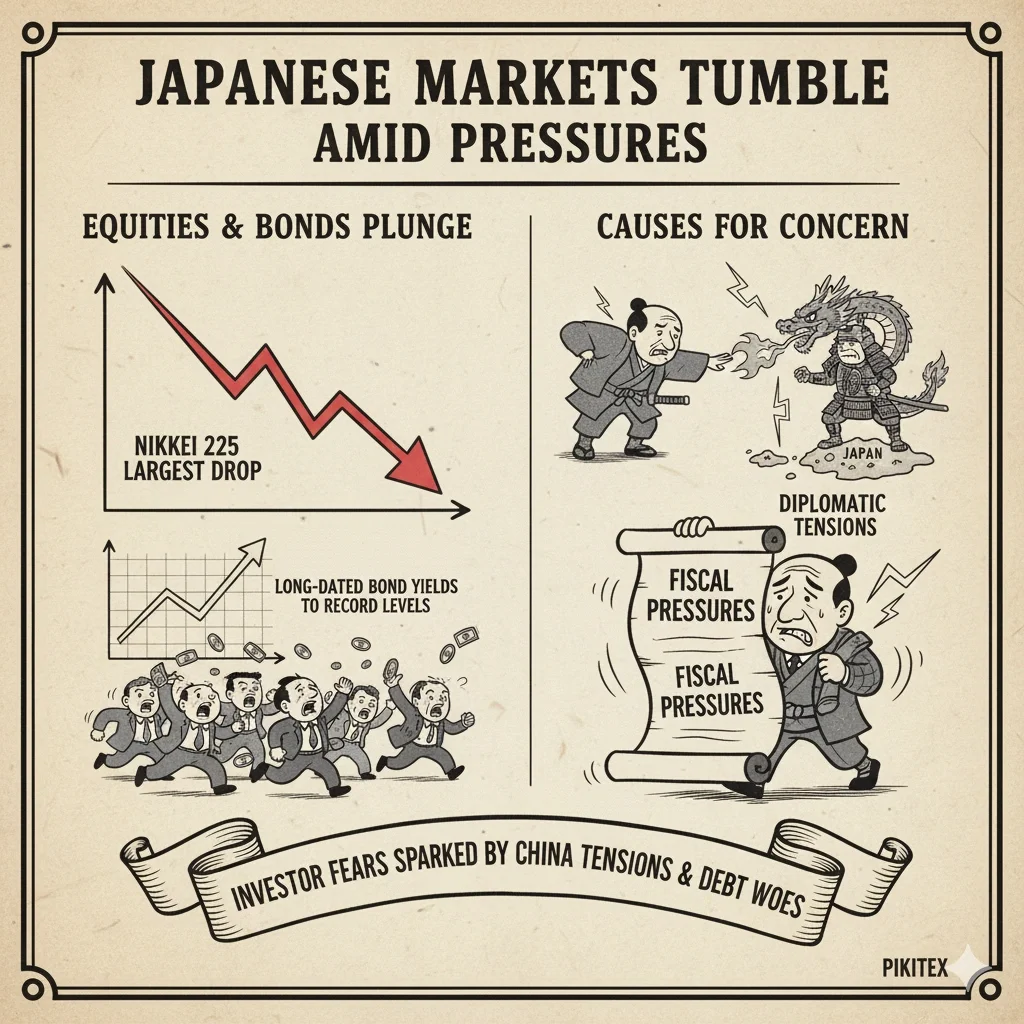
On 18 November, the Nikkei 225 dropped 3.2%, dragged lower by mounting uncertainty surrounding Prime Minister Sanae Takaichi’s forthcoming economic stimulus package. Investors fear that the policy measures—expected to focus on growth incentives and social welfare spending—could further strain Japan’s already challenged public finances. Japan currently holds one of the world’s largest debt burdens relative to GDP, heightening sensitivity to any signs of increased fiscal pressure.
Technology and AI-related shares were hit particularly hard. SoftBank Group, Furukawa Electric, and Ibiden, all of which are heavily tied to semiconductor and AI infrastructure development, recorded notable losses. Analysts attributed the sell-off to falling tech valuations and concerns that global investors are rotating away from high-growth technology names amid rising interest rates and bond-market volatility. The broader Topix Index also weakened, reinforcing a broader downturn across Japanese equities.
Bond Markets Signal Rising Stress
Long-term Japanese government bonds experienced sharp declines as well. The yield on 40-year JGBs climbed 8 basis points to reach 3.68%, the highest level since the securities were first issued in 2007. Rising yields indicate falling bond prices, and the jump signals that investors are demanding higher returns to compensate for heightened perceived fiscal risk.
Market strategists warned that the bond sell-off reflects growing uncertainty over how Prime Minister Takaichi’s economic plans will be financed. With inflation remaining moderate and the Bank of Japan slowly stepping back from years of heavy bond buying, traders expect greater market-driven volatility ahead.
Some analysts noted that the government may be forced to increase bond issuance, further pushing yields higher. For investors, the concern is that rapid increases in long-term borrowing costs could complicate public debt management while also affecting corporate financing and mortgage rates.
China Tensions Add Another Layer of Volatility
The downturn in Japan stocks slide November 2025 was exacerbated by renewed tensions with China following remarks by Prime Minister Takaichi regarding Taiwan. Although her comments were aligned with Japan’s long-standing security stance, they were perceived in Beijing as hostile, contributing to diplomatic strain between the two major trading partners.
Japan’s deep economic ties with China mean that political friction often translates into market instability. Traders moved quickly to de-risk their portfolios amid speculation about potential retaliatory measures, reduced trade flow, or heightened geopolitical uncertainty in East Asia.
Profit-Taking and Risk Retrenchment Weigh on Sentiment
Beyond structural concerns, some strategists attributed part of the sell-off to profit-taking. Japanese equities have posted strong gains in recent quarters, benefiting from corporate governance reforms, yen weakness, and global interest in AI-linked stocks. With valuations elevated and uncertainty rising, investors saw the decline as an opportunity to lock in profits.
Analysts also pointed to reduced global risk appetite. Concerns about global inflation trajectories, U.S. Federal Reserve policy, and geopolitical risks have pushed global investors toward safer assets. The retreat from risk-heavy sectors hit Japanese tech shares particularly hard.
Could Nvidia Earnings Provide Short-Term Relief?
Market observers suggested that stronger-than-expected earnings from Nvidia could offer temporary relief to Japan’s tech sector. Japanese semiconductor suppliers, component makers, and AI infrastructure firms are heavily integrated into Nvidia’s supply chain, meaning positive results could lift sentiment—even if only briefly.
Still, strategists caution that broader concerns driving the Japan stocks slide November 2025 remain unresolved. Fiscal challenges, bond-market fragility, and Japan-China diplomatic tensions continue to weigh on the outlook.
Outlook: Volatility Likely to Continue
With markets reacting to a mix of economic uncertainty and geopolitical pressures, analysts expect continued volatility. Investors will be watching closely for details of Prime Minister Takaichi’s economic package, potential Bank of Japan interventions, and any diplomatic developments with China.
For now, the market-wide sell-off underscores the fragility of investor confidence as Japan navigates a complex intersection of fiscal, political, and external risks.