
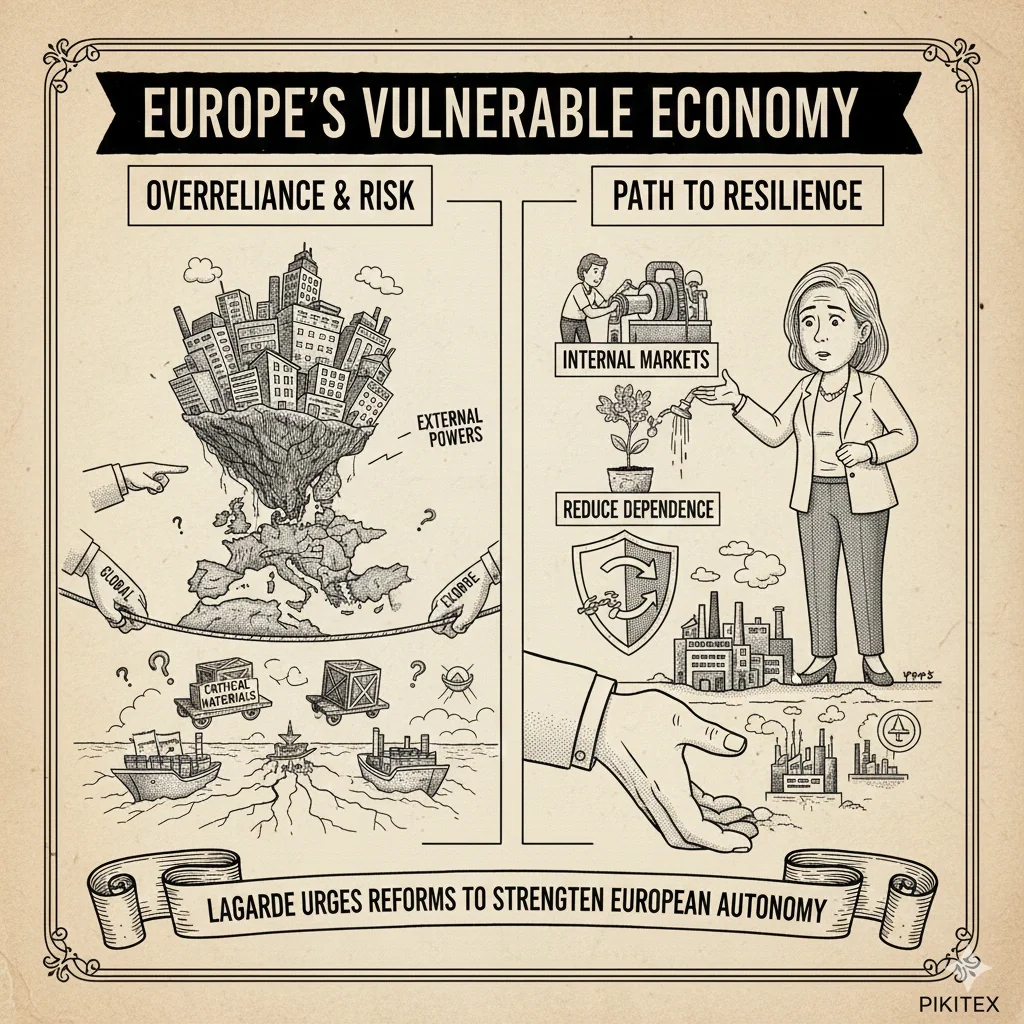
Christine Lagarde, President of the European Central Bank (ECB), has issued a stark warning about the European Union’s economic vulnerability, emphasizing the risks posed by overreliance on global trade and critical materials imported from abroad. Speaking at a recent economic forum, Lagarde urged EU policymakers to implement comprehensive reforms to strengthen internal markets, boost growth, and reduce dependence on external powers.
Dependence on Global Trade and Critical Materials
Lagarde highlighted the EU’s exposure to international shocks, noting that critical inputs such as rare earth metals and semiconductors are essential for key industries including automotive manufacturing, wind turbines, and electric motors. She warned that dependence on third countries, particularly China, leaves the European economy vulnerable to protectionist measures and geopolitical tensions, which could disrupt supply chains and slow industrial growth.
Digital Technology and Innovation Gaps
In addition to material dependencies, Lagarde criticized the EU for slow progress in digital technology, artificial intelligence, and capital markets. She noted that internal regulatory barriers hinder trade and productivity, preventing European firms from fully competing on the global stage. Lagarde emphasized the importance of harmonizing rules and enabling mutual recognition of authorized companies across member states to improve competitiveness and innovation.
Proposed Reforms
To address these vulnerabilities, Lagarde proposed a set of targeted reforms aimed at enhancing EU economic resilience:
- Lowering trade barriers between member states to improve market access.
- Harmonizing regulations to reduce bureaucratic obstacles and streamline cross-border business operations.
- Allowing mutual recognition of authorized companies to facilitate growth and competitiveness.
- Implementing qualified majority voting for tax policy decisions to prevent individual countries from blocking necessary reforms.
She stressed that these measures are critical to unlocking the EU’s growth potential while mitigating risks from external dependencies.
Acknowledging Europe’s Strengths
While cautioning about vulnerabilities, Lagarde acknowledged several positive aspects of the EU economy. She cited a resilient labor market, growing digital investment, and ongoing government spending as stabilizing factors that support economic continuity. According to Lagarde, leveraging these strengths alongside structural reforms could enable Europe to reduce external reliance and foster sustainable growth.
Implications for Policy and Industry
Lagarde’s remarks carry significant implications for both policymakers and European businesses. Industries reliant on imported materials may need to diversify supply chains, invest in local production, or adopt alternative technologies. Governments across the EU will be pressured to coordinate reforms that remove internal bottlenecks, ensure fair competition, and promote innovation in emerging sectors.
Conclusion
Christine Lagarde’s warning underscores a critical moment for the European Union. By addressing structural weaknesses, reducing dependence on external partners, and modernizing internal markets, the EU can enhance resilience and sustain long-term growth. Lagarde’s call for action reflects a proactive strategy to safeguard Europe’s economic future amid a rapidly evolving global landscape.
Learn More
For the latest updates from France, visit our France news page.