
Indonesia has taken a major step forward in global environmental cooperation with the signing of a landmark Indonesia peatland agreement alongside Germany’s renowned Greifswald Mire Centre (GMC). Formalized on 23 November at COP30 in Belém, Brazil, the agreement aims to enhance research, monitoring, sustainable management, and international collaboration on tropical peatland protection—an essential component of global climate mitigation.
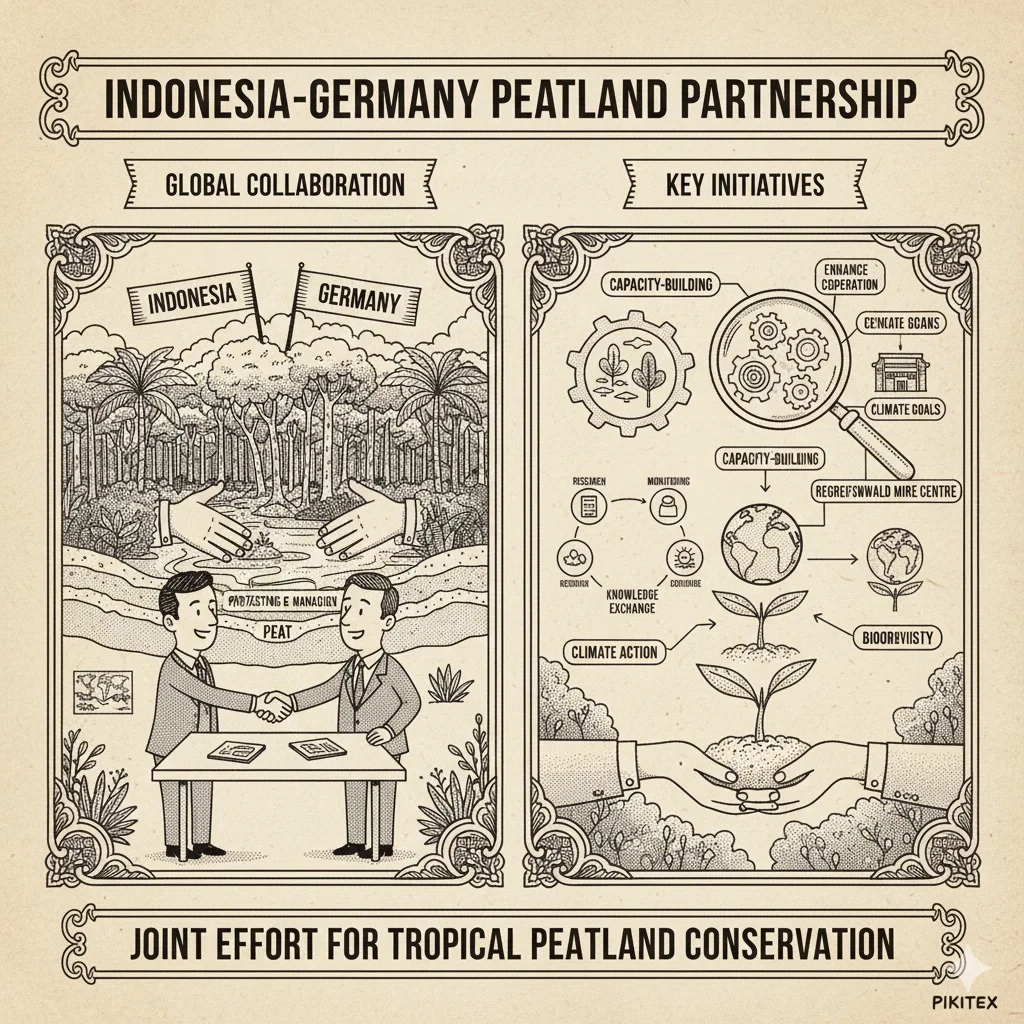
The Joint Declaration between Indonesia and the GMC underscores a shared commitment to safeguarding some of the world’s most carbon-rich ecosystems. Tropical peatlands are natural climate regulators, capable of storing an estimated 89 gigatons of carbon, making them critical in global strategies to reduce greenhouse gas emissions.
A Strategic Partnership to Protect Tropical Peatlands
The newly signed Indonesia peatland agreement prioritizes scientific cooperation, data exchange, and practical field-based solutions. Areas of collaboration include:
- Comprehensive peatland mapping
- Emissions monitoring and carbon accounting
- Restoration research and sustainable management techniques
- Community-based conservation approaches
- Knowledge exchange between researchers and policymakers
- Capacity building through workshops and technical training
For Indonesia, home to some of the world’s most expansive tropical peatlands, this partnership represents a major opportunity to advance evidence-based climate policy.
Indonesia’s ITPC to Become a Regional Research Hub
Under the agreement, Indonesia’s International Tropical Peatland Centre (ITPC) will serve as a regional hub connecting not only Southeast Asia but also the Congo Basin and the Amazon Basin—two other global peatland hotspots.
This expansion positions Indonesia as a leading center for international peatland research, enabling coordinated action across continents facing similar environmental challenges.
The ITPC will coordinate:
- Cross-regional research missions
- Training for local conservation officers
- Data harmonization across countries
- Development of restoration toolkits for communities
- Policy guidance based on scientific findings
The hub’s unified platform is intended to accelerate the global adoption of best practices in peatland protection and sustainable land management.
Supporting Indonesia’s FOLU Net Sink 2030 Goal
Peatlands are at the heart of Indonesia’s ambitious Forestry and Other Land Use (FOLU) Net Sink 2030 strategy, which aims for the country’s land sector to absorb more carbon than it emits by the end of the decade.
If managed properly, peatlands could reduce emissions by up to 2.6 gigatons of CO₂ equivalent annually, making them one of the most effective natural climate solutions available.
The Indonesia peatland agreement strengthens the scientific foundation needed for Indonesia to meet these targets by improving monitoring systems, restoration methodologies, and long-term policy planning.
Global Collaboration With Leading Climate Institutions
The Joint Declaration also highlights collaboration with several prominent climate and conservation bodies, including:
- United Nations Environment Programme (UNEP)
- Food and Agriculture Organization (FAO)
- CIFOR-ICRAF
- National and international research institutions
These partnerships combine global expertise and ensure that Indonesia’s peatland conservation aligns with international climate frameworks.
Supporting Indigenous and Local Communities
Another major focus of the agreement is empowering indigenous peoples and rural communities who live in or near peatland ecosystems. Through training programs, restoration projects, and sustainable livelihood initiatives, the partnership seeks to promote local stewardship and protect communities that rely on peatlands for agriculture, water, and cultural heritage.
Both Indonesia and Germany emphasized that long-term climate solutions cannot succeed without empowering local populations with practical tools and scientific knowledge.
A Milestone for Global Climate Action
The signing of the Indonesia peatland agreement is widely viewed as one of the most significant environmental commitments announced at COP30. With peatlands playing a crucial role in carbon storage and climate resilience, this cooperation enhances global readiness to tackle climate change while positioning Indonesia as a model for tropical ecosystem management.
As implementation begins, the partnership is expected to deliver major advancements in monitoring systems, sustainable land-use strategies, and community-driven conservation—ultimately contributing to climate stability on a global scale.