
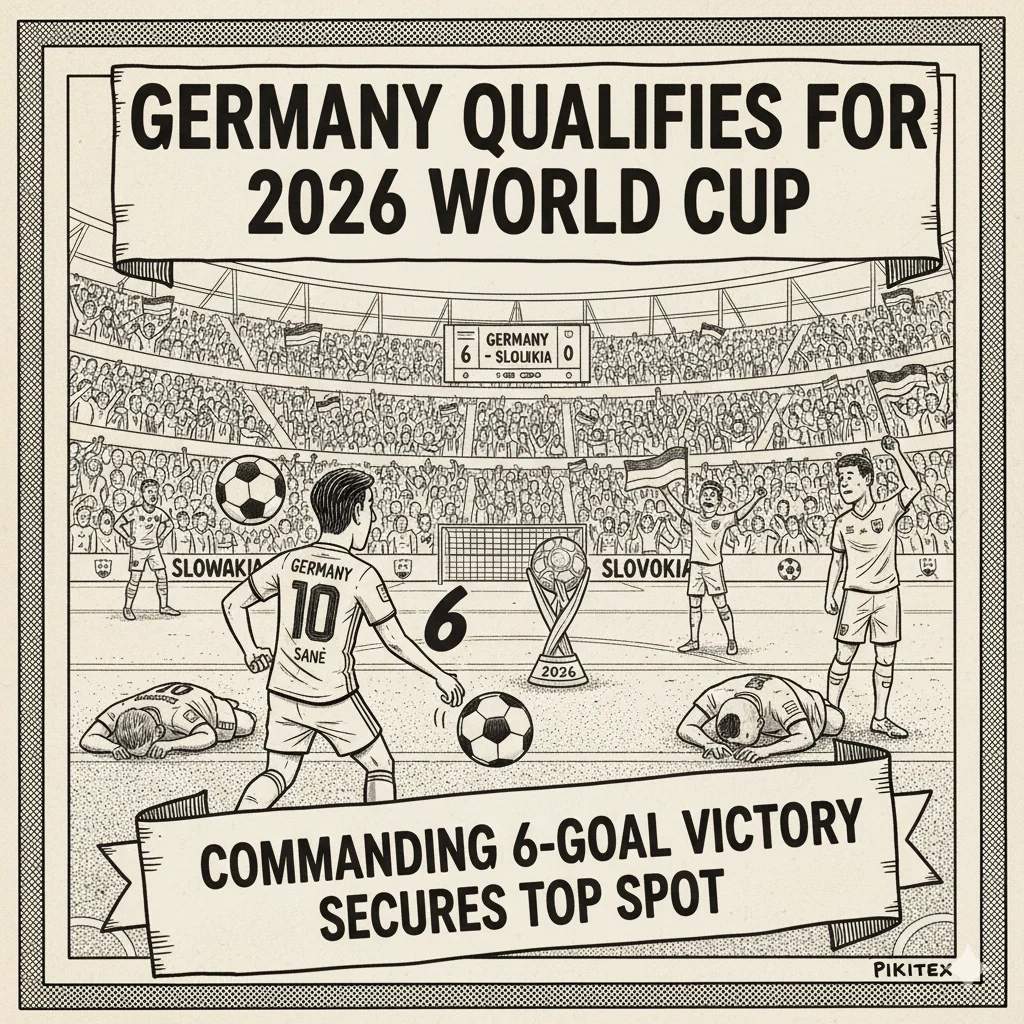
Germany World Cup qualification 2026 became official reality after a commanding six-goal performance against Slovakia sealed top spot in Group A. The emphatic victory on November 17, 2025, delivered automatic entry to the tournament and demonstrated Germany’s determination to restore their international football reputation after recent disappointments.
Dominant First-Half Performance Secures Qualification
The qualification was effectively secured in a ruthless first half that saw the team score four goals against Slovakia. This commanding performance put the match beyond doubt early and showcased the attacking prowess that has characterized the qualifying campaign.
Nick Woltemade opened the scoring, setting the tone for the dominant display. His goal energized the German attack and signaled the team’s intent to secure qualification with an emphatic performance rather than a cautious approach.
Serge Gnabry added to the tally before Leroy Sane delivered a memorable brace that essentially guaranteed the victory. Sane’s two goals demonstrated the attacking quality and clinical finishing that have become hallmarks of Julian Nagelsmann’s tactical approach.
Group A Final Standings and Tournament Entry
The campaign was achieved by finishing Group A with 15 points, three ahead of Slovakia’s 12 points. This top position ensures direct automatic entry to the tournament without requiring playoff matches or additional qualification hurdles.
The qualifying run demonstrated consistency and resilience. Despite Slovakia having beaten Germany earlier in the cycle, Nagelsmann’s team recovered to dominate the group and secure the critical top position.
The path included victories over multiple Group A opponents. The team’s ability to respond after the Slovakia defeat showed mental strength and tactical adaptability that will prove valuable at the tournament itself.
Coach Nagelsmann’s Reaction to Victory
Julian Nagelsmann praised his team’s spirit following the confirmation. The coach emphasized that every player “gave it all” under pressure, highlighting the collective commitment that drove the successful campaign.
Nagelsmann’s tactical approach throughout the qualifiers balanced attacking ambition with defensive solidity. His ability to manage the squad, rotate players effectively, and maintain consistent performance levels proved crucial to securing top spot in Group A.
The coach’s comments reflected satisfaction with the achievement while maintaining focus on future challenges. Nagelsmann recognizes that reaching the tournament represents only the first step toward the ultimate goal of championship success.
Second-Half Substitutes Complete Emphatic Victory
Celebrations intensified when second-half substitutes Ridle Baku and Assan Ouedraogo added late goals. These additional strikes emphasized squad depth and the competitive environment Nagelsmann has created within the team.
Nineteen-year-old Assan Ouedraogo made history during the clinching match by becoming the nation’s youngest scorer on debut. His goal represents the exciting young talent emerging within German football and promises a bright future beyond the 2026 tournament.
The late goals allowed Nagelsmann to showcase emerging players while managing workload for established stars. This rotation capability will prove valuable during the intense tournament schedule where squad depth often determines success.
Historical Context and Tournament Significance
This marks the 21st time Germany has qualified for the FIFA World Cup. This remarkable record demonstrates consistent excellence in international football spanning nearly a century of tournament competition.
However, this qualification carries particular significance following two consecutive early exits. Germany suffered disappointing group-stage eliminations in 2018 and 2022, damaging their reputation as perennial tournament contenders and championship favorites.
The successful campaign provides opportunity for redemption. The team aims to restore their international reputation, demonstrate tactical evolution under Nagelsmann, and prove they remain among world football’s elite nations despite recent setbacks.
Slovakia’s Challenge in the Decisive Match
Slovakia entered the decisive match having previously beaten Germany earlier in the campaign. That earlier victory had given Slovakia genuine hopes of securing top spot and automatic qualification themselves.
However, Slovakia struggled to cope with Germany’s relentless pace during the crucial encounter. The intensity, pressing, and attacking movement overwhelmed Slovakia’s defensive structure from the opening minutes.
Slovakia’s defeat means they must navigate playoff matches to reach the tournament. Their earlier victory demonstrated capability, but consistency proved elusive against top-tier opposition throughout the qualifying campaign.
Tactical Analysis of the Six-Goal Victory
Success was secured through tactical superiority and individual quality. Nagelsmann’s system emphasized high pressing, rapid transitions, and creating numerical advantages in attacking positions through intelligent movement and positioning.
Leroy Sane’s brace highlighted the importance of individual brilliance within Nagelsmann’s tactical framework. The coach provides structure while allowing creative players freedom to exploit defensive weaknesses and make game-changing contributions.
The six-goal margin reflected both offensive excellence and Slovakia’s defensive vulnerabilities under sustained pressure. Germany’s ability to maintain attacking intensity throughout the match demonstrated superior physical conditioning and mental focus.
Tournament Hosts and Expanded Format
Qualification delivers entry to a tournament jointly hosted by the United States, Mexico, and Canada. This tri-nation hosting arrangement represents the first competition featuring three host countries and promises unique logistical and competitive dynamics.
The 2026 tournament will feature an expanded format with 48 teams, making it the largest competition ever staged. This expansion increases opportunities for nations worldwide while presenting new challenges for traditional powers.
Success ensures participation in this historic expanded tournament. The format changes, multiple host nations, and increased team numbers create unpredictable variables that could favor experienced teams like Germany with deep talent pools.
Player Development Impact on Campaign Success
The qualifying campaign benefited significantly from emerging young talent integrating with experienced players. Ouedraogo’s record-breaking debut goal symbolizes the youth development success supporting the national team’s future beyond this tournament cycle.
The blend of youth and experience throughout the campaign suggests Germany is building sustainable success rather than relying on aging stars. Nagelsmann has successfully integrated multiple generations, creating competition for positions while maintaining team chemistry.
The approach demonstrates commitment to long-term planning. While immediate tournament success matters, developing players who will compete at 2030 and beyond ensures Germany remains competitive at football’s highest level.
Fan Expectations Following Qualification Success
The emphatic victory triggers significant expectations among German football supporters. After two consecutive tournament disappointments, fans demand performances matching the nation’s historical success including four championship titles.
The commanding nature of the six-goal victory raises hopes that Germany has rediscovered the attacking potency and defensive solidity that characterized their most successful teams. Supporters view qualification as merely the foundation for deeper tournament ambitions.
Managing expectations represents a challenge for Nagelsmann and the German Football Association. While optimism is warranted, the coach must balance confidence with realistic assessment of competition from traditional powers and emerging football nations.
Looking Ahead to 2026 Tournament
Germany’s commanding performance sends a powerful message to potential tournament opponents. The team’s attacking quality, tactical discipline, and squad depth suggest they will arrive at the competition prepared to challenge for the championship.
The victory over Slovakia demonstrated the team’s capacity to deliver under pressure. With qualification secured, Nagelsmann can now focus on fine-tuning tactics, managing player fitness, and preparing strategically for the tournament draw.
The road to restoring Germany’s reputation as world football royalty begins with this qualification success. The six-goal performance, youth integration, and tactical evolution under Nagelsmann provide genuine reasons for optimism about championship prospects in 2026.