
China AI chips policy tightened further this week as regulators ordered all state-backed data center projects to use only domestically manufactured processors, marking a major escalation in Beijing’s efforts to achieve technological self-sufficiency. The new rule could force projects already under construction to remove foreign components, reshaping China’s rapidly expanding AI infrastructure.
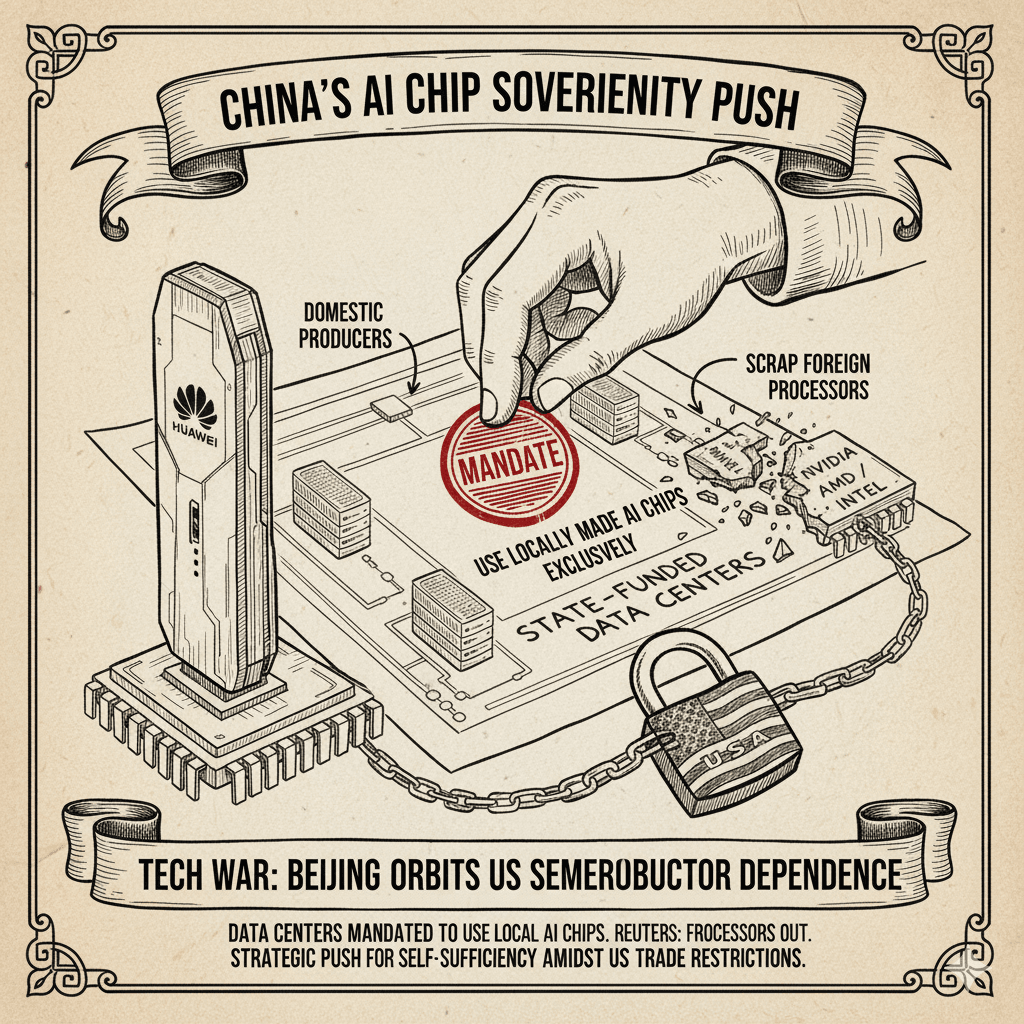
China’s AI Chip Policy Targets Self-Reliance Amid Global Tensions
According to Reuters, Chinese authorities have directed developers of government-funded or government-backed data centers to source exclusively from domestic AI chip manufacturers. The policy applies to facilities funded by national, provincial, or municipal programs and is part of a broader campaign to reduce dependence on American semiconductors.
Under the new regulation, projects that have not yet reached 30% completion must scrap all foreign AI chips or cancel procurement orders involving international suppliers. Those beyond that stage will face individual assessments to determine whether existing components must be replaced.
The move is expected to hit global chip giants Nvidia, AMD, and Intel, whose processors currently dominate AI computing worldwide.
Boosting Domestic AI Innovation and Security
China’s tightening grip on AI hardware comes amid deepening U.S.-China technology tensions and export controls targeting advanced semiconductor products. By focusing on China AI chips, Beijing aims to accelerate domestic innovation, strengthen cybersecurity resilience, and ensure strategic control over the nation’s critical digital infrastructure.
The directive also aligns with China’s “New Quality Productive Forces” initiative, which prioritizes technological independence across AI, quantum computing, and cloud technologies. Analysts say the policy will likely bolster national champions like Huawei, Cambricon, and Birentech, who are already producing homegrown AI accelerators for enterprise and government use.
Industry insiders believe the regulation will initially slow deployment of some large-scale AI models but could ultimately stimulate long-term ecosystem growth as Chinese firms race to match or surpass global performance benchmarks.
Impact on Global Chipmakers and U.S.-China Trade Relations
The China AI chips restriction underscores a new front in the U.S.-China tech rivalry. Washington’s export bans have already limited China’s access to Nvidia’s most advanced GPUs, prompting Beijing to retaliate through policies that prioritize local alternatives.
Major U.S. chip firms could lose a significant share of their China revenue — one of their largest global markets. Nvidia, for instance, previously tailored versions of its chips (like the H20 and L20 models) to meet U.S. export rules, but even these may now face exclusion from state-funded projects.
Analysts warn this decoupling could disrupt supply chains and fragment the global AI computing landscape. Some experts predict parallel ecosystems will emerge — one powered by Western-designed chips and the other by Chinese domestic hardware, each optimized for different regulatory and geopolitical environments.
Future of China’s AI Development Strategy
Beijing’s long-term objective is clear: build a self-reliant AI ecosystem that integrates chip design, cloud services, and software frameworks under local control. The government has already committed billions of yuan to support chip fabrication, R&D, and AI-focused supercomputing hubs.
While the current rule applies only to state-backed data centers, private sector operators are expected to follow suit as local technology matures and regulatory pressure grows.
China’s Ministry of Industry and Information Technology (MIIT) has emphasized that compliance will be strictly monitored, particularly for facilities processing sensitive or government-related data.
Source:
Reuters – China bans foreign AI chips in state-funded data centres, sources say
For more China-related updates, visit our China News page.