
The Barnaby Joyce Net Zero Walkout has reignited bitter internal divisions within Australia’s National Party over the nation’s 2050 climate commitment. Former leader Barnaby Joyce stormed out of a party room meeting this week as members clashed over whether to abandon the Coalition’s net zero emissions target, exposing long-standing rifts that could reshape conservative politics ahead of the next federal election.
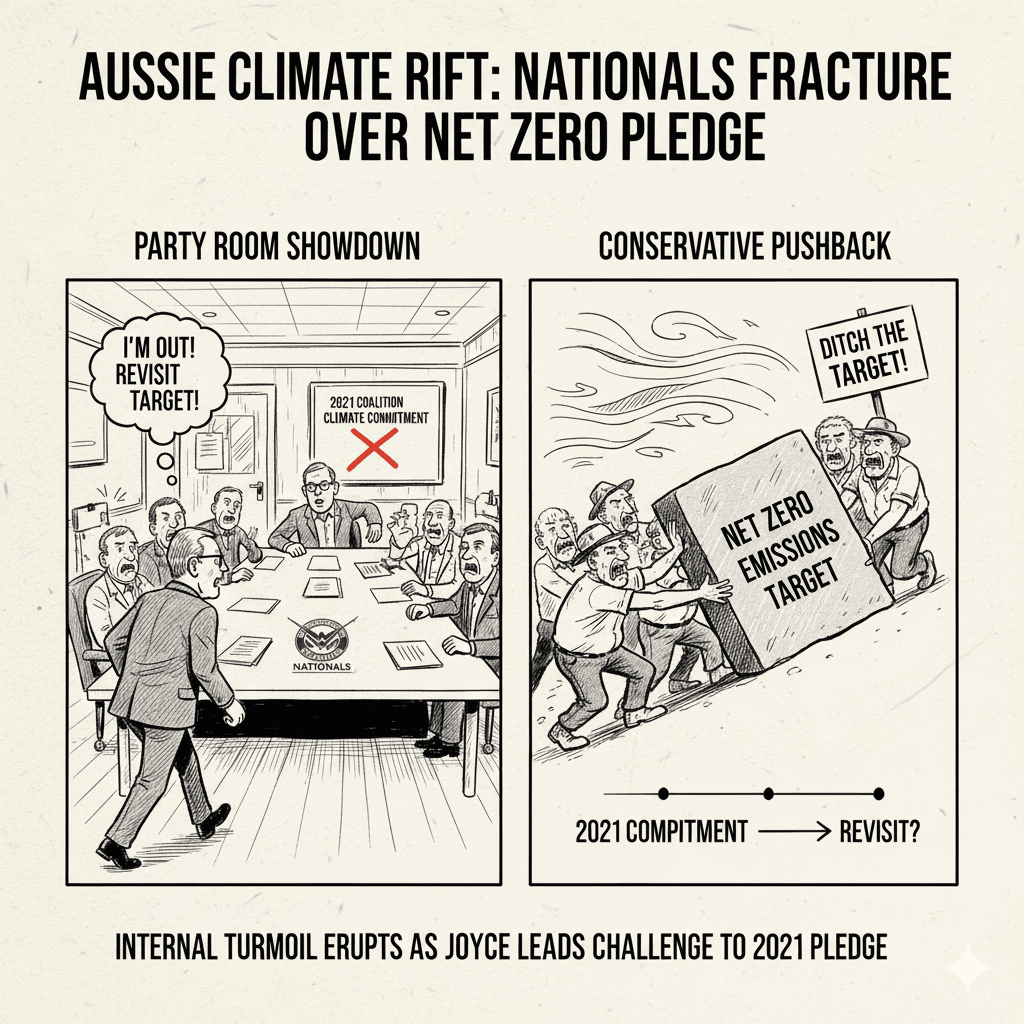
Nationals Revisit Net Zero Target, Sparking Fresh Infighting
The turmoil erupted during a heated internal debate on Monday when Nationals MPs revisited the net zero by 2050 pledge, originally endorsed under former Prime Minister Scott Morrison. The commitment, struck in 2021 after tense negotiations, had been pivotal in maintaining Coalition unity between the Liberal and National parties at the time.
However, with global climate policies accelerating and regional economies still dependent on coal and agriculture, the issue remains a flashpoint for internal dissent. Joyce, who helped broker the original deal as deputy prime minister, walked out mid-meeting, expressing frustration with what he described as “political tokenism” surrounding the net zero goal.
His departure from the room symbolized the deep divisions within the Nationals — between those urging economic realism and others pushing for alignment with international climate standards.
Joyce Criticizes “City-Centric” Climate Policy
Speaking to media in Canberra shortly after his walkout, Joyce condemned the net zero commitment, arguing that it unfairly burdens rural and regional Australians.
“Net zero means zero jobs for a lot of country people,” Joyce told reporters, adding that “regional industries are being sacrificed to make city voters feel good.”
While confirming he remains a Nationals member, Joyce reiterated that he will not contest the next federal election for his New England seat — a decision that further clouds the future of one of Australia’s most polarizing political figures.
The outspoken MP’s possible alignment with Pauline Hanson’s One Nation Party has sparked intense speculation, with some insiders warning that such a move could fracture the conservative base and cost the Coalition crucial regional votes.
Government and Industry React to Nationals’ Rift
Energy Minister Chris Bowen seized on the Nationals’ internal chaos, describing it as “another normal day for a party resisting the clean energy transition.”
“While the world moves forward on renewables, the Nationals are stuck fighting yesterday’s battles,” Bowen said in Parliament.
Business leaders and regional councils have also voiced concern, noting that policy uncertainty undermines investment confidence in emerging sectors like green hydrogen, carbon capture, and renewable energy infrastructure.
Analysts warn that the Barnaby Joyce Net Zero Walkout could isolate the Nationals from broader economic trends as both the private sector and international partners accelerate toward decarbonization.
A Familiar Split Over Climate and Identity
Political observers see the latest dispute as part of a recurring pattern within the Nationals — a party torn between protecting rural industries and adapting to global economic shifts. Similar divisions erupted during the 2021 negotiations, when Joyce initially resisted Morrison’s net zero proposal before eventually agreeing under party pressure.
This time, however, the political landscape is different. The Labor government’s renewable energy policies, coupled with mounting international pressure for carbon reduction, have made backtracking on net zero far riskier.
Yet, for Joyce and his supporters, the issue is as much about identity and sovereignty as economics. By portraying net zero as a policy imposed by elites, they aim to rally disaffected voters in mining towns and agricultural communities.
Barnaby Joyce’s Walkout Signals a Party at a Crossroads
As the Barnaby Joyce Net Zero Walkout continues to dominate headlines, political analysts suggest it could mark a defining moment for the Nationals — forcing the party to clarify whether it stands for pragmatic governance or ideological resistance.
If internal divisions persist, the Nationals risk not only splintering their voter base but also weakening the broader Coalition’s path back to government.
With Joyce’s political future uncertain and climate politics set to dominate the 2025 election cycle, one thing is clear: the Nationals’ uneasy truce over net zero has been shattered once again.
For more Australia-related updates, visit our Australia News page.