
The US and China trade deal has taken a major step forward as both nations reached a preliminary agreement to prevent the November 1 tariff hike. The deal, announced by US Treasury Secretary Scott Bessent, marks a breakthrough in economic relations between Washington and Beijing following months of escalating trade tensions.
Bessent described the accord as a “positive and balanced framework” that strengthens trade stability while opening the door for a more comprehensive US–China trade deal in the months ahead.
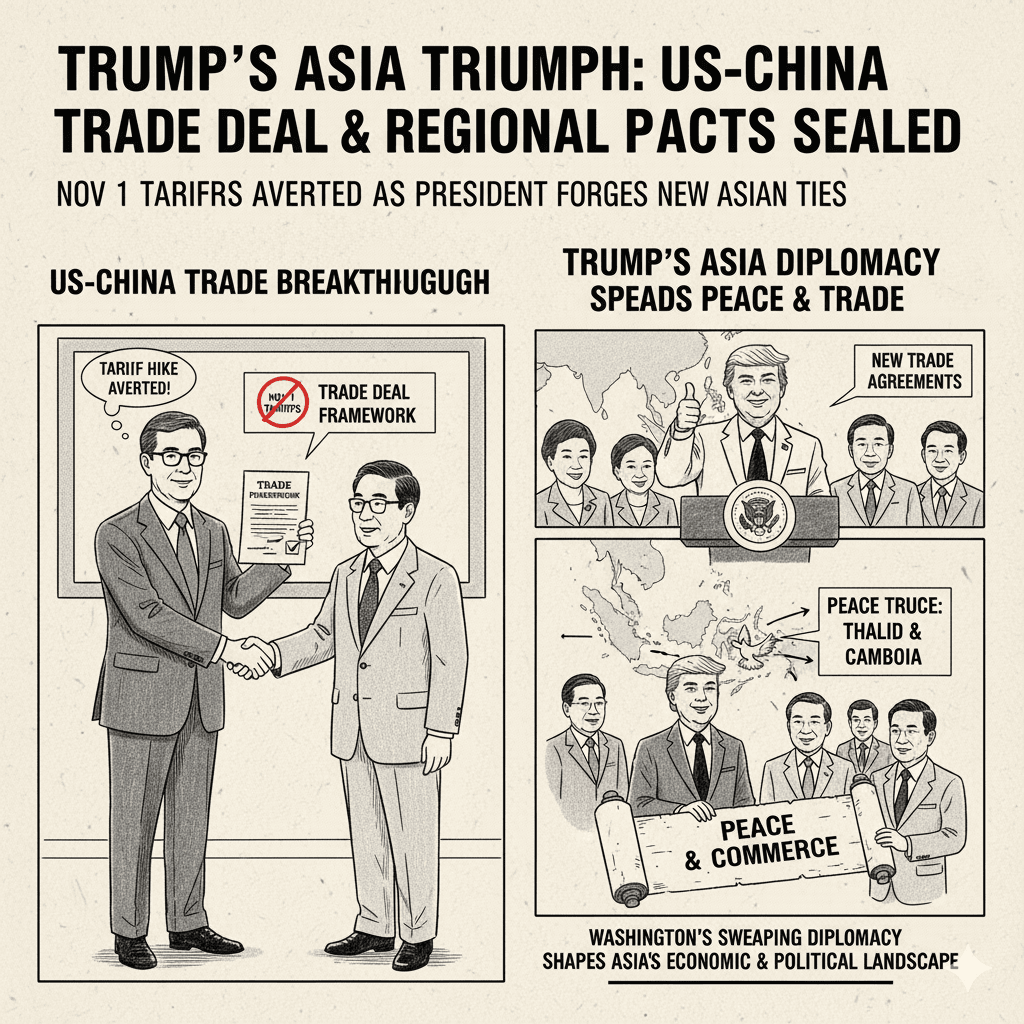
Details of the US and China Trade Deal
The agreement suspends the planned 100% tariffs on Chinese imports and restores access for US soybean exporters, while China has agreed to ease restrictions on rare earth exports, crucial for American technology and clean energy sectors.
Negotiations were held during the ASEAN Summit in Malaysia, where Chinese Vice Commerce Minister Li Chenggang characterized the talks as “constructive and forward-looking.” Both sides emphasized their shared interest in reducing global trade uncertainty and stabilizing markets.
Trump Expands Regional Cooperation Across Asia
During his Asian tour, President Donald Trump announced several new trade partnerships with Malaysia, Vietnam, Thailand, and Cambodia, highlighting the US’s growing engagement in Southeast Asia.
In Kuala Lumpur, Malaysia pledged to maintain the free flow of critical minerals, while the US–Vietnam agreement will expand mutual market access for agriculture and manufacturing. Trump also witnessed the signing of a peace truce between Thailand and Cambodia, a landmark step toward regional stability and economic collaboration.
Next Steps: Trump–Xi Meeting Expected to Finalize Framework
The US and China trade deal is expected to be finalized during a high-level meeting between President Trump and President Xi Jinping in Busan, South Korea later this week. Analysts say both leaders aim to transform the preliminary framework into a comprehensive trade pact covering technology, agriculture, and investment.
Economists predict that the agreement will ease inflationary pressures, stabilize the global supply chain, and boost investor confidence after years of economic tension between the two largest economies in the world.
Global Reaction and Economic Impact
Financial markets in Asia and Europe responded positively, with stock indexes climbing amid renewed optimism over the US–China economic outlook. The US and China trade deal is seen as a turning point in global trade diplomacy, signaling a shift from confrontation toward pragmatic cooperation.
Experts also note that this development could influence upcoming trade talks with Japan and South Korea, positioning the US as a stabilizing economic force in the Indo-Pacific region.
For more China-related updates, visit our China News page.