
Summary
China is embarking on an ambitious five-year plan to transform its economy by fostering “new quality productive forces,” focusing on emerging technologies such as AI, quantum computing, bio-manufacturing, and humanoid robotics to drive sustainable industrial growth.
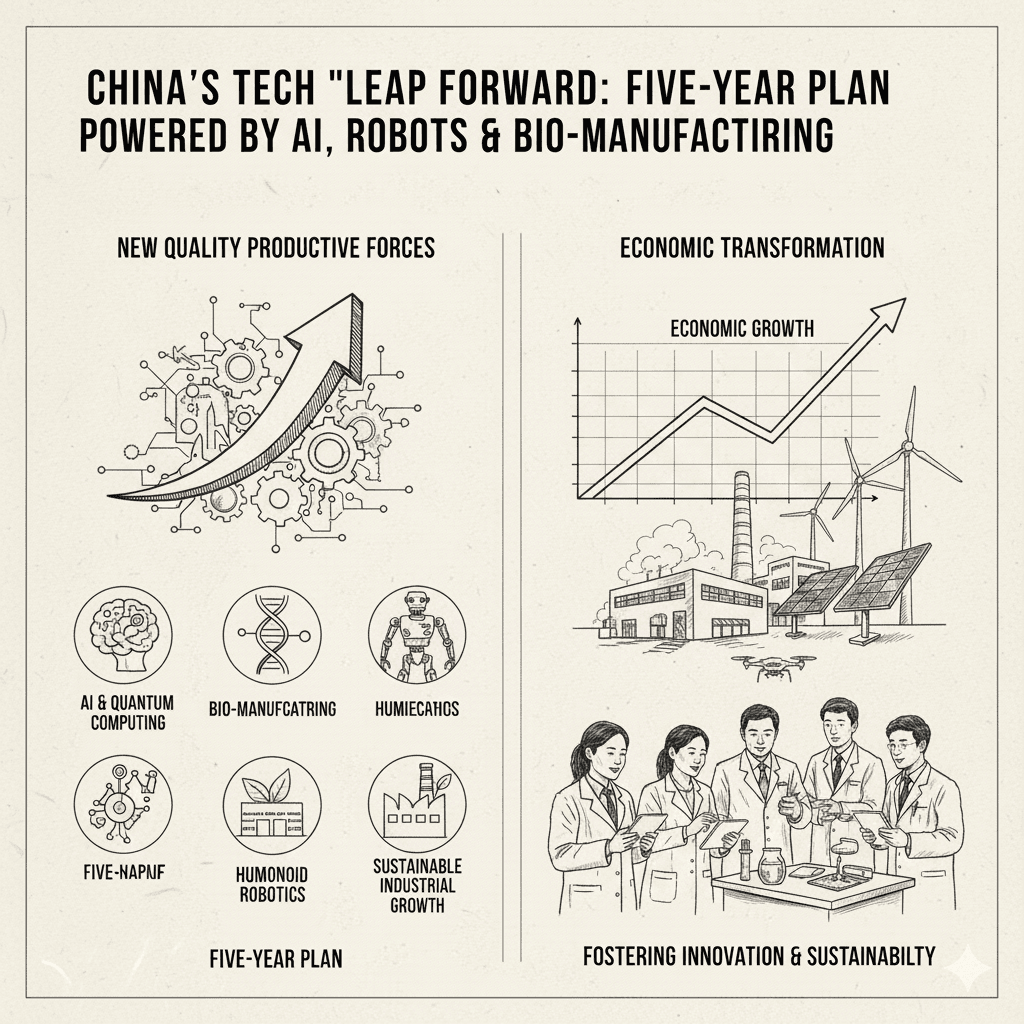
China has unveiled a sweeping technological transformation strategy centered on turning cutting-edge innovations into new industries that will serve as engines for long-term economic growth. The initiative emphasizes advanced fields including quantum technology, hydrogen and fusion energy, sixth-generation (6G) communications, and brain-computer interfaces.
In Shenzhen’s Pearl River Delta, startups such as EngineAI and UBTECH are leading this shift with humanoid robots designed for factory work and cognitive tasks. Currently, China employs 470 industrial robots per 10,000 manufacturing workers, with AI-powered robots expected to increasingly complement the human workforce. The nation has already established over 35,000 smart factories, highlighting its growing emphasis on automation and digital integration.
Beyond robotics, companies like NeuroXess are pioneering brain-computer interfaces, enabling patients to communicate through thought, while QuantumCTek, based in Hefei, is advancing quantum-secure communication systems to make unhackable encryption widely accessible. These innovations reflect China’s strategic focus on transitioning from quantity-driven to quality-driven industrial output.
China’s robust private sector — accounting for over 92% of high-tech enterprises and producing 372 unicorn companies in 2024 — remains a cornerstone of this transformation. The government has reinforced this momentum through its first law dedicated to private sector promotion and by offering incentives such as “robotics coupons”, which provide subsidies up to 1,500 yuan for individuals and 250,000 yuan for enterprises.
The initiative underscores the nation’s determination to integrate AI, robotics, and quantum technology across industries while maintaining strong manufacturing foundations. Officials describe this effort as a new industrial revolution that will redefine China’s economic landscape through innovation, digitalization, and sustainable productivity.