
An international team of scientists has made a groundbreaking discovery: a 34-million-year-old Antarctic Eden buried beneath over 2 kilometers of ice in East Antarctica. This pristine fossil landscape stretches across 32,000 km²—larger than Wales—and preserves ancient valleys, mountains, and river systems untouched for millions of years.
The find provides a rare glimpse into Antarctica’s pre-glacial environment and offers critical insights into climate change, ice sheet formation, and Earth’s climate history. By studying this lost world, scientists can better understand how CO₂ levels and temperature shifts influenced the transition from a warmer planet to a glaciated Antarctica.
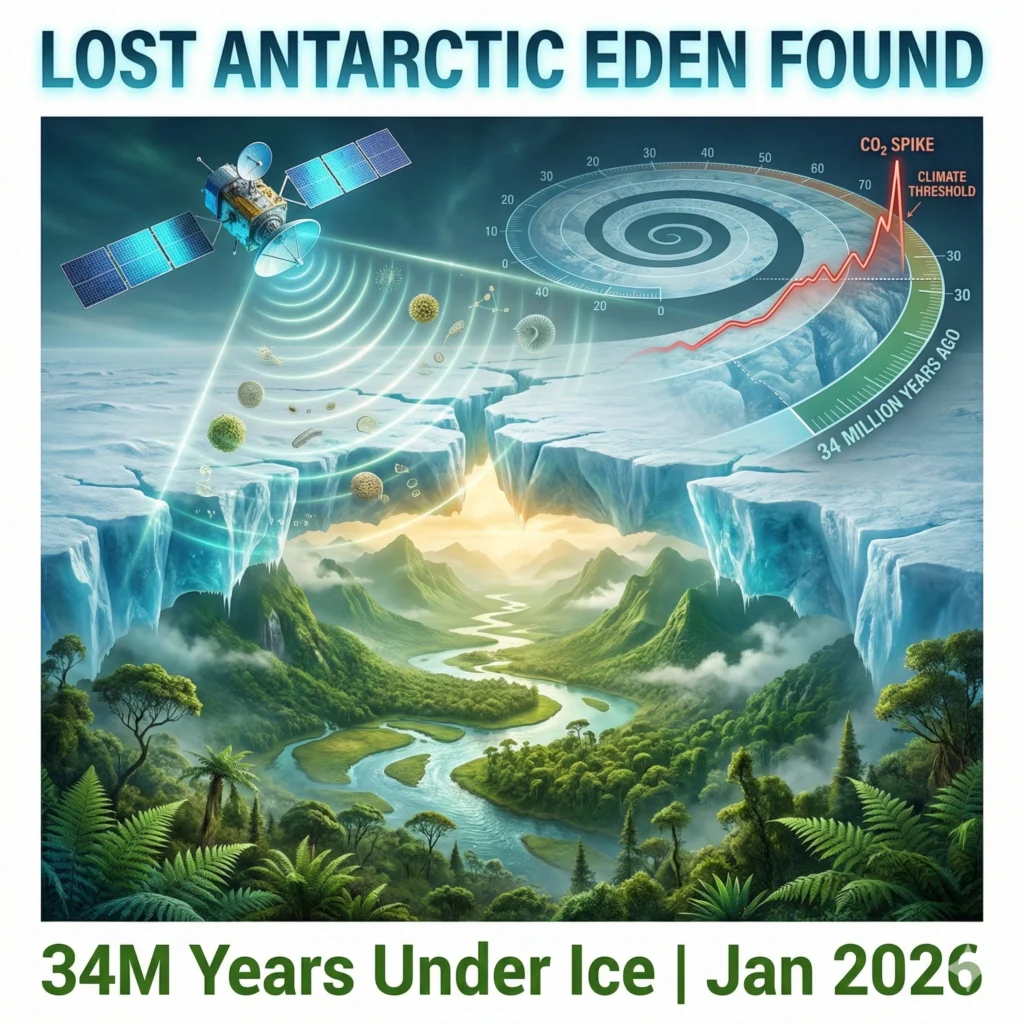
Mapping the 34-Million-Year-Old Antarctic Eden
Stewart Jamieson and his team used ice-penetrating radar to map the region’s ancient rivers and drainage basins. The radar revealed that “cold-based” ice, which prevents erosion, preserved the landscape almost perfectly.
These maps show how rivers carved deep valleys and how local glaciers sculpted the terrain before the East Antarctic Ice Sheet permanently sealed it. Researchers believe these features offer important clues about Earth’s climate transitions and the relationship between greenhouse gas concentrations and ice sheet stability.
Evidence of Ancient Forests
Complementary research from a 2024 Science study adds further context. Sediments from West Antarctica contain fossils of Patagonian-like temperate forests, indicating that while East Antarctica froze early, the western regions remained green and habitable for millions of years longer.
This contrast demonstrates the asynchronous glaciation of the continent. Understanding the timing and pattern of ice formation in East versus West Antarctica provides critical insights into ancient climate tipping points and how ecosystems responded to dramatic environmental changes.
How Antarctica’s Ice Preserved Ancient Landscapes
One of the reasons the 34-million-year-old Antarctic Eden is so well-preserved is the nature of cold-based ice. Unlike flowing glaciers that erode everything in their path, cold-based ice acts almost like a protective blanket. This allowed river valleys, ridges, and other landforms to remain virtually intact for tens of millions of years, providing a rare record of Earth’s prehistoric geography.
Scientists also note that this preservation gives a window into Earth’s climate cycles during the Eocene-Oligocene transition. By analyzing the structure and sedimentary patterns beneath the ice, researchers can infer how ancient glaciers advanced and retreated, offering a blueprint for understanding modern ice sheet behavior and potential instability.
Ancient Rivers and Ecosystem Insights
The discovery of extensive ancient river systems within the Antarctic Eden is reshaping our understanding of prehistoric polar ecosystems. These rivers would have supported early plant life and possibly small microbial communities, creating diverse habitats long before the continent froze completely. Mapping these networks allows scientists to reconstruct ancient drainage patterns and explore how freshwater flow influenced both local and global ecosystems.
In addition, the presence of such preserved river valleys helps researchers understand the long-term interactions between climate, topography, and biodiversity. These insights are critical for predicting how future climate changes might alter polar regions and for modeling the response of ice-covered ecosystems to warming temperatures and rising CO₂ levels.
Modern Climate Implications of the Antarctic Eden Discovery
The discovery of the 34-million-year-old Antarctic Eden has profound relevance today. Warming in the Amundsen Sea has tripled ice shelf melt rates, raising concerns over the potential collapse of West Antarctica. Such a collapse could trigger rapid global sea level rise, affecting millions of people worldwide.
Studying ancient frozen landscapes helps scientists model how modern increases in CO₂ levels could destabilize ice sheets. These insights are invaluable for understanding the long-term impacts of climate change on polar regions and global sea levels.
Future Exploration and EPICA Drilling Plans
Next steps involve extracting soil and ancient DNA from beneath the ice through EPICA drilling and subglacial lake exploration. Scientists aim to reconstruct past ecosystems, microbial life, and biodiversity, which existed before the continent’s complete glaciation.
By combining these findings with satellite and radar data, researchers hope to refine models for climate tipping points, ice sheet dynamics, and global environmental change. This ongoing research will deepen our understanding of Antarctica’s geological and ecological history, helping forecast how modern ice sheets may respond to warming temperatures.
Conclusion
The discovery of the 34-million-year-old Antarctic Eden offers a unique window into Earth’s ancient climate, landscapes, and ecosystems. Preserved beneath 2 kilometers of ice, this lost world reveals the formation of ice sheets, the resilience of polar environments, and the risks posed by rising CO₂ levels today.
Studying these ancient landscapes is essential for preparing for future climate challenges and understanding how our planet might respond to ongoing environmental change.
For more details & sources visit: Noticias Ambientales
Read more on Antarctica news: 360 News Orbit – Antarctica