
The 2026 UK–Taiwan Business Survey 80 marks a historic high point in the economic relationship between the British and Taiwanese markets. As the global economy faces unprecedented shifts, the findings released this March highlight a resilient and mutually beneficial partnership that is outperforming many traditional trade corridors. For the first time, this comprehensive study captures a dual perspective, integrating the voices of both British firms operating in East Asia and Taiwanese enterprises looking toward Europe.
The data suggests that despite the shadows of geopolitical tension, the practical reality of trade is one of growth, innovation, and deep-seated institutional trust. Both nations are now moving beyond traditional manufacturing to forge high-tech alliances that will define the next decade of their commercial history.
2026 UK–Taiwan Business Survey 80 Results Analysis
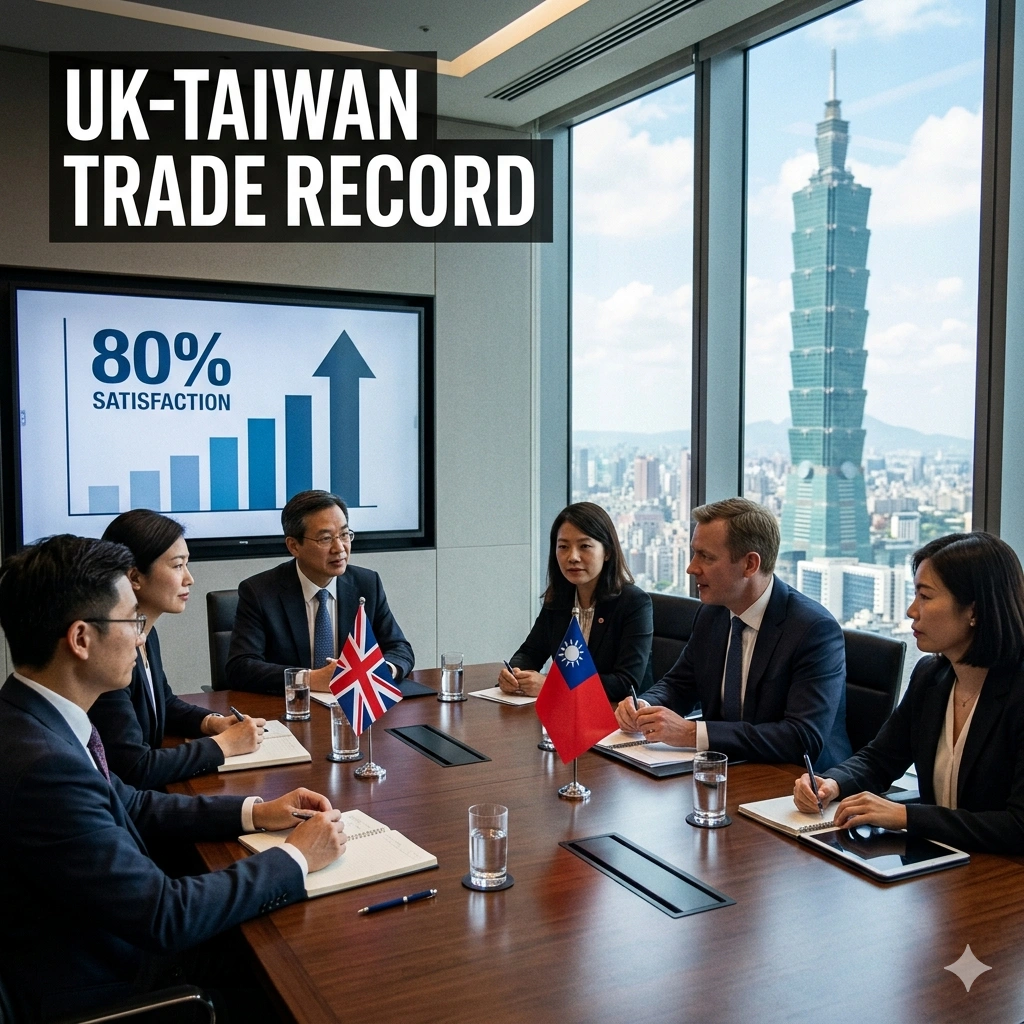
The 2026 UK–Taiwan Business Survey 80 results indicate that a staggering 80% of British companies currently operating in Taiwan report high levels of operational satisfaction. This record-breaking figure underscores the stability of the Taiwanese business environment even amidst broader regional uncertainties. British Representative Ruth Bradley-Jones noted during the unveiling that this satisfaction is rooted in Taiwan’s transparent legal frameworks and its highly skilled workforce.
On the reciprocal side, the survey highlights that Taiwanese firms now rank the United Kingdom as their second most favorable trading partner among major global economies. This is a significant climb, placing the UK ahead of several larger G7 nations in terms of perceived reliability and ease of doing business. The high trust in British governance and the rule of law has made the UK a primary destination for Taiwanese capital looking for a stable European foothold.
Furthermore, the 2026 UK–Taiwan Business Survey 80 reveals that bilateral trade has grown by a healthy 4% over the previous fiscal year. This growth is particularly impressive given the global slowdown in several other sectors, proving that the UK-Taiwan link is uniquely insulated from certain market volatilities. The focus on high-tech exports and renewable energy consultancy has been the primary engine driving these increased trade volumes.
Strategic AI Partnerships and Machine Learning
The most forward-looking aspect of the 2026 UK–Taiwan Business Survey 80 is the emergence of deep strategic synergies in Artificial Intelligence. Approximately 31% of Taiwanese companies expressed an explicit desire to collaborate with British firms on AI and machine learning projects. This interest is driven by the UK’s global leadership in AI ethics and software development, paired with Taiwan’s world-class hardware manufacturing capabilities.
These AI partnerships are expected to revolutionize industries ranging from precision medicine to automated logistics within the next few years. The survey suggests that the “hardware-software” marriage between these two nations is a unique competitive advantage in the global tech race. By combining British algorithmic innovation with Taiwanese semiconductor excellence, both regions are positioning themselves as central hubs for the next generation of computing.
Investment in these high-tech fields is also being supported by government-led initiatives designed to lower the barriers to cross-border research. The 2026 UK–Taiwan Business Survey 80 notes that several joint ventures are already in the pilot phase, focusing on sustainable AI infrastructure. This collaborative spirit is a direct result of the Enhanced Trade Partnership (ETP) frameworks established in previous years.
2026 UK–Taiwan Business Survey 80
The 2026 UK–Taiwan Business Survey 80 highlights that while optimism is high, 64% of UK companies expect significant revenue growth in the coming twelve months. This confidence is bolstered by the digital trade provisions included in the recent bilateral agreements, which have streamlined customs and data transfer protocols. Businesses are finding it easier than ever to move services and intellectual property between London and Taipei.
However, the 2026 UK–Taiwan Business Survey 80 does not shy away from the challenges facing the partnership. British firms have expressed specific anxieties regarding the long-term reliability of Taiwan’s domestic energy supply, particularly as the demand for power-hungry data centers grows. Addressing these infrastructure concerns will be a critical priority for the Taiwanese government if they wish to maintain this record-high level of foreign investor satisfaction.
Additionally, domestic political uncertainty in both regions is cited as a potential headwind for long-term planning. Despite these concerns, the fundamental economic indicators remains strong, with most firms choosing to expand their local footprints rather than retreat. The 2026 UK–Taiwan Business Survey 80 serves as a testament to the fact that business interests often find a way to thrive even when the political landscape is complex.
Renewable Energy and Net-Zero Goals
- Offshore wind projects in the Taiwan Strait continue to be a primary area for UK engineering consultancy.
- Taiwanese investors are increasingly looking at British green hydrogen technologies to meet their 2050 targets.
- The survey identifies a 12% increase in “green trade” services compared to the 2024 reporting period.
- Joint research into carbon capture and storage (CCS) is a growing priority for bilateral science funds.
The push toward a net-zero future is a core component of the 2026 UK–Taiwan Business Survey 80. British expertise in offshore wind has been instrumental in helping Taiwan develop its renewable energy capacity, creating thousands of high-tech jobs in the process. Conversely, Taiwanese precision manufacturing is helping the UK scale up its own renewable infrastructure at a more competitive price point.
The alignment of environmental goals between the two nations has created a “green corridor” for trade that is largely immune to traditional protectionist measures. The 2026 UK–Taiwan Business Survey 80 indicates that companies specializing in environmental, social, and governance (ESG) metrics are seeing the fastest growth in bilateral contracts. This shift reflects a broader global trend toward sustainable commerce that both nations are eager to lead.
Moreover, the transition to renewable energy is seen as a partial solution to the energy security concerns mentioned earlier in the report. By diversifying the energy mix with British-supported wind and solar projects, Taiwan can provide a more stable environment for high-tech manufacturing. The 2026 UK–Taiwan Business Survey 80 emphasizes that energy policy and trade policy are now inextricably linked.
Enhanced Trade Partnership (ETP) Impact
The Enhanced Trade Partnership (ETP) of 2025 has been a game-changer for the metrics recorded in the 2026 UK–Taiwan Business Survey 80. By removing specific tariff barriers and harmonizing digital standards, the ETP has reduced the “cost of doing business” for small and medium-sized enterprises (SMEs). This has allowed a new wave of British startups to enter the Taiwanese market with lower initial capital requirements.
The survey findings suggest that the ETP’s focus on digital trade has been particularly effective in the post-pandemic era. E-commerce platforms and digital service providers have seen a surge in cross-border transactions, supported by the clear legal frameworks provided by the partnership. The 2026 UK–Taiwan Business Survey 80 proves that well-crafted trade agreements can have an immediate and measurable impact on business confidence.
Furthermore, the ETP has fostered a culture of regular dialogue between trade commissioners and industry leaders. This “constant feedback loop” ensures that any emerging trade friction is identified and resolved before it can impact the bottom line. The success of the ETP as highlighted in the 2026 UK–Taiwan Business Survey 80 is now being looked at as a model for other bilateral trade negotiations globally.
The Role of High-Tech Semiconductors
Taiwan’s role as the world’s semiconductor powerhouse is a central theme in the 2026 UK–Taiwan Business Survey 80. For British firms in the automotive and consumer electronics sectors, the reliability of the Taiwanese chip supply chain is the single most important factor for their global operations. The survey indicates that these supply chains have become more integrated over the last year, with several UK firms establishing dedicated procurement offices in Hsinchu.
The partnership also works in reverse, with Taiwanese chip designers utilizing British ARM-based architectures for their next generation of processors. This deep technological interdependence is one of the reasons why the 2026 UK–Taiwan Business Survey 80 shows such high levels of mutual trust. Neither nation can achieve its full tech potential without the specific contributions of the other.
As AI continues to evolve, the demand for specialized “AI chips” is expected to drive even more trade between the two regions. The 2026 UK–Taiwan Business Survey 80 predicts that the semiconductor sector will remain the backbone of the relationship for the foreseeable future. This “silicon shield” not only protects economic interests but also fosters a level of strategic cooperation that goes beyond mere commerce.
Taiwanese Investment in British Governance
One of the most surprising findings of the 2026 UK–Taiwan Business Survey 80 is the high level of favorability Taiwanese firms express toward the UK’s regulatory environment. Many Taiwanese executives cited the UK’s “predictable and transparent” governance as a key reason for choosing it over other major markets, including the United States. This perception of the UK as a safe haven for capital is a major asset for British trade promoters.
The survey notes that Taiwanese investment is not just limited to tech but is also flowing into British real estate, infrastructure, and financial services. The 2026 UK–Taiwan Business Survey 80 highlights that these investors value the “soft power” of British institutions, including the legal system and the educational sector. This holistic attraction to the British model is a recurring theme throughout the report.
This trust is also reflected in the growing number of Taiwanese students choosing UK universities for advanced degrees in engineering and business. These alumni often return to Taiwan with a deep understanding of the British market, acting as natural bridges for future trade. The 2026 UK–Taiwan Business Survey 80 underscores the importance of these human connections in building long-term economic prosperity.
Overcoming Geopolitical and Energy Challenges
- Geopolitical tensions in the region remain the top concern for 45% of surveyed UK firms.
- Energy supply reliability is a primary concern for high-energy manufacturing sectors in Taiwan.
- Supply chain diversification is being prioritized to mitigate the risk of sudden regional disruptions.
- Both governments are working on a “resilience pact” to ensure trade continuity in crisis scenarios.
The 2026 UK–Taiwan Business Survey 80 acknowledges that the shadow of geopolitics is a constant factor in business planning. However, the report suggests that firms are becoming more adept at managing these risks through diversification and insurance strategies. Instead of pulling out, many companies are “double-downing” on their local operations while simultaneously building redundant supply lines elsewhere.
The energy anxiety mentioned in the 2026 UK–Taiwan Business Survey 80 is being addressed through increased investment in liquefied natural gas (LNG) and nuclear power research. British firms are playing a significant role in providing the technical expertise needed to modernize Taiwan’s grid. This synergy turns a potential threat into a commercial opportunity for British energy consultants and engineers.
The resilience of the trade relationship is perhaps the most impressive takeaway from the 2026 UK–Taiwan Business Survey 80. Despite the noise of international politics, the underlying business-to-business connections are stronger than ever. This suggests that the economic reality of the UK-Taiwan partnership is built on a foundation of mutual necessity that is difficult to shake.
Future Outlook: The Digital Trade Revolution
As we look toward the 2027 reporting period, the 2026 UK–Taiwan Business Survey 80 predicts that digital trade will become the dominant force in the relationship. The transition to “paperless trade” and the use of blockchain for supply chain verification are already being tested by leading firms in both nations. This digital revolution is expected to further reduce transaction costs and increase transparency.
The survey also points to a growing interest in “smart city” collaborations. British urban planners and Taiwanese IoT (Internet of Things) providers are working together to create more efficient and sustainable urban environments. The 2026 UK–Taiwan Business Survey 80 identifies this as a multi-billion dollar opportunity for the next five years.
Ultimately, the future of the UK-Taiwan relationship looks bright, provided that both nations continue to prioritize innovation and open markets. The 2026 UK–Taiwan Business Survey 80 provides the data-driven confidence needed for firms to continue investing in this dynamic corridor. The path from “frameworks” to “tangible commercial actions” is now clearly defined.
Conclusion: A Model for International Trade
The 2026 UK–Taiwan Business Survey 80 is more than just a collection of data; it is a blueprint for how two distinct economies can thrive through strategic alignment. By focusing on high-growth sectors like AI and renewable energy, the UK and Taiwan have created a resilient partnership that serves as a model for the rest of the world. The record-high satisfaction levels are a testament to the hard work of businesses and diplomats on both sides.
As the findings are shared globally, the 2026 UK–Taiwan Business Survey 80 will likely inspire other nations to look at Taiwan not just as a manufacturing hub, but as a strategic partner in the digital age. For the UK, the survey confirms that its “tilt” toward the Indo-Pacific is yielding real economic dividends for British workers and firms. The relationship has successfully matured from a series of transactional trades into a deep, multifaceted alliance.
The next year will be a critical time for turning these insights into even more growth. Both governments must remain vigilant in addressing the energy and geopolitical concerns raised by the business community. However, with the 2026 UK–Taiwan Business Survey 80 as a guide, the future of UK-Taiwan trade has never looked more promising.
For more details & sources visit: GOV.UK
Read more on Taiwan news: 360 News Orbit – Taiwan.