
The 2026 annular solar eclipse is a celestial event that will capture the world’s attention as it creates a spectacular “ring of fire” over the frozen landscape of Antarctica. While most of the global population will be unable to witness this phenomenon in person, the scientific community is preparing for a historical moment of observation.
On February 17, 2026, the moon will align perfectly with the sun, but because it is near its apogee, it will appear slightly smaller than the solar disk. This leaves a brilliant golden ring visible around the moon’s silhouette. This specific event is unique due to its path of annularity, which is almost exclusively restricted to one of the most remote and inhospitable regions on Earth.
The Science Behind the 2026 Annular Solar Eclipse
The mechanics of an annular eclipse are a fascinating display of orbital dynamics. Unlike a total solar eclipse, where the moon completely obscures the sun, an annular eclipse occurs when the moon is at a further point in its elliptical orbit around Earth. This distance means the moon’s apparent size is insufficient to cover the sun entirely. The result is the famous annulus, or ring, which provides a unique high-contrast visual that is particularly useful for solar researchers studying the sun’s outer edges.
During the 2026 annular solar eclipse, the shadow of the moon will race across the Southern Ocean at incredible speeds. Because the Earth is a sphere, the angle at which the shadow hits the polar regions creates an elongated path. This path will touch down in areas that are largely uninhabited by humans, save for the dedicated researchers stationed at international Antarctic outposts. The rarity of such an event in the southern polar region makes it a primary focus for climatologists and astronomers alike.
Why This Eclipse Skips the Northern Hemisphere
One of the most striking aspects of the 2026 annular solar eclipse is its geographical exclusivity. For residents in the United Arab Emirates, India, or North America, the event will remain entirely below the horizon. The geometry of the Earth-Moon-Sun alignment on February 17 dictates that the antumbral shadow stays confined to high southern latitudes. This means that while the “ring of fire” is technically happening, the curvature of the Earth prevents the northern half of the globe from seeing even a partial phase.
The 2026 annular solar eclipse serves as a reminder of how specific eclipse paths can be. Each “Saros series” — a period of approximately 18 years used to predict eclipses — shifts the path of visibility. For this particular cycle, the southern hemisphere is the primary stage. This has led to a surge in interest for high-definition live streams, as digital platforms become the only window for billions of people to witness the solar spectacle.
2026 Annular Solar Eclipse
The 2026 annular solar eclipse will reach its peak over the icy plains of the Antarctic continent. Specifically, the path of annularity will cross near the Concordia Research Station, a French-Italian facility known for its extreme isolation. Scientists there will experience roughly two minutes and twenty seconds of the annular phase. During this window, the sunlight will dim significantly, and the temperature, already frigid, is expected to drop further as the solar radiation is momentarily throttled by the moon’s presence.
For those stationed at the Mirny Station or other coastal research hubs, the 2026 annular solar eclipse offers a rare data-gathering opportunity. The interaction between solar obscuration and the polar atmosphere is a subject of intense study. Observations made during these few minutes can help researchers understand how sudden changes in solar input affect the ionosphere over the poles, which in turn impacts global satellite communications and GPS accuracy.
Observing the Ring of Fire from the Southern Ocean
The Southern Ocean is known for its treacherous waters and unpredictable weather, yet it will be the primary viewing gallery for the 2026 annular solar eclipse. Expedition vessels and specialized “eclipse cruises” have been planned for years to position themselves within the narrow path. These ships provide a mobile platform that can navigate around cloud cover, offering the best chance of a clear view of the golden ring.
Observers on these vessels will see the moon slowly encroaching upon the sun over several hours. However, the true magic of the 2026 annular solar eclipse happens during the few minutes of maximum coverage. Even though the sun is not entirely blocked, the light takes on a strange, silvery quality. Shadows become sharper and more defined, and the “Baily’s Beads” effect—where sunlight peeks through lunar valleys—may be visible just before and after the full ring forms.
Essential Gear for Safe Viewing
Safety is paramount when viewing any solar event, and the 2026 annular solar eclipse is no exception. Because the sun is never fully covered, looking at it directly without protection will cause permanent eye damage.
- ISO-Certified Solar Filters: These are necessary for telescopes and cameras to prevent the intense light from damaging sensitive sensors.
- Eclipse Glasses: Standard sunglasses are insufficient; viewers must use glasses that meet the ISO 12312-2 international safety standard.
- Pinhole Projectors: A low-tech but effective way to watch the progress of the eclipse by projecting the sun’s image onto a flat surface.
Where Partial Views are Visible
While the full “ring of fire” is limited to Antarctica, a partial 2026 annular solar eclipse will be visible from several other southern locations. Residents in the southern tips of South America, including parts of Patagonia in Chile and Argentina, will see a bite taken out of the sun. The obscuration will be relatively low in these regions, but it remains a noteworthy event for local stargazers.
Further east, southern Africa will also experience the 2026 annular solar eclipse as a partial event. Cities like Cape Town and Durban are expected to see between 5% and 20% of the sun obscured. In the Indian Ocean, islands such as Mauritius and Madagascar will have a similar vantage point. While these viewers won’t see the perfect ring, the partial phase still offers a unique photographic opportunity as the sun takes on a crescent shape during the afternoon hours.
The Role of Technology and Live Streaming
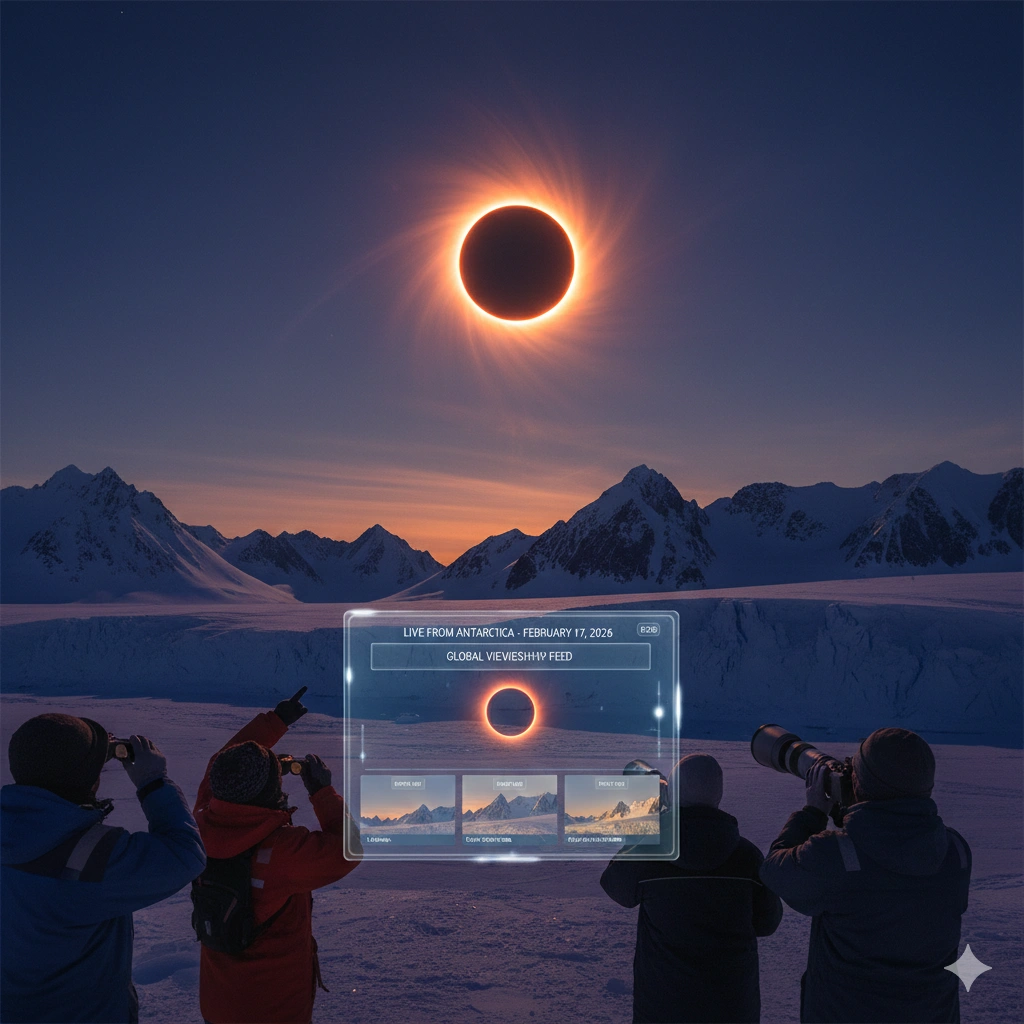
In an era of global connectivity, the 2026 annular solar eclipse will be a massive digital event. Organizations like NASA and timeanddate have already begun logistics planning to station remote-operated cameras in Antarctica. These cameras must be ruggedized to withstand sub-zero temperatures and high winds. The feeds will be transmitted via satellite to a global audience, ensuring that the 2026 annular solar eclipse is the most-watched Antarctic eclipse in history.
The live stream of the 2026 annular solar eclipse will feature expert commentary from astronomers who can explain the nuances of the “ring of fire.” For students and educators, this provides a real-time science lesson. Seeing the 2026 annular solar eclipse through a 4K feed allows viewers to see details of the solar surface and lunar limb that would be difficult to spot with the naked eye, even with protective glasses.
Impact on Antarctic Wildlife
The 2026 annular solar eclipse doesn’t just affect humans; the local wildlife will also react to the sudden change in light. Antarctica is home to massive colonies of Adélie and Emperor penguins. Previous studies during solar eclipses have shown that animals often become confused when the sun dims unexpectedly. Birds may return to their nesting sites, and vocalization patterns often change.
Biologists stationed in the path of the 2026 annular solar eclipse will be monitoring these colonies closely. The “ring of fire” creates a unique twilight-like environment that lasts for a significant duration. Observing how the fauna of the white continent responds to the 2026 annular solar eclipse adds a biological layer to an otherwise purely astronomical event.
Navigating the Logistics of Polar Observation
Planning an expedition for the 2026 annular solar eclipse is a monumental task. The window of opportunity is small, and the environment is unforgiving. Most observers will be part of highly organized scientific teams or high-end tourism groups. The logistics involve everything from specialized cold-weather fuels to redundant communication systems.
The 2026 annular solar eclipse is more than just a visual treat; it is a test of human ingenuity in extreme conditions. To capture the “ring of fire,” photographers must manage battery life in temperatures that can cause electronics to fail instantly. Despite these challenges, the allure of the 2026 annular solar eclipse remains strong. The chance to witness a golden ring hanging over a vast, white horizon is a once-in-a-lifetime experience for those brave enough to make the journey.
Future Eclipses: What Comes After 2026?
The 2026 annular solar eclipse is just one part of a busy decade for solar events. Later in 2026, a total solar eclipse will cross parts of Europe, including Spain and Iceland. However, the 2026 annular solar eclipse on February 17 remains distinct because of its isolated path. For those who miss the “ring of fire” this time, the next major annular event will occur in 2027, crossing parts of South America and Africa.
Understanding the 2026 annular solar eclipse helps astronomers refine their models for future events. Every time the moon passes in front of the sun, we learn more about the lunar topography and the solar diameter. The 2026 annular solar eclipse will provide a wealth of data that will be analyzed for years to come.
Comparing Annular and Total Eclipses
It is important to distinguish why the 2026 annular solar eclipse is different from a total eclipse. While a total eclipse brings “totality”—a complete blocking of the sun that reveals the solar corona—the 2026 annular solar eclipse maintains a constant ring of sunlight.
- Luminosity: An annular eclipse is much brighter than a total eclipse; the corona is not visible.
- Shadow: The “antumbral” shadow of an annular eclipse is different from the “umbral” shadow of a total eclipse.
- Duration: Annular phases can sometimes last longer than total phases depending on the moon’s speed and distance.
A Global Moment for the 2026 Annular Solar Eclipse
The 2026 annular solar eclipse stands as a testament to the predictable yet awe-inspiring nature of our solar system. Even though the “ring of fire” will skip the majority of the world’s population, its impact will be felt globally through science and digital media. The 2026 annular solar eclipse reminds us of our place in the cosmos, highlighting the delicate dance between the Earth, Moon, and Sun.
As we approach February 17, the excitement for the 2026 annular solar eclipse continues to build. Whether you are a scientist at a remote Antarctic base or a curious observer watching a live stream from your home, the 2026 annular solar eclipse promises a moment of profound beauty. Ensure your filters are ready and your internet connection is stable, because the 2026 annular solar eclipse is an event you won’t want to miss.
The 2026 annular solar eclipse will go down in the record books as one of the most exclusive and visually stunning events of the decade. By the time the moon moves away and the sun returns to its full strength over the Southern Ocean, the 2026 annular solar eclipse will have left an indelible mark on the field of astronomy. Don’t forget to mark your calendars for the 2026 annular solar eclipse, a true highlight of the 2026 astronomical year.
Final Thoughts on the Ring of Fire
The 2026 annular solar eclipse is a bridge between the physical world and the digital one. While the “ring of fire” is physically located in the far south, it belongs to the whole world. The 2026 annular solar eclipse is a shared human experience that transcends borders, reminding us that even in the most remote corners of our planet, the wonders of the universe are always within reach.
As the 2026 annular solar eclipse concludes, the focus will shift to the data collected. Every photograph and sensor reading from the 2026 annular solar eclipse contributes to our collective knowledge. We look forward to the 2026 annular solar eclipse with anticipation, ready to witness the majesty of the “ring of fire” one more time.
For more details & sources visit: Evrim Ağacı / EarthSky cross‑reporting
Read more on Antarctica news: 360 News Orbit – Antarctica